Introduction to Optimization
Optimization finds the absolute maximum or minimum of a quantity in context.
Part 1 · Hook
Why this matters
Part 2 · Before you start
What this builds on
Part 3 · Prerequisite check
Quick check before you start
1. On a closed interval, where can the absolute maximum of a continuous function occur?
- At an endpoint or a critical point
- Only where
- Only at an endpoint
- Where
Show the answer
The Candidates Test checks both.
- Correct: At an endpoint or a critical point:
- Only where :
- Only at an endpoint:
- Where :
2. and mean
- a relative maximum at
- a relative minimum at
- a point of inflection at
- nothing
Show the answer
The Second Derivative Test.
- Correct: a relative maximum at :
- a relative minimum at :
- a point of inflection at :
- nothing:
Part 4 · See it
See it first
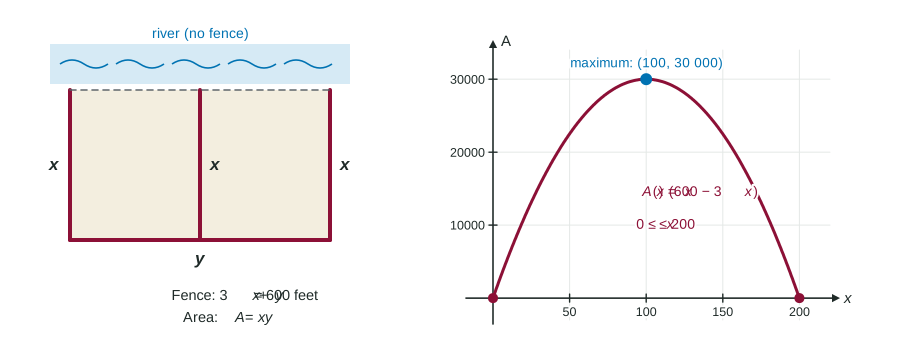
Part 5 · Step by step
How it works, step by step
- A problem asks for the largest or smallest of somethingname that quantity and write the objective function for it
- The objective function has two variablesuse the given fact (a fixed perimeter, a fixed product) to write one variable in terms of the other
- The variable must make physical sensefind the domain: lengths and amounts are not negative
- Find the critical points and compare (or use one-critical-point reasoning)the absolute extremum, justified, answered in context with units
Part 6 · Key ideas
Key ideas
- Optimization: finding the absolute maximum or minimum of a quantity in context.
- The objective function is the quantity to optimize, written in one variable with a domain.
- Justify the absolute extremum: Candidates Test on a closed interval, or one critical point that is a relative extremum.
- Answer the question asked: the dimensions or the price, with units, not just .
Part 7 · Misconception
A common mistake
The wrong idea: Find where the derivative is zero, and that is the answer.
What actually happens: A critical point is only a candidate. It could be a minimum when you want a maximum (the shipping cost above), or an endpoint could win. Justify that it is the absolute extremum, and answer in context.
Part 8 · Check yourself
Check yourself
Exam-style questions. Anything you miss goes into your review queue.
Diagram
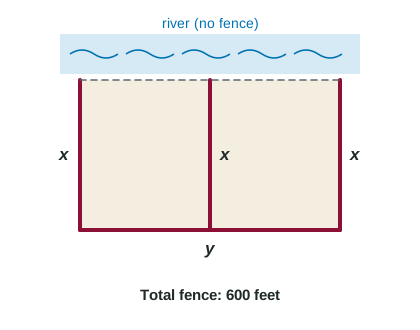
A two-part pen against a river
1. Which function gives the area of the pen in terms of alone?
Show the answer
Fence: two ends and a divider () plus one long side (): , so . Area .
- : That forgets the middle fence: there are three pieces of length .
- Correct: : The fence is , so and .
- : That fences the river side too ().
- : is the length of fence, and it still has two variables.
2. What is the domain of that makes sense for the pen?
Show the answer
Both and , so . (The ends give zero area, so the maximum is inside.)
- Correct: : needs ; lengths cannot be negative.
- : At , .
- : At , .
- : For , would be negative.
3. Find the value of that gives the largest area. Include units.
No calculator. Type the exact value (a fraction, π, e or a root is fine), then its unit.
Show the answer
gives feet. , and are smaller, so gives the largest area.
- Answer: 100 feet
4. Find the largest possible area of the pen. Include units.
No calculator. Type the exact value (a fraction, π, e or a root is fine), then its unit.
Show the answer
- Answer: 30000 square feet
5. Which argument shows that gives the absolute maximum area on ?
- , so is the largest area
- is continuous on , and , , : the largest candidate is
- , so it is the maximum
- is the midpoint of
Show the answer
The candidates are , (endpoints) and (the critical point). is the largest, so it is the absolute maximum.
- , so is the largest area: A critical point alone could be a minimum or neither.
- Correct: is continuous on , and , , : the largest candidate is : A Candidates Test: endpoints and the one critical point.
- , so it is the maximum: Many areas are positive; being positive does not make one largest.
- is the midpoint of : The midpoint has no special meaning; it happens to work here.
6. A student finds that a cost function on has one critical point, , and that for all . What can she conclude?
- is a relative minimum, but a lower cost may exist
- is the absolute minimum cost
- is the absolute maximum cost
- Nothing, because the interval has no endpoints
Show the answer
makes a relative minimum, and it is the only critical point on the interval, so is the absolute minimum.
- is a relative minimum, but a lower cost may exist: With one critical point and concave up everywhere, nothing can be lower.
- Correct: is the absolute minimum cost: One critical point that is a relative minimum on an interval gives the absolute minimum there.
- is the absolute maximum cost: Concave up at a flat point is a minimum.
- Nothing, because the interval has no endpoints: The one-critical-point argument works on open intervals.
Part 9 · Summary
Summary
Part 10 · Up next
What comes next
Part 11 · Connections