Solving Optimization Problems
Solve an optimization problem in a fixed order: draw and label, write the objective function, use the constraint to reduce it to one variable, find the domain, find the critical points, justify the absolute extremum with candidates or one-critical-point reasoning, and answer in context with units.
Part 1 · Hook
Why this matters
Part 2 · Before you start
What this builds on
Part 3 · Prerequisite check
Quick check before you start
1. The objective function in an optimization problem is
- the quantity to maximize or minimize, in one variable
- the derivative set equal to zero
- the domain of the problem
- the second derivative
Show the answer
You optimize that function.
- Correct: the quantity to maximize or minimize, in one variable:
- the derivative set equal to zero:
- the domain of the problem:
- the second derivative:
2.
Show the answer
Chain rule: .
- Correct: :
- :
- :
- :
Part 4 · See it
See it first
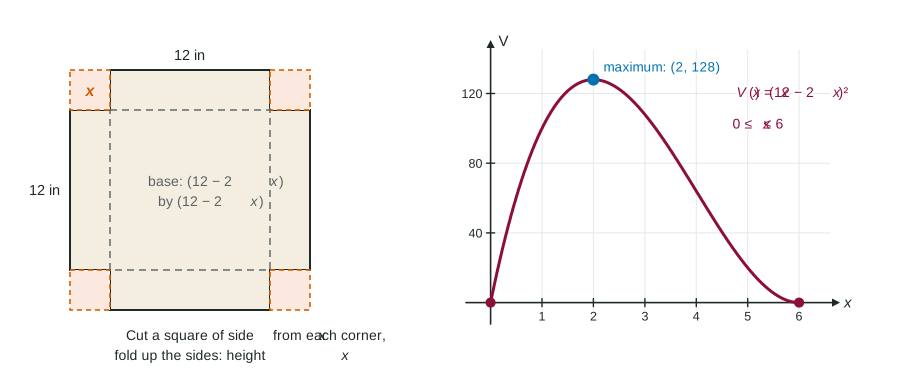
Part 5 · Step by step
How it works, step by step
- Draw the situation and label the variablesyou can see which quantities are fixed and which change
- Write the objective function and the constraintthe constraint lets you eliminate a variable: the objective becomes a function of one variable
- Find the domain from the physical limitsyou know the endpoints and which critical points count
- Differentiate, solve, and compare candidates (or use one-critical-point reasoning)the absolute extremum, justified, stated in context with units
Part 6 · Key ideas
Key ideas
- Constraint: a fixed condition (a perimeter, a volume, a budget) that links the variables. Use it to write the objective in one variable.
- Steps: draw, label, objective, constraint, one variable, domain, critical points, justify, answer in context.
- Reject critical points outside the domain (the cut inches on a 10-inch side).
- Calculator problems: solve with the solver or a graph, store the value, and compare candidates.
Part 7 · Misconception
A common mistake
The wrong idea: The objective function and the constraint are the same equation.
What actually happens: The constraint is the fixed fact (volume ); the objective is what you optimize (surface area). Using the constraint as if it were the objective, or forgetting to substitute it, is the most common setup error.
Part 8 · Check yourself
Check yourself
Exam-style questions. Anything you miss goes into your review queue.
Diagram
An open box from a 16 by 10 sheet
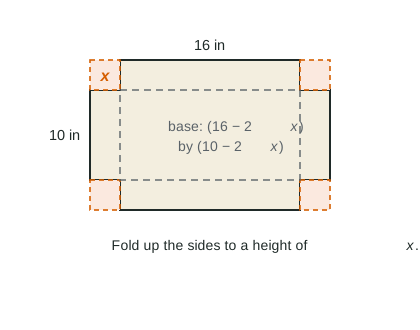
1. Write the volume of the box, in cubic inches, as a function of .
Type an expression for .
Show the answer
Height , base by :
- Answer:
2. Which domain for makes sense?
Show the answer
Each dimension must be at least 0: and , so . (The ends give zero volume.)
- : At , the side is negative.
- : Both sides would be negative long before .
- Correct: : The short side must not be negative.
- : A cut larger than half the short side is impossible.
3. How large a square should be cut from each corner to make the box's volume as large as possible? Include units.
No calculator. Type the exact value (a fraction, π, e or a root is fine), then its unit.
Show the answer
- Answer: 2 inches
4. Find the largest possible volume of the box. Include units.
No calculator. Type the exact value (a fraction, π, e or a root is fine), then its unit.
Show the answer
cubic inches.
- Answer: 144 cubic inches
5. Which justification shows that gives the absolute maximum on ?
- , so is the largest volume
- is the smaller solution of
- is a positive volume
- is continuous on ; , , , so the largest candidate is
Show the answer
On the closed interval , compare the candidates , and . The absolute maximum is 144 cubic inches at .
- , so is the largest volume: A critical point is only a candidate.
- is the smaller solution of : Being the smaller root proves nothing about size.
- is a positive volume: Positive does not mean largest.
- Correct: is continuous on ; , , , so the largest candidate is : The Candidates Test: endpoints and the critical point in the domain.
6. An open box with a square base of side and height must hold 32 cubic feet. You want to use the least material. Which is the constraint?
Show the answer
The constraint is the fixed fact, the volume ; it lets you write and the objective in one variable.
- : That is the objective function, the amount of material to minimize.
- : 32 is a volume, not a surface area.
- : That mixes lengths; 32 is a volume.
- Correct: : The fixed volume links and .
Part 9 · Summary
Summary
Part 10 · Up next
What comes next
Part 11 · Connections