Concavity and Points of Inflection
The sign of f″ gives the concavity: f″ > 0 (equivalently f′ increasing) means concave up, f″ < 0 means concave down.
Part 1 · Hook
Why this matters
Part 2 · Before you start
What this builds on
Part 3 · Prerequisite check
Quick check before you start
1. A graph that is concave up lies
- above its tangent lines
- below its tangent lines
- on its tangent lines
- above the -axis
Show the answer
Concave up: the curve bends upward away from each tangent line.
- Correct: above its tangent lines:
- below its tangent lines:
- on its tangent lines:
- above the -axis:
2. If , then
Show the answer
, and .
- Correct: :
- :
- :
- :
3. If on an interval, then is
- increasing there
- concave up there
- decreasing there
- concave down there
Show the answer
The sign of gives direction.
- Correct: increasing there:
- concave up there:
- decreasing there:
- concave down there:
Part 4 · See it
See it first
Part 5 · Step by step
How it works, step by step
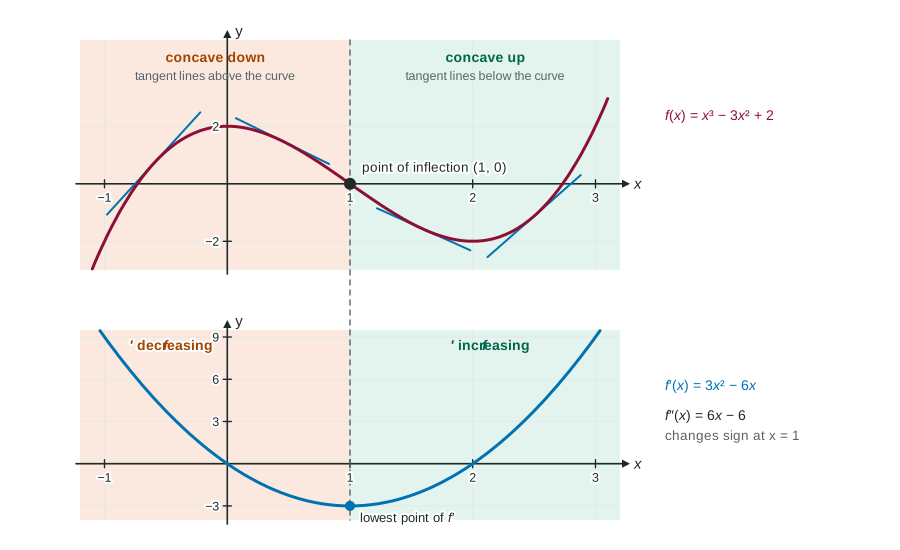
- on an interval is increasing there, the slopes grow, and the graph of is concave up
- on an interval is decreasing, the slopes shrink, and the graph is concave down
- changes sign at (and is continuous there)the concavity changes, so is a point of inflection
- but keeps its sign (as for )no change of concavity, so no point of inflection
Part 6 · Key ideas
Key ideas
- Concave up on an interval: is increasing there (). Concave down: is decreasing ().
- Point of inflection: a point on the graph where the concavity changes, that is, where changes sign, or where changes from increasing to decreasing or back.
- On a graph of : inflection points of are at the high and low points of , not at its zeros.
- Candidates are where or does not exist; then check the sign of on each side.
Part 7 · Misconception
A common mistake
The wrong idea: , so the graph of has a point of inflection at .
What actually happens: only makes a candidate. The concavity must actually change: must change sign. has but is concave up on both sides. On a graph of , also do not confuse zeros of (extrema of ) with turns of (inflection points).
Part 8 · Check yourself
Check yourself
Exam-style questions. Anything you miss goes into your review queue.
Graph
The graph of , the derivative of
1. On which interval is the graph of concave down?
- , where
- and
- , where
Show the answer
is concave down where is decreasing: between the high point of at and its low point at .
- Correct: : is decreasing on , so there.
- , where : means is decreasing, not concave down.
- and : There is increasing: is concave up.
- , where : means is increasing. Concavity comes from whether rises or falls.
2. At which values of does the graph of have a point of inflection?
- , and
- , where the graph of crosses between its turns
- and , the endpoints
- and
Show the answer
Points of inflection are where changes sign, that is, where changes from increasing to decreasing or back: at the relative extrema of , and .
- , and : Those are zeros of : candidates for extrema of , not inflection points.
- , where the graph of crosses between its turns: is a zero of ; is decreasing on both sides of it.
- and , the endpoints: An endpoint cannot be a point of inflection: concavity must change on both sides.
- Correct: and : changes from increasing to decreasing at 1 and from decreasing to increasing at 3.
3. Which describes the graph of at ?
- Decreasing and concave up
- Increasing and concave down
- Decreasing and concave down
- Increasing and concave up
Show the answer
, so is decreasing; is decreasing on , so and is concave down.
- Decreasing and concave up: is still decreasing at 2.5; it turns up only at .
- Increasing and concave down:
, so is decreasing. - Correct: Decreasing and concave down: (below the axis) and is falling there.
- Increasing and concave up: Both conditions are reversed.
4. Which justification earns credit for "the graph of has a point of inflection at "?
- " changes sign at ."
- " changes from decreasing to increasing at ."
- "."
- " changes from decreasing to increasing at ."
Show the answer
An inflection point needs a change of concavity: changes sign, or equivalently changes from decreasing to increasing (or back). At , has a low point.
- " changes sign at .": ; does not change sign there. A sign change of would be about extrema.
- Correct: " changes from decreasing to increasing at .": That means changes from negative to positive: concavity changes.
- ".": alone does not prove a change of concavity.
- " changes from decreasing to increasing at .": on both sides of 3, so is decreasing on both sides; and that would be about extrema anyway.
5. For , . Is there a point of inflection at ?
- Yes, because
- Yes, because the graph is flat at
- No, because
- No, because on both sides, so the concavity does not change
Show the answer
is positive on both sides of 0. The concavity does not change, so there is no point of inflection, even though .
- Yes, because : makes a candidate only; must change sign.
- Yes, because the graph is flat at : Flatness is about , not concavity.
- No, because : The right answer for a wrong reason: is about extrema.
- Correct: No, because on both sides, so the concavity does not change: The graph is concave up on both sides of 0.
6. is the number of people who have heard a rumor days after it starts. increases for and decreases for . What happens at ?
- The most people have heard the rumor
- The rumor stops spreading
- The rumor is spreading fastest; the graph of has a point of inflection
- The rumor is spreading slowest; has a relative minimum
Show the answer
changes from increasing to decreasing at , so changes from positive to negative: has a point of inflection, and the rate is greatest there.
- The most people have heard the rumor: itself can keep growing after ; only its rate slows.
- The rumor stops spreading: is its largest value, not 0.
- Correct: The rumor is spreading fastest; the graph of has a point of inflection: , the spreading rate, peaks at , where changes from concave up to concave down.
- The rumor is spreading slowest; has a relative minimum: is largest at 3, not smallest.
Part 9 · Summary
Summary
Part 10 · Up next
What comes next
Part 11 · Connections