Many quantities change together. As a balloon fills, its radius and its volume both grow. As two cars drive away from a corner, the distance between them grows. An equation links the quantities at every instant, and differentiating that equation with respect to time links their rates. That is the whole idea of related rates; this page sets up the method, and the next topic solves full problems.
Everything is a function of time
In there is no in sight. But if the circle is a spreading ripple, then depends on , and so does . To find how fast changes, differentiate both sides with respect to . The right side is a composite function, , so the chain rule applies:
This is the same move as implicit differentiation, with in place of . Every variable that changes gets its rate as a factor; constants such as do not.
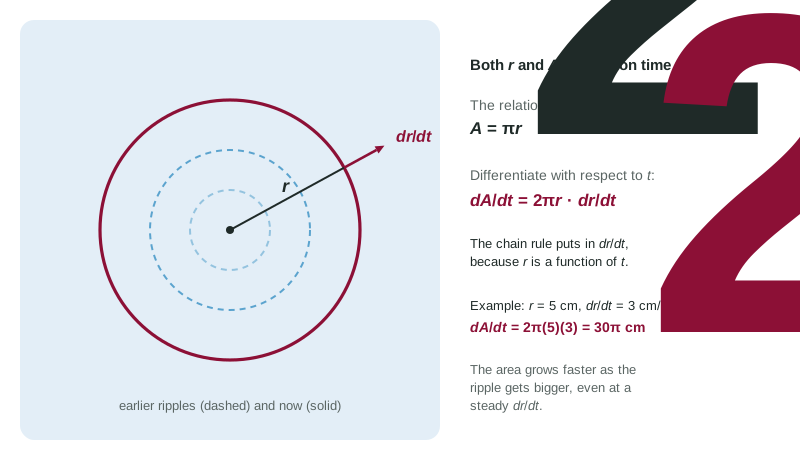
The equation explains something you can see on a pond. Even if the ripple's radius grows at a steady 3 cm per second, the area grows faster and faster, because the factor grows. At cm the area grows at cm² per second; at cm, at cm² per second.
The basic move, on common formulas
| Relation | Differentiated with respect to |
|---|---|
| circle: | |
| sphere: | |
| cube: | |
| rectangle: | |
| right triangle: |
Worked example 1. A spherical balloon's radius grows at 2 cm per second. How fast does its volume grow when cm?
Relation: . Differentiate with respect to : .
Now substitute the instant: and . cm³ per second.
Worked example 2. Air is pumped into the balloon at 100 cm³ per second. How fast is the radius growing when cm?
Same equation, different unknown: , so
Two rules that prevent most errors
Differentiate first, substitute second. The values of one instant (like ) are true only at that instant. If you put them into the equation before differentiating, they become constants with derivative 0, and the rates you need vanish.
Signs come from the words. "Increasing at 2 cm per second" means ; "decreasing at 2 cm per second" or "shrinking by 2 cm each second" means . A distance to a point that something approaches is decreasing, so its rate is negative.
Worked example 3. Car A drives east from an intersection at 60 mph and car B drives north at 45 mph. When A is 30 miles and B is 40 miles from the intersection, how fast is the distance between them growing?
Relation: . Differentiate:
At this instant . Substitute:
If car B were instead driving toward the intersection, and
Slips that cost points
- Differentiating with respect to or instead of , so no rates appear.
- Dropping the chain rule factor: writing for .
- Substituting values before differentiating.
- Entering a decreasing rate as positive.
- Missing the product rule on a product of two changing quantities.