Unit 3 · Topic 3.4 Beta

Derivatives of Inverse Trigonometric Functions

4 min read · freeNot practiced

The inverse trigonometric functions turn a ratio back into an angle: arcsin⁡12=π6\arcsin\frac{1}{2} = \frac{\pi}{6}, arctan⁡1=π4\arctan 1 = \frac{\pi}{4}. Their derivatives are a pleasant surprise. Although the functions are about angles, their derivatives contain no trigonometry at all, only square roots and fractions. This page derives the three you need, shows why they have those shapes, and practices them with the chain rule.

A quick reminder of the functions

Sine is not one-to-one, so we invert it only on [−π2,π2]\left[-\frac{\pi}{2}, \frac{\pi}{2}\right]. That gives y=arcsin⁡xy = \arcsin x, defined for −1≤x≤1-1 \le x \le 1, with outputs from −π2-\frac{\pi}{2} to π2\frac{\pi}{2}. In the same way arccos⁡x\arccos x has outputs in [0,π][0, \pi], and arctan⁡x\arctan x is defined for every xx, with outputs strictly between −π2-\frac{\pi}{2} and π2\frac{\pi}{2}. You may also see sin−1⁡x\sin^{-1} x for arcsin⁡x\arcsin x; the −1-1 means inverse, not a reciprocal.

Deriving the arcsine derivative

We do not need a new idea, only implicit differentiation. Let y=arcsin⁡xy = \arcsin x. Then sin⁡y=x\sin y = x, with yy between −π2-\frac{\pi}{2} and π2\frac{\pi}{2}. Differentiate both sides with respect to xx:

cos⁡y⋅dydx=1,sodydx=1cos⁡y\cos y \cdot \frac{dy}{dx} = 1, \quad\text{so}\quad \frac{dy}{dx} = \frac{1}{\cos y}

The answer should be in terms of xx. Since sin2⁡y+cos2⁡y=1\sin^2 y + \cos^2 y = 1, we have cos⁡y=±1−sin2⁡y\cos y = \pm\sqrt{1 - \sin^2 y}. On [−π2,π2]\left[-\frac{\pi}{2}, \frac{\pi}{2}\right] cosine is never negative, so we take the plus sign, and sin⁡y=x\sin y = x gives

ddxarcsin⁡x=11−x2,−1<x<1\frac{d}{dx}\arcsin x = \frac{1}{\sqrt{1 - x^2}}, \quad -1 < x < 1

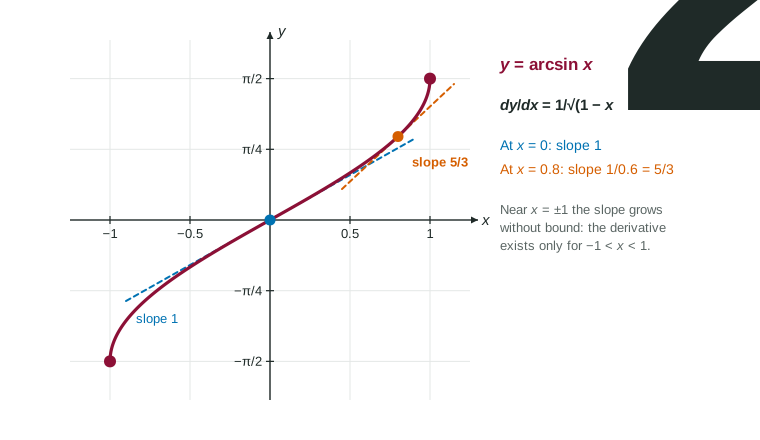
The graph of y = arcsin x for x from −1 to 1, from (−1, −π/2) to (1, π/2) with closed endpoints. Tangent lines at x = 0 (slope 1) and at x = 0.8 (slope 5/3) show the slope growing toward the ends.
Figure 1. The graph of arcsin⁡x\arcsin x steepens toward its ends: slope 1 at the origin, 53\frac{5}{3} at x=0.8x = 0.8, and no finite slope at x=±1x = \pm 1. LevlPrep original diagram.

The formula matches the picture. At x=0x = 0 the slope is 1. At x=0.8x = 0.8 it is 10.36=10.6=53\frac{1}{\sqrt{0.36}} = \frac{1}{0.6} = \frac{5}{3}. As xx approaches ±1\pm 1 the denominator approaches 0 and the slope grows without bound: the tangent lines at the endpoints are vertical, so the derivative exists only on the open interval.

Arctangent and arccosine

For y=arctan⁡xy = \arctan x, write tan⁡y=x\tan y = x and differentiate: sec2⁡y⋅dydx=1\sec^2 y \cdot \frac{dy}{dx} = 1. The identity sec2⁡y\sec^2 y=1+tan2⁡y= 1 + \tan^2 y=1+x2= 1 + x^2 gives

ddxarctan⁡x=11+x2\frac{d}{dx}\arctan x = \frac{1}{1 + x^2}

This works for every xx, and it is never larger than 1: the arctangent graph is steepest at the origin and flattens as it levels toward its horizontal asymptotes. Arccosine is the mirror image of arcsine (in fact arccos⁡x\arccos x=π2−arcsin⁡x= \frac{\pi}{2} - \arcsin x), so its derivative is the negative of the arcsine derivative.

FunctionDerivativeWhere it exists
arcsin⁡x\arcsin x11−x2\frac{1}{\sqrt{1 - x^2}}−1<x<1-1 < x < 1
arccos⁡x\arccos x−11−x2-\frac{1}{\sqrt{1 - x^2}}−1<x<1-1 < x < 1
arctan⁡x\arctan x11+x2\frac{1}{1 + x^2}every xx

The other three (arccotangent, arcsecant, arccosecant) follow from the same method and appear rarely; if one comes up, derive it the same way instead of memorizing it.

With the chain rule

Most exam questions put an inside function into the formula. The pattern is always the same: square the whole inside function in the denominator, and multiply by its derivative.

ddxarcsin⁡u=u′1−u2,ddxarctan⁡u=u′1+u2\frac{d}{dx}\arcsin u = \frac{u'}{\sqrt{1 - u^2}}, \qquad \frac{d}{dx}\arctan u = \frac{u'}{1 + u^2}

Worked example 1. Differentiate y=arctan⁡(3x)y = \arctan(3x).

Inside u=3xu = 3x, so u2=9x2u^2 = 9x^2 and u′=3u' = 3.

dydx=31+9x2\frac{dy}{dx} = \frac{3}{1 + 9x^2}. A common slip is 11+3x2\frac{1}{1 + 3x^2}: the square must cover the 3, and the factor 3 must multiply.

Worked example 2. Differentiate y=arcsin⁡(x2)y = \arcsin(x^2) for −1<x<1-1 < x < 1, and find the slope at x=12x = \frac{1}{2}.

Inside u=x2u = x^2, so u2=x4u^2 = x^4 and u′=2xu' = 2x: dydx=2x1−x4\frac{dy}{dx} = \frac{2x}{\sqrt{1 - x^4}}.

At x=12x = \frac{1}{2}: 2⋅121−116\frac{2 \cdot \frac{1}{2}}{\sqrt{1 - \frac{1}{16}}}=115/4= \frac{1}{\sqrt{15}/4}=415= \frac{4}{\sqrt{15}}.

Worked example 3. Values from a table: g(1)=12g(1) = \frac{1}{2} and g′(1)=3g'(1) = 3. Find the derivative of h(x)=arcsin⁡(g(x))h(x) = \arcsin(g(x)) at x=1x = 1.

h′(1)h'(1)=g′(1)1−[g(1)]2= \frac{g'(1)}{\sqrt{1 - [g(1)]^2}}=31−14= \frac{3}{\sqrt{1 - \frac{1}{4}}}=33/2= \frac{3}{\sqrt{3}/2}=23= 2\sqrt{3}.

Slips that cost points

  • Mixing up the patterns. Arcsine and arccosine have 1−u2\sqrt{1 - u^2}; arctangent has 1+u21 + u^2 with no root.
  • Losing the minus sign of the arccosine derivative.
  • Squaring only part of the inside: (3x)2=9x2(3x)^2 = 9x^2, (ex)2=e2x(e^x)^2 = e^{2x}.
  • Forgetting the inside derivative, exactly as with any chain rule.
  • Using the formula at u=±1u = \pm 1 for arcsine or arccosine, where it divides by 0.

Spot a mistake on this page?