Unit 3 · Topic 3.4 Beta

Derivatives of Inverse Trigonometric Functions

The derivatives of the inverse trigonometric functions are algebraic: d/dx arcsin x = 1/(√(1 − x²)) , d/dx arccos x = −1/(√(1 − x²)) and d/dx arctan x = 1/(1 + x²) .

Practice 1: Implementing Mathematical Processes

Question set for this topic

Part 1 · Hook

Why this matters

A ramp rises 1 meter for every 2 meters forward: its angle is the arctangent of one half. When the rise changes, how fast does the angle change? Inverse trigonometric functions turn ratios into angles, and their derivatives answer exactly that kind of question.

Part 2 · Before you start

What this builds on

Part 3 · Prerequisite check

Quick check before you start

1. What is arcsin⁡12\arcsin\frac{1}{2}?

  1. π6\frac{\pi}{6}
  2. π3\frac{\pi}{3}
  3. 12\frac{1}{2}
  4. 3030
Show the answer

sin⁡π6=12\sin\frac{\pi}{6} = \frac{1}{2}, and π6\frac{\pi}{6} is in [−π2,π2]\left[-\frac{\pi}{2}, \frac{\pi}{2}\right].

  • Correct: π6\frac{\pi}{6}:
  • π3\frac{\pi}{3}:
  • 12\frac{1}{2}:
  • 3030:

2. If gg is the inverse of ff, then g′(x)g'(x) equals

  1. 1f′(g(x))\frac{1}{f'(g(x))}
  2. 1f′(x)\frac{1}{f'(x)}
  3. f′(g(x))f'(g(x))
  4. −f′(x)-f'(x)
Show the answer

Reciprocal of the slope of ff at the matching point.

  • Correct: 1f′(g(x))\frac{1}{f'(g(x))}:
  • 1f′(x)\frac{1}{f'(x)}:
  • f′(g(x))f'(g(x)):
  • −f′(x)-f'(x):

Part 4 · See it

See it first

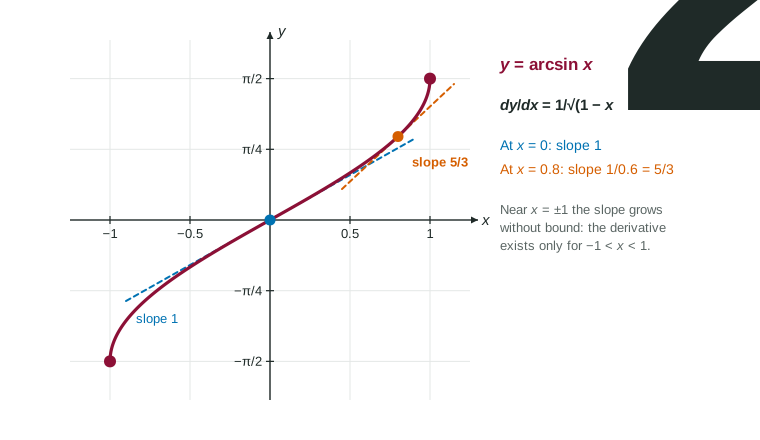
The graph of y = arcsin x for x from −1 to 1, from (−1, −π/2) to (1, π/2) with closed endpoints. Tangent lines at x = 0 (slope 1) and at x = 0.8 (slope 5/3) show the slope growing toward the ends.
y=arcsin⁡xy = \arcsin x has slope 1 at the origin and 53\frac{5}{3} at x=0.8x = 0.8. Near x=±1x = \pm 1 the slope 11−x2\frac{1}{\sqrt{1 - x^2}} grows without bound. LevlPrep original diagram.

Part 5 · Step by step

How it works, step by step

  1. y=arcsin⁡xy = \arcsin x means sin⁡y=x\sin y = x with −π2≤y≤π2-\frac{\pi}{2} \le y \le \frac{\pi}{2}differentiate implicitly: cos⁡y⋅dydx=1\cos y \cdot \frac{dy}{dx} = 1
  2. On that interval cos⁡y≥0\cos y \ge 0, so cos⁡y\cos y=1−sin2⁡y= \sqrt{1 - \sin^2 y}=1−x2= \sqrt{1 - x^2}ddxarcsin⁡x\frac{d}{dx}\arcsin x=11−x2= \frac{1}{\sqrt{1 - x^2}}
  3. The same steps on tan⁡y=x\tan y = x use sec2⁡y=1+x2\sec^2 y = 1 + x^2ddxarctan⁡x\frac{d}{dx}\arctan x=11+x2= \frac{1}{1 + x^2}
  4. With an inside function u=g(x)u = g(x)multiply by u′u': ddxarctan⁡u\frac{d}{dx}\arctan u=u′1+u2= \frac{u'}{1 + u^2}

Part 6 · Key ideas

Key ideas

  • ddxarcsin⁡x\frac{d}{dx}\arcsin x=11−x2= \frac{1}{\sqrt{1 - x^2}} and ddxarccos⁡x\frac{d}{dx}\arccos x=−11−x2= -\frac{1}{\sqrt{1 - x^2}}, for −1<x<1-1 < x < 1.
  • ddxarctan⁡x\frac{d}{dx}\arctan x=11+x2= \frac{1}{1 + x^2} for every xx.
  • With an inside function, square the whole inside in the formula and multiply by its derivative.
  • The results come from implicit differentiation or from the inverse rule 1f′(g(x))\frac{1}{f'(g(x))}.

Part 7 · Misconception

A common mistake

The wrong idea: ddxarctan⁡(3x)\frac{d}{dx}\arctan(3x)=11+3x2= \frac{1}{1 + 3x^2}.

What actually happens: The whole inside is squared and its derivative multiplies: 11+(3x)2⋅3\frac{1}{1 + (3x)^2} \cdot 3=31+9x2= \frac{3}{1 + 9x^2}.

Part 8 · Check yourself

Check yourself

Exam-style questions. Anything you miss goes into your review queue.

Graph

The graph of f(x)=arctan⁡(2x)f(x) = \arctan(2x)

−3−2−1123−2−1.5−1−0.50.511.52xyf(1/2, π/4)

1. Find f′(x)f'(x) for the function in the graph, f(x)=arctan⁡(2x)f(x) = \arctan(2x).

Type an expression for f′(x)=f'(x) =.

Show the answer

ddxarctan⁡u\frac{d}{dx}\arctan u=11+u2⋅u′= \frac{1}{1 + u^2} \cdot u' with u=2xu = 2x: 11+(2x)2⋅2\frac{1}{1 + (2x)^2} \cdot 2=21+4x2= \frac{2}{1 + 4x^2}.

  • Answer: f′(x)=f'(x) = 21+4x2\frac{2}{1 + 4x^{2}}

2. What is the slope of the graph of ff at the origin?

No calculator. Type the exact value (a fraction, π, e or a root is fine).

Show the answer

f′(0)=21+0=2f'(0) = \frac{2}{1 + 0} = 2. The graph is steepest at the origin.

  • Answer: 2

3. At which xx-values does the graph of ff have slope 1?

  1. x=±12x = \pm\frac{1}{2}
  2. x=±1x = \pm 1
  3. x=0x = 0
  4. x=±14x = \pm\frac{1}{4}
Show the answer

Solve 21+4x2=1\frac{2}{1 + 4x^2} = 1: 1+4x2=21 + 4x^2 = 2, so x2=14x^2 = \frac{1}{4} and x=±12x = \pm\frac{1}{2}.

  • Correct: x=±12x = \pm\frac{1}{2}: 21+4x2=1\frac{2}{1 + 4x^2} = 1 gives 4x2=14x^2 = 1.
  • x=±1x = \pm 1: There the slope is 25\frac{2}{5}.
  • x=0x = 0: There the slope is 2, its largest value.
  • x=±14x = \pm\frac{1}{4}: There the slope is 21.25=85\frac{2}{1.25} = \frac{8}{5}.

Table

Values of gg and g′g'

Selected values of a differentiable function g and its derivative
xx11223344
g(x)g(x)12\frac{1}{2}0011−12-\frac{1}{2}
g′(x)g'(x)33−4-42266

4. Using the table, find the derivative of the composite function h(x)=arcsin⁡(g(x))h(x) = \arcsin(g(x)) at x=1x = 1.

No calculator. Type the exact value (a fraction, π, e or a root is fine).

Show the answer

h′(x)h'(x)=g′(x)1−[g(x)]2= \frac{g'(x)}{\sqrt{1 - [g(x)]^2}}, so h′(1)h'(1)=31−14= \frac{3}{\sqrt{1 - \frac{1}{4}}}=332= \frac{3}{\frac{\sqrt{3}}{2}}=23= 2\sqrt{3}.

  • Answer: 232\,\sqrt{3} ≈ 3.464

5. Let k(x)=arctan⁡(g(x))k(x) = \arctan(g(x)). What is k′(2)k'(2)?

  1. 11
  2. −4-4
  3. −417-\frac{4}{17}
  4. 44
Show the answer

k′(x)k'(x)=g′(x)1+[g(x)]2= \frac{g'(x)}{1 + [g(x)]^2}, so k′(2)k'(2)=−41+0= \frac{-4}{1 + 0}=−4= -4.

  • 11: This is 11+[g(2)]2\frac{1}{1 + [g(2)]^2} without the inside derivative g′(2)=−4g'(2) = -4.
  • Correct: −4-4: g′(2)1+[g(2)]2\frac{g'(2)}{1 + [g(2)]^2}=−41= \frac{-4}{1}.
  • −417-\frac{4}{17}: This puts g′(2)g'(2) in the denominator. The denominator uses the value g(2)=0g(2) = 0.
  • 44: The sign of g′(2)=−4g'(2) = -4 carries through.

6. Which is ddxarccos⁡x\frac{d}{dx}\arccos x for −1<x<1-1 < x < 1?

  1. −11−x2-\frac{1}{\sqrt{1 - x^2}}
  2. 11−x2\frac{1}{\sqrt{1 - x^2}}
  3. −11+x2-\frac{1}{1 + x^2}
  4. 11+x2\frac{1}{\sqrt{1 + x^2}}
Show the answer

ddxarccos⁡x\frac{d}{dx}\arccos x=−11−x2= -\frac{1}{\sqrt{1 - x^2}}, the negative of the arcsine derivative.

  • Correct: −11−x2-\frac{1}{\sqrt{1 - x^2}}: Arccosine falls as xx grows, so its slope is negative.
  • 11−x2\frac{1}{\sqrt{1 - x^2}}: This is the derivative of arcsin⁡x\arcsin x.
  • −11+x2-\frac{1}{1 + x^2}: The 1+x21 + x^2 belongs to arctangent.
  • 11+x2\frac{1}{\sqrt{1 + x^2}}: The expression under the root is 1−x21 - x^2, which keeps xx between −1-1 and 11.

Part 9 · Summary

Summary

The derivatives of the inverse trigonometric functions are algebraic: ddxarcsin⁡x\frac{d}{dx}\arcsin x=11−x2= \frac{1}{\sqrt{1 - x^2}}, ddxarccos⁡x\frac{d}{dx}\arccos x=−11−x2= -\frac{1}{\sqrt{1 - x^2}} and ddxarctan⁡x\frac{d}{dx}\arctan x=11+x2= \frac{1}{1 + x^2}. With an inside function, square the whole inside and multiply by its derivative.
Part 10 · Up next

What comes next

Part 11 · Connections

Connections