Unit 2 · Topic 2.7 Beta

Derivatives of sin x, cos x, e to the x and ln x

The derivatives of sine and cosine are cosine and negative sine (in radians); e^x is its own derivative; and ln x has derivative 1/x for x > 0 .

Practice 1: Implementing Mathematical ProcessesPractice 2: Connecting Representations

Question set for this topic

Part 1 · Hook

Why this matters

Tides, sound waves and the swing of a pendulum follow sine curves; populations and savings accounts grow along exe^x; earthquake and decibel scales are built on logarithms. The rates of change of these four functions are themselves simple functions, and once you know them, you can differentiate much of the natural world.

Part 2 · Before you start

What this builds on

Part 3 · Prerequisite check

Quick check before you start

1. What is cos⁡(π3)\cos\left( \frac{\pi}{3} \right)?

  1. 12\frac{1}{2}
  2. 32\frac{\sqrt{3}}{2}
  3. 00
  4. 22\frac{\sqrt{2}}{2}
Show the answer

On the unit circle at π3\frac{\pi}{3}, the point is (12,32)\left( \frac{1}{2}, \frac{\sqrt{3}}{2} \right); cosine is the first coordinate.

  • Correct: 12\frac{1}{2}:
  • 32\frac{\sqrt{3}}{2}:
  • 00:
  • 22\frac{\sqrt{2}}{2}:

2. limx→0sin⁡xx\lim_{x \to 0} \frac{\sin x}{x} equals

  1. 11
  2. 00
  3. It does not exist
  4. ∞\infty
Show the answer

A key limit from Unit 1, proved with the squeeze theorem (in radians).

  • Correct: 11:
  • 00:
  • It does not exist:
  • ∞\infty:

3. ddx(5x2−3)\frac{d}{dx}\left( 5x^2 - 3 \right) is

  1. 10x10x
  2. 10x−310x - 3
  3. 5x5x
  4. 10x210x^2
Show the answer

Constant multiple and power rule on 5x25x^2; the constant −3-3 has derivative 0.

  • Correct: 10x10x:
  • 10x−310x - 3:
  • 5x5x:
  • 10x210x^2:

Part 4 · See it

See it first

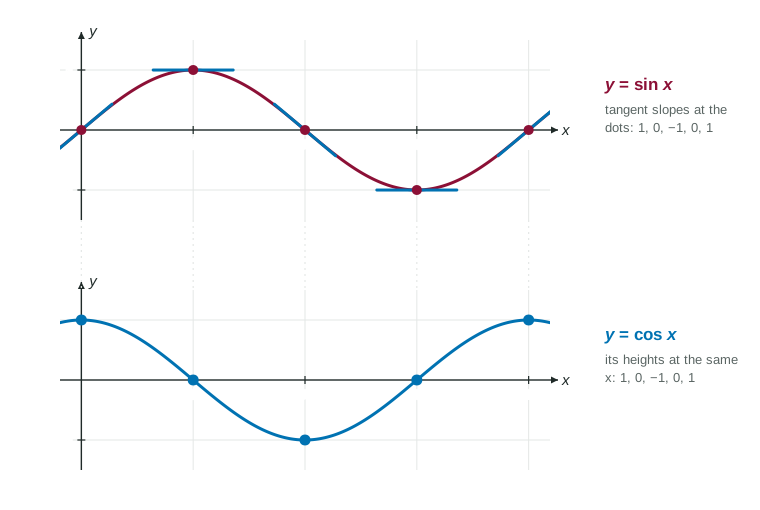
Top: y = sin x from 0 to 2 pi with short tangent segments at 0, pi/2, pi, 3pi/2 and 2pi, whose slopes are 1, 0, minus 1, 0 and 1. Bottom, on the same scale: y = cos x, whose heights at those x values are 1, 0, minus 1, 0 and 1. The derivative of sin x is cos x.
The slopes of y=sin⁡xy = \sin x at 0,π2,π,3π2,2π0, \frac{\pi}{2}, \pi, \frac{3\pi}{2}, 2\pi are 1,0,−1,0,11, 0, -1, 0, 1: exactly the heights of y=cos⁡xy = \cos x at the same inputs. LevlPrep original diagram.

Part 5 · Step by step

How it works, step by step

  1. The graph of sin⁡x\sin x is steepest upward at 0, level at π2\frac{\pi}{2} and steepest downward at π\piits slopes trace out the cosine curve: ddx(sin⁡x)=cos⁡x\frac{d}{dx}(\sin x) = \cos x
  2. Cosine is sine shifted left by π2\frac{\pi}{2}its slopes are sine shifted the same way, which is −sin⁡x-\sin x
  3. ee is the base whose graph has slope 1 at x=0x = 0the slope of exe^x at every point equals its height: ddx(ex)=ex\frac{d}{dx}\left( e^x \right) = e^x
  4. Each formula is a derivativea limit like limh→0sin⁡(a+h)−sin⁡ah\lim_{h \to 0} \frac{\sin(a + h) - \sin a}{h} can be evaluated as cos⁡a\cos a

Part 6 · Key ideas

Key ideas

  • Learn the four: ddx(sin⁡x)=cos⁡x\frac{d}{dx}(\sin x) = \cos x, ddx(cos⁡x)=−sin⁡x\frac{d}{dx}(\cos x) = -\sin x, ddx(ex)=ex\frac{d}{dx}\left( e^x \right) = e^x, ddx(ln⁡x)=1x\frac{d}{dx}(\ln x) = \frac{1}{x} for x>0x > 0.
  • The trigonometric formulas hold only in radians.
  • The power rule does not apply to exe^x: the variable is in the exponent.
  • A limit as a derivative: limh→0f(a+h)−f(a)h\lim_{h \to 0} \frac{f(a + h) - f(a)}{h} is f′(a)f'(a). Name ff and aa, then use the derivative formula.

Part 7 · Misconception

A common mistake

The wrong idea: ddx(cos⁡x)=sin⁡x\frac{d}{dx}(\cos x) = \sin x.

What actually happens: Look at the graph of cos⁡x\cos x just to the right of 0: it is falling, so its slope there is negative, while sin⁡x\sin x is positive. The derivative is −sin⁡x-\sin x. Sine to cosine has no sign change; cosine to sine does.

Part 8 · Check yourself

Check yourself

Exam-style questions. Anything you miss goes into your review queue.

Graph

The graph of y=sin⁡xy = \sin x on [0,2π][0, 2\pi]

π/2π3π/22π−1.5−1−0.50.511.5xyy = sin x

1. What is the slope of the graph of y=sin⁡xy = \sin x at x=πx = \pi?

No calculator. Type the exact value (a fraction, π, e or a root is fine).

Show the answer

ddx(sin⁡x)=cos⁡x\frac{d}{dx}(\sin x) = \cos x, and cos⁡π=−1\cos \pi = -1.

  • Answer: -1

2. Which is an equation of the line tangent to y=sin⁡xy = \sin x at x=0x = 0?

  1. y=xy = x
  2. y=1y = 1
  3. y=−xy = -x
  4. y=x+1y = x + 1
Show the answer

Point (0,sin⁡0)=(0,0)(0, \sin 0) = (0, 0), slope cos⁡0=1\cos 0 = 1: y=0+1(x−0)y = 0 + 1(x - 0).

  • Correct: y=xy = x: Through the origin with slope 1.
  • y=1y = 1: That is level; the graph rises through the origin.
  • y=−xy = -x: The slope is cos⁡0=+1\cos 0 = +1.
  • y=x+1y = x + 1: The line must pass through (0,0)(0, 0).

3. For 0≤x≤2π0 \le x \le 2\pi, where is the line tangent to y=sin⁡xy = \sin x level?

  1. x=π2x = \frac{\pi}{2} and x=3π2x = \frac{3\pi}{2}
  2. x=0x = 0, x=πx = \pi and x=2πx = 2\pi
  3. x=π4x = \frac{\pi}{4} and x=5π4x = \frac{5\pi}{4}
  4. x=πx = \pi
Show the answer

The slope is cos⁡x\cos x, which is 0 at π2\frac{\pi}{2} and 3π2\frac{3\pi}{2}: the top and bottom of the wave.

  • Correct: x=π2x = \frac{\pi}{2} and x=3π2x = \frac{3\pi}{2}: Where cos⁡x=0\cos x = 0.
  • x=0x = 0, x=πx = \pi and x=2πx = 2\pi: Those are where sin⁡x=0\sin x = 0, the heights; the slopes there are ±1\pm 1.
  • x=π4x = \frac{\pi}{4} and x=5π4x = \frac{5\pi}{4}: There cos⁡x=±22\cos x = \pm\frac{\sqrt{2}}{2}, not 0.
  • x=πx = \pi: At π\pi the slope is −1-1.

4. For 0≤x≤2π0 \le x \le 2\pi, at which xx is the graph of y=sin⁡xy = \sin x falling most steeply?

  1. x=πx = \pi
  2. x=3π2x = \frac{3\pi}{2}
  3. x=π2x = \frac{\pi}{2}
  4. x=2πx = 2\pi
Show the answer

The slope cos⁡x\cos x is most negative, −1-1, at x=πx = \pi.

  • Correct: x=πx = \pi: Slope cos⁡π=−1\cos \pi = -1, the least value of cosine.
  • x=3π2x = \frac{3\pi}{2}: That is the lowest point; the slope there is 0.
  • x=π2x = \frac{\pi}{2}: That is the highest point; the slope there is 0.
  • x=2πx = 2\pi: There the slope is cos⁡2π=1\cos 2\pi = 1: rising most steeply.

5. What is ddx(cos⁡x)\frac{d}{dx}(\cos x)?

  1. −sin⁡x-\sin x
  2. sin⁡x\sin x
  3. −cos⁡x-\cos x
  4. cos⁡x\cos x
Show the answer

Just right of x=0x = 0 the cosine graph is falling while sin⁡x>0\sin x > 0, so the derivative must be −sin⁡x-\sin x.

  • Correct: −sin⁡x-\sin x: Negative sine.
  • sin⁡x\sin x: Missing the minus sign: cosine falls where sine is positive.
  • −cos⁡x-\cos x: That is the derivative of −sin⁡x-\sin x, one step further around the cycle.
  • cos⁡x\cos x: That would make cosine its own derivative, like exe^x.

6. Which limit equals cos⁡1\cos 1?

  1. limh→0sin⁡(1+h)−sin⁡1h\lim_{h \to 0} \frac{\sin(1 + h) - \sin 1}{h}
  2. limh→0cos⁡(1+h)−cos⁡1h\lim_{h \to 0} \frac{\cos(1 + h) - \cos 1}{h}
  3. limh→0(sin⁡(1+h)−sin⁡1)\lim_{h \to 0} \left( \sin(1 + h) - \sin 1 \right)
  4. limh→0sin⁡(1+h)h\lim_{h \to 0} \frac{\sin(1 + h)}{h}
Show the answer

It is the derivative of sin⁡x\sin x at 1, which is cos⁡1\cos 1.

  • Correct: limh→0sin⁡(1+h)−sin⁡1h\lim_{h \to 0} \frac{\sin(1 + h) - \sin 1}{h}: The derivative of sine at x=1x = 1.
  • limh→0cos⁡(1+h)−cos⁡1h\lim_{h \to 0} \frac{\cos(1 + h) - \cos 1}{h}: That is the derivative of cosine at 1, which is −sin⁡1-\sin 1.
  • limh→0(sin⁡(1+h)−sin⁡1)\lim_{h \to 0} \left( \sin(1 + h) - \sin 1 \right): Without dividing by hh this is a change in height, and its limit is 0.
  • limh→0sin⁡(1+h)h\lim_{h \to 0} \frac{\sin(1 + h)}{h}: The numerator must be a change, sin⁡(1+h)−sin⁡1\sin(1 + h) - \sin 1; as written the limit does not exist.

Part 9 · Summary

Summary

The derivatives of sine and cosine are cosine and negative sine (in radians); exe^x is its own derivative; and ln⁡x\ln x has derivative 1x\frac{1}{x} for x>0x > 0. With the sum and constant multiple rules they combine freely, and any limit of the form limh→0f(a+h)−f(a)h\lim_{h \to 0} \frac{f(a + h) - f(a)}{h} can be read as f′(a)f'(a) and evaluated with them.

Part 10 · Up next

What comes next

Part 11 · Connections

Connections