Unit 2 · Topic 2.8 Beta
The Product Rule
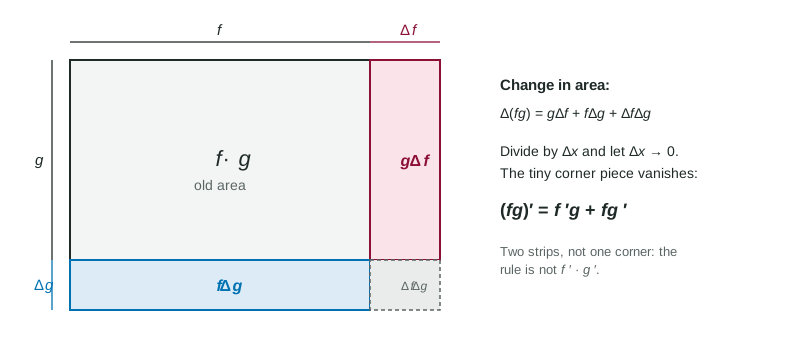
When two factors both change, the product changes by each factor's change times the other factor: (fg)′ = f′g + fg′ .
Practice 1: Implementing Mathematical Processes
Question set for this topic
Part 1 · Hook
Why this matters
A store's revenue is price times the number of items sold. If the price rises while sales fall, how fast is revenue changing? Both factors are moving at once, and the answer is not the product of their rates. The product rule tells you exactly how two changing factors combine.
Part 2 · Before you start
What this builds on
Part 3 · Prerequisite check
Quick check before you start
1. is
Show the answer
The slopes of sine are the values of cosine.
- Correct: :
- :
- :
- :
2. is
Show the answer
is its own derivative.
- Correct: :
- :
- :
- :
3. If , then is
Show the answer
Constant multiple rule: the factor 3 rides along.
- Correct: :
- :
- :
- :
Part 5 · Step by step
How it works, step by step
- Both factors of change as changes→the change in the product has two main parts: times the change in , and times the change in
- The extra piece is a product of two small changes→after dividing by it still goes to 0
- Divide by and take the limit→
- Three factors→differentiate one factor at a time and add:
Part 6 · Key ideas
Key ideas
- The product rule: .
- In words: derivative of the first times the second, plus the first times the derivative of the second.
- The derivative of a product is NOT the product of the derivatives: , but .
- From a table: uses both the value columns and the derivative columns.
- If one factor is a constant, the product rule reduces to the constant multiple rule.
Part 7 · Misconception
A common mistake
The wrong idea: .
What actually happens: Try : the product is , whose derivative is , but . Each factor's change is multiplied by the other factor's value, and the two contributions add: .
Part 8 · Check yourself
Check yourself
Exam-style questions. Anything you miss goes into your review queue.
Table
Values of , and their derivatives
The functions
and
have derivatives for all
.
Selected values of , , and | | | | |
|---|
| 0 | 2 | 3 | 5 | |
|---|
| 1 | | 2 | 3 | 4 |
|---|
| 3 | 4 | | 1 | 2 |
|---|
1. Let . Find .
No calculator. Type the exact value (a fraction, π, e or a root is fine).
Show the answer
.
2. Let . Find .
No calculator. Type the exact value (a fraction, π, e or a root is fine).
Show the answer
, so .
3. Which is an equation of the line tangent to the graph of at ?
Show the answer
and .
- Correct: : Height 10, slope 13.
- : Slope is , the product of the derivatives.
- : The height and the slope are swapped.
- : Slope 15 is only the first term of the product rule.
4. Let . Find .
No calculator. Type the exact value (a fraction, π, e or a root is fine).
Show the answer
, so .
5. Use the product rule to differentiate , a power of times a sine.
Type an expression for .
Show the answer
First , second : .
- Answer:
6. Let and . Which comparison of and is correct?
- and ; they differ, so
- Both equal , so for these two functions
- Both equal , because and for these functions
- and ; they differ, so
Show the answer
, whose derivative is ; . By the product rule, .
- Correct: and ; they differ, so : One counterexample is enough.
- Both equal , so for these two functions: , not .
- Both equal , because and for these functions: , not 1.
- and ; they differ, so : That swaps the two results.
Part 9 · Summary
Summary
When two factors both change, the product changes by each factor's change times the other factor:
. It is never just
. For three factors, differentiate one at a time and add the three terms. From a table, the rule needs the values as well as the derivatives.
Part 10 · Up next
What comes next
Part 11 · Connections
Connections