Unit 3 · Topic 3.3 Beta
Derivatives of Inverse Functions
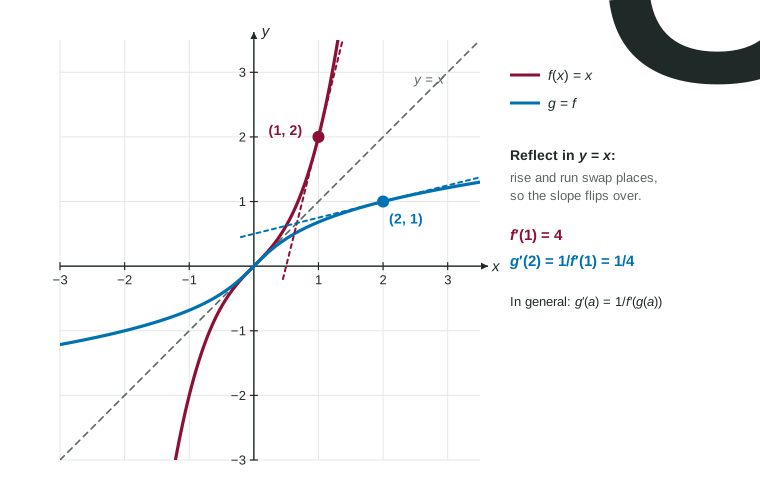
The graph of an inverse is a reflection in y = x , which swaps rise and run, so slopes become reciprocals at matching points: (f⁻¹)′(a) = 1/(f′(f⁻¹(a))) .
Practice 1: Implementing Mathematical ProcessesPractice 2: Connecting Representations
Question set for this topic
Part 1 · Hook
Why this matters
If you know how fast a
function climbs, you also know how fast its inverse climbs: undo the function and the steepness flips. A thermometer that converts a voltage to a temperature, or a calculator's square root key, is an
inverse function, and this topic finds its
slope without a formula for it.
Part 2 · Before you start
What this builds on
Part 3 · Prerequisite check
Quick check before you start
1. If and is the inverse of , what is ?
Show the answer
An inverse swaps inputs and outputs: means .
- Correct: :
- :
- :
- :
2. By the chain rule, is
Show the answer
The outside derivative at the inside function, times the inside derivative.
- Correct: :
- :
- :
- :
Part 5 · Step by step
How it works, step by step
- The graph of is the graph of reflected in →the point on becomes on
- Reflection in swaps rise and run→a tangent line of slope becomes one of slope
- So the slope of at is the reciprocal of the slope of at →
- Where →the tangent line of at is vertical and does not exist
Part 6 · Key ideas
Key ideas
- The rule: when is the inverse of and .
- Two steps: first find , the input of that gives ; then take the reciprocal of there.
- From a table, find the given number in the row, read its , then read in that column.
- It comes from the chain rule: differentiate to get .
Part 7 · Misconception
A common mistake
The wrong idea: If and , then .
What actually happens: The input of must be , the where gives 4: . Reading at 4 uses the wrong point of the graph.
Part 8 · Check yourself
Check yourself
Exam-style questions. Anything you miss goes into your review queue.
Table
Values of and
Selected values of a differentiable, one-to-one function f and its derivative; g is the inverse function of f | | | | | |
|---|
| 1 | 3 | 4 | 7 | 9 |
|---|
| 3 | 2 | 2 | 4 | 3 |
|---|
1. The function is the inverse of . Find .
No calculator. Type the exact value (a fraction, π, e or a root is fine).
Show the answer
because . Then .
- Answer: ≈ 0.500
2. What is ?
Show the answer
Find from the table: , so . Then .
- Correct: : and , so .
- : This is ; the slope of the inverse is its reciprocal.
- : This is , the reciprocal of the input. The rule uses at .
- : This is . The rule takes the reciprocal of a slope, , not of a value.
3. Which is an equation of the line tangent to the graph of at ?
Show the answer
gives , and . So .
- : The slope 2 is ; the inverse needs its reciprocal.
- Correct: : The point is and the slope is .
- : This is a line through , a point of . On the coordinates swap: .
- : This uses . Read at , not at 3.
4. Let . Find .
No calculator. Type the exact value (a fraction, π, e or a root is fine).
Show the answer
By the chain rule, , using and .
5. Let . Find .
No calculator. Type the exact value (a fraction, π, e or a root is fine).
Show the answer
, so . , so and .
- Answer: ≈ 0.500
6. A one-to-one differentiable function has , , and . What is ?
Show the answer
means . Then .
- : This is . The input 5 is an output of ; the matching input is 2.
- Correct: : , so the slope is .
- : This is ; the inverse's slope is the reciprocal.
- : This is , the reciprocal of a value instead of a slope.
Part 9 · Summary
Summary
The graph of an inverse is a reflection in
, which swaps rise and run, so slopes become reciprocals at matching points:
. Find first, then take the reciprocal of at that input.Part 10 · Up next
What comes next
Part 11 · Connections
Connections