Skills Beta

Exponentials and Logarithms

e^x is the exponential function calculus uses; it is always positive and passes through (0, 1) .

Practice 1: Implementing Mathematical Processes

Question set for this topic

Part 1 · Hook

Why this matters

Money that earns interest continuously, a cooling drink, a population, a drug leaving the bloodstream: they all change by the same percentage over equal times, and they are all modeled with exe^x. Its partner, ln⁡x\ln x, is how you solve for the time. Calculus uses both constantly, so this is a page worth knowing by heart.

Part 2 · Before you start

What this builds on

Part 3 · Prerequisite check

Quick check before you start

1. Which expression equals xa⋅xbx^a \cdot x^b?

  1. xa+bx^{a + b}
  2. xabx^{ab}
  3. xa−bx^{a - b}
  4. 2xa+b2x^{a + b}
Show the answer

Multiplying powers of one base adds the exponents.

  • Correct: xa+bx^{a + b}:
  • xabx^{ab}:
  • xa−bx^{a - b}:
  • 2xa+b2x^{a + b}:

2. What is 2−32^{-3}?

  1. 18\frac{1}{8}
  2. −8-8
  3. −6-6
  4. 16\frac{1}{6}
Show the answer

A negative exponent is a reciprocal.

  • Correct: 18\frac{1}{8}:
  • −8-8:
  • −6-6:
  • 16\frac{1}{6}:

Part 4 · See it

See it first

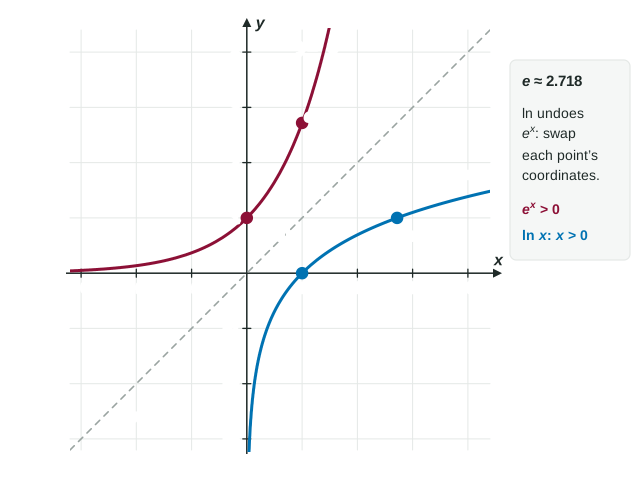
The curve y = e to the x passes through (0, 1) and (1, e) and stays above the x-axis; the curve y = ln x passes through (1, 0) and (e, 1) and exists only for x greater than 0. They are mirror images across the dashed line y = x.
y=exy = e^x and y=ln⁡xy = \ln x are mirror images across y=xy = x: the point (1,e)(1, e) on one matches (e,1)(e, 1) on the other. LevlPrep original diagram.

Part 5 · Step by step

How it works, step by step

  1. An exponential function bxb^x multiplies by the same factor bb for each unit step in xxit models growth by a fixed percentage; the base e≈2.718e \approx 2.718 is the one calculus prefers
  2. ln⁡x\ln x answers "what power of ee gives xx?"eln⁡x=xe^{\ln x} = x for x>0x > 0 and ln⁡(ex)=x\ln(e^x) = x for every xx
  3. Exponent rules read in reversegive the log rules: ln⁡(ab)=ln⁡a+ln⁡b\ln(ab) = \ln a + \ln b, ln⁡ab=ln⁡a−ln⁡b\ln\frac{a}{b} = \ln a - \ln b, ln⁡ap=pln⁡a\ln a^p = p\ln a
  4. A variable in an exponent, as in e2x=9e^{2x} = 9take ln⁡\ln of both sides to bring it down: 2x=ln⁡92x = \ln 9

Part 6 · Key ideas

Key ideas

  • ex>0e^x > 0 for every xx; e0=1e^0 = 1. The graph rises steeply to the right and approaches the xx-axis to the left.
  • ln⁡x\ln x is defined only for x>0x > 0; ln⁡1=0\ln 1 = 0, ln⁡e=1\ln e = 1. Its graph is the graph of exe^x reflected across y=xy = x.
  • Log rules: ln⁡(ab)=ln⁡a+ln⁡b\ln(ab) = \ln a + \ln b, ln⁡ab=ln⁡a−ln⁡b\ln\frac{a}{b} = \ln a - \ln b, ln⁡(ap)=pln⁡a\ln(a^p) = p\ln a. There is no rule for ln⁡(a+b)\ln(a + b).
  • ee and ln⁡\ln cancel: eln⁡x=xe^{\ln x} = x (x>0x > 0) and ln⁡(ex)=x\ln(e^x) = x. Use them to solve equations.
  • AektA e^{kt} grows when k>0k > 0 and decays when k<0k < 0; the time to double is ln⁡2k\frac{\ln 2}{k}.

Part 7 · Misconception

A common mistake

The wrong idea: ln⁡(x+3)=ln⁡x+ln⁡3\ln(x + 3) = \ln x + \ln 3.

What actually happens: The log of a sum does not split. ln⁡x+ln⁡3=ln⁡(3x)\ln x + \ln 3 = \ln(3x), a product. Test x=1x = 1: ln⁡4≈1.39\ln 4 \approx 1.39, but ln⁡1+ln⁡3≈1.10\ln 1 + \ln 3 \approx 1.10.

Part 8 · Check yourself

Check yourself

Exam-style questions. Anything you miss goes into your review queue.

1. Evaluate e3ln⁡2e^{3\ln 2} exactly.

No calculator. Type the exact value (a fraction, π, e or a root is fine).

Show the answer

The log of a power: 3ln⁡2=ln⁡23=ln⁡83\ln 2 = \ln 2^3 = \ln 8. Then eln⁡8=8e^{\ln 8} = 8.

  • Answer: 8

2. For x>0x > 0 and y>0y > 0, which expression equals ln⁡(x3y)\ln\left(\frac{x^3}{y}\right)?

  1. 3ln⁡x−ln⁡y3\ln x - \ln y
  2. 3ln⁡xln⁡y\frac{3\ln x}{\ln y}
  3. ln⁡(3x)−ln⁡y\ln(3x) - \ln y
  4. (ln⁡x)3−ln⁡y(\ln x)^3 - \ln y
Show the answer

Log of a quotient, then log of a power: ln⁡x3−ln⁡y\ln x^3 - \ln y=3ln⁡x−ln⁡y= 3\ln x - \ln y.

  • Correct: 3ln⁡x−ln⁡y3\ln x - \ln y: ln⁡ab=ln⁡a−ln⁡b\ln\frac{a}{b} = \ln a - \ln b and ln⁡a3=3ln⁡a\ln a^3 = 3\ln a.
  • 3ln⁡xln⁡y\frac{3\ln x}{\ln y}: The log of a quotient is a difference of logs, not a quotient of logs.
  • ln⁡(3x)−ln⁡y\ln(3x) - \ln y: ln⁡(x3)=3ln⁡x\ln(x^3) = 3\ln x, not ln⁡(3x)\ln(3x).
  • (ln⁡x)3−ln⁡y(\ln x)^3 - \ln y: ln⁡(x3)=3ln⁡x\ln(x^3) = 3\ln x; (ln⁡x)3(\ln x)^3 is something else.

3. Solve e2x=9e^{2x} = 9 for xx. Give the exact value.

No calculator. Type the exact value (a fraction, π, e or a root is fine).

Show the answer

Take ln⁡\ln of both sides: 2x=ln⁡92x = \ln 9, so xx=ln⁡92= \frac{\ln 9}{2}=2ln⁡32= \frac{2\ln 3}{2}=ln⁡3= \ln 3.

  • Answer: ln⁡(3)\ln(3) ≈ 1.099

4. Solve ln⁡(x+2)=1\ln(x + 2) = 1 for xx. Give the exact value.

No calculator. Type the exact value (a fraction, π, e or a root is fine).

Show the answer

Exponentiate both sides: x+2=e1=ex + 2 = e^1 = e, so x=e−2≈0.718x = e - 2 \approx 0.718. Check: x+2=e>0x + 2 = e > 0, inside the domain.

  • Answer: e−2e - 2 ≈ 0.718

5. For x>0x > 0, which expression equals ln⁡(x2)\ln(x^2)?

  1. 2ln⁡x2\ln x
  2. (ln⁡x)2(\ln x)^2
  3. ln⁡2+ln⁡x\ln 2 + \ln x
  4. ln⁡x+2\ln x + 2
Show the answer

The log of a power: ln⁡(xp)=pln⁡x\ln(x^p) = p\ln x.

  • Correct: 2ln⁡x2\ln x: The exponent comes out front as a multiplier.
  • (ln⁡x)2(\ln x)^2: (ln⁡x)2(\ln x)^2 squares the log, a different function: at x=ex = e it is 1, but ln⁡(e2)=2\ln(e^2) = 2.
  • ln⁡2+ln⁡x\ln 2 + \ln x: ln⁡2+ln⁡x=ln⁡(2x)\ln 2 + \ln x = \ln(2x).
  • ln⁡x+2\ln x + 2: Adding 2 is not the same as multiplying by 2.

6. Which equation is true for every x>0x > 0 and y>0y > 0?

  1. ln⁡(xy)=ln⁡x+ln⁡y\ln(xy) = \ln x + \ln y
  2. ln⁡(x+y)=ln⁡x+ln⁡y\ln(x + y) = \ln x + \ln y
  3. ln⁡xln⁡y\frac{\ln x}{\ln y}=ln⁡(x−y)= \ln(x - y)
  4. (ln⁡x)2=2ln⁡x(\ln x)^2 = 2\ln x
Show the answer

Logs turn products into sums. Test the others with x=y=ex = y = e: ln⁡(2e)≈1.69\ln(2e) \approx 1.69, not 2; 11=1\frac{1}{1} = 1, but ln⁡0\ln 0 is undefined; 12=11^2 = 1, not 2.

  • Correct: ln⁡(xy)=ln⁡x+ln⁡y\ln(xy) = \ln x + \ln y: The log of a product is a sum of logs.
  • ln⁡(x+y)=ln⁡x+ln⁡y\ln(x + y) = \ln x + \ln y: At x=y=ex = y = e: ln⁡(2e)≈1.69\ln(2e) \approx 1.69, but ln⁡e+ln⁡e=2\ln e + \ln e = 2.
  • ln⁡xln⁡y\frac{\ln x}{\ln y}=ln⁡(x−y)= \ln(x - y): There is no rule for a quotient of logs; at x=yx = y the right side is ln⁡0\ln 0.
  • (ln⁡x)2=2ln⁡x(\ln x)^2 = 2\ln x: At x=e3x = e^3: (ln⁡x)2=9(\ln x)^2 = 9, but 2ln⁡x=62\ln x = 6.

7. A substance decays so that A(t)=80ektA(t) = 80e^{kt} grams after tt hours, and half of it remains after 5 hours. What is kk?

  1. k=−ln⁡25k = -\frac{\ln 2}{5}
  2. k=ln⁡25k = \frac{\ln 2}{5}
  3. k=−110k = -\frac{1}{10}
  4. k=ln⁡(12)⋅5k = \ln\left(\frac{1}{2}\right) \cdot 5
Show the answer

80e5k=4080e^{5k} = 40, so e5k=12e^{5k} = \frac{1}{2} and 5k=ln⁡12=−ln⁡25k = \ln\frac{1}{2} = -\ln 2. Then k=−ln⁡25≈−0.139k = -\frac{\ln 2}{5} \approx -0.139.

  • Correct: k=−ln⁡25k = -\frac{\ln 2}{5}: 5k=−ln⁡25k = -\ln 2.
  • k=ln⁡25k = \frac{\ln 2}{5}: A positive kk means growth, not decay; ln⁡12\ln\frac{1}{2} is negative.
  • k=−110k = -\frac{1}{10}: Halving is not losing a tenth per hour; solve e5k=12e^{5k} = \frac{1}{2} with logs.
  • k=ln⁡(12)⋅5k = \ln\left(\frac{1}{2}\right) \cdot 5: Divide by 5 to solve 5k=ln⁡125k = \ln\frac{1}{2}; do not multiply.

Part 9 · Summary

Summary

exe^x is the exponential function calculus uses; it is always positive and passes through (0,1)(0, 1). ln⁡x\ln x, defined for x>0x > 0, undoes it: eln⁡x=xe^{\ln x} = x and ln⁡(ex)=x\ln(e^x) = x. Logs turn products into sums, quotients into differences and powers into multipliers, which is how you solve for a variable in an exponent.

Part 10 · Up next

What comes next

Part 11 · Connections

Connections