Continuity at a Point
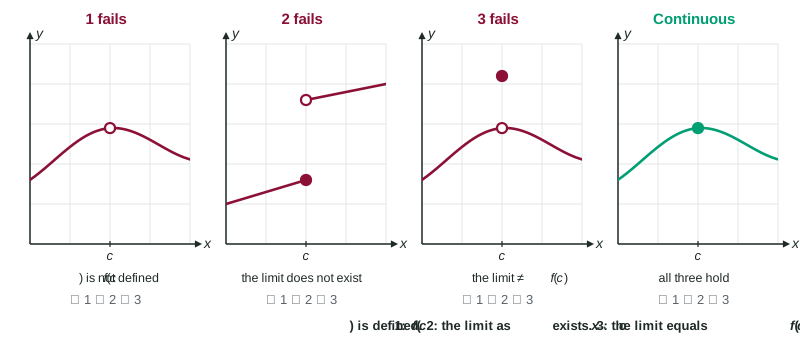
f is continuous at c when f(c) is defined, lim as x → c, f(x) exists, and the two are equal.
Part 1 · Hook
Why this matters
Part 2 · Before you start
What this builds on
Part 3 · Prerequisite check
Quick check before you start
1. A removable discontinuity at means
- the limit at exists, but the value is missing or different
- the one-sided limits at differ
- the function is unbounded near
- the function is defined at
Show the answer
Removable: a hole, possibly with the point elsewhere.
- Correct: the limit at exists, but the value is missing or different:
- the one-sided limits at differ:
- the function is unbounded near :
- the function is defined at :
2. If and , then
- equals 2
- does not exist
- equals
- equals 4
Show the answer
Equal one-sided limits give the two-sided limit.
- Correct: equals 2:
- does not exist:
- equals :
- equals 4:
Part 4 · See it
See it first
Part 5 · Step by step
How it works, step by step
- is undefinedcondition 1 fails: there is no point on the graph at
- is defined, but the one-sided limits differ or are unboundedcondition 2 fails: does not exist
- The value and the limit both exist but are different numberscondition 3 fails: the point is not where the curve arrives
- All three conditions hold is continuous at , and
, so the limit can be found by substitution
Part 6 · Key ideas
Key ideas
- Continuous at means: (1) is defined, (2) exists, (3)
. - Check the conditions in order. The first one that fails tells you the reason, and the kind of discontinuity.
- At the break point of a piecewise function, find both one-sided limits from the pieces, then compare with the value the function is given there.
- A justification shows all three conditions with numbers: ", , so
." - If is continuous at , its limit at is just . That is why direct substitution works.
Part 7 · Misconception
A common mistake
The wrong idea: is defined, so is continuous at .
What actually happens: A defined value is only the first condition. The limit must exist and equal it. A function can be defined at a jump (the value sits on one side) or at a misplaced point above a hole.
Part 8 · Check yourself
Check yourself
Exam-style questions. Anything you miss goes into your review queue.
Table
A function defined in three parts
| Where | Rule for |
|---|---|
1. Which is a complete justification that is continuous at ?
- , and both one-sided limits are 3, so
- Both one-sided limits at 2 equal 3, so the limit exists
- is defined, and each piece of is a polynomial on its interval
- is defined at , so the graph of can have no break at
Show the answer
All three conditions must be shown: exists, exists, and they are equal.
- Correct: , and both one-sided limits are 3, so
: Defined value, existing limit, and the two equal: all three conditions. - Both one-sided limits at 2 equal 3, so the limit exists: This shows the limit exists but never compares it with .
- is defined, and each piece of is a polynomial on its interval: Polynomial pieces can still fail to meet at the break point; the limits must be checked.
- is defined at , so the graph of can have no break at : A defined value is the first condition only; a function can be defined at a jump.
2. Suppose the rule at were changed to . Which condition for continuity at 2 would fail?
- is defined; changing it leaves undefined
; the limit is 3 but the value is 5 - exists; the one-sided limits would differ
- No condition; would still be continuous at
Show the answer
The one-sided limits come from the rules left and right of 2, which do not change. The limit is still 3, but now , so the third condition fails: a removable discontinuity.
- is defined; changing it leaves undefined: is defined.
- Correct:
; the limit is 3 but the value is 5: Value 5, limit 3: the third condition fails. - exists; the one-sided limits would differ: The pieces left and right of 2 are unchanged, so both one-sided limits are still 3.
- No condition; would still be continuous at : A value different from the limit breaks the graph.
Graph
The graph of
3. Why is not continuous at ?
- does not exist
- is not equal to
- is unbounded near
- is not defined
Show the answer
The graph has an open circle at and no closed dot above , so does not exist. The first condition fails, even though .
- does not exist: From both sides the line heads to 1.5, so the limit exists.
- is not equal to : 1.5 is the limit, not a value: the point is missing.
- is unbounded near : The line stays near 1.5; nothing grows without bound.
- Correct: is not defined: An open circle with no closed dot means there is no value at 1.
4. is defined. Why is still not continuous at ?
- does not exist: the sides approach 2.5 and 3.5
- is not defined because there is an open circle at
- exists but equals 3.5, which is not
- is unbounded near , so there is a vertical asymptote
Show the answer
- Correct: does not exist: the sides approach 2.5 and 3.5: The second condition fails: the one-sided limits differ.
- is not defined because there is an open circle at : The closed dot at gives .
- exists but equals 3.5, which is not : 3.5 is only the right-hand limit; the left side heads to 2.5.
- is unbounded near , so there is a vertical asymptote: Both one-sided limits are finite.
5. Let for and . Which describes at ?
- Not continuous: is not defined
- Not continuous: the limit at 3 does not exist
- Not continuous: the limit is 6 but
- Continuous: and the limit both exist
Show the answer
- Not continuous: is not defined: The second rule defines .
- Not continuous: the limit at 3 does not exist: near 3, so the limit is 6.
- Correct: Not continuous: the limit is 6 but : Value 3, limit 6: they must be equal.
- Continuous: and the limit both exist: Both exist, but they are not equal.
6. is continuous at , and
No calculator. Type the exact value (a fraction, π, e or a root is fine).
Show the answer
By the limit laws,
- Answer: 5
Part 9 · Summary
Summary
Part 10 · Up next
What comes next
Part 11 · Connections