An infinite series is a sum with no last term:
You cannot add infinitely many numbers one at a time, so "the sum" needs a definition. It comes from adding a finite number of terms and asking where those totals head.
Partial sums
The th partial sum is the sum of the first terms:
The partial sums form a new sequence. The series converges to the number if ; then is the sum of the series. If the partial sums have no finite limit, because they grow without bound or never settle, the series diverges.
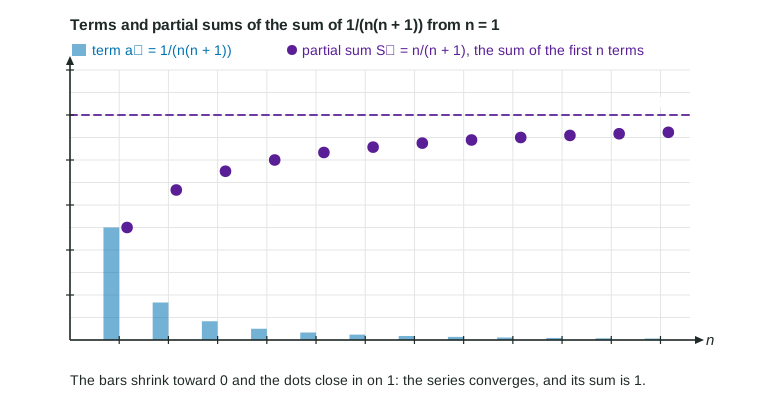
Two sequences, two questions. In the figure, the terms shrink toward 0 and the partial sums climb toward 1. The series converges, and its sum is 1. Say it that way: "the series converges to 1". The 2024 exam readers took points from answers that said the terms converge when they meant the series.
Finding a sum from the partial sums
Worked example 1. Find .
Split each term:
Write out a partial sum:
Each negative piece cancels the next positive piece, so
Take the limit:
A series like this, where the partial sums collapse, is called telescoping. Most series do not have a neat formula for ; the tests in 10.3 through 10.9 decide convergence without one.
Going the other way, if you know the partial sums you know the terms: and . If , then
Three ways to diverge
| Series | Partial sums | Why it diverges |
|---|---|---|
| grow without bound | ||
| never settle on one number | ||
| grow without bound, slowly, though the terms approach 0 |
The middle row is a warning about regrouping. Grouping as suggests 0; grouping as suggests 1. Each grouping looks at only some of the partial sums. The definition looks at all of them, and they have no limit, so the series has no sum.
The last row is the most important fact in this unit: terms that approach 0 do not guarantee convergence. Infinitely many small pieces can still add up to something infinite.
Rules that carry over
Worked example 2.
Multiplying every term by 3 multiplies every partial sum by 3, so .
Dropping the first three terms subtracts 2.5 from every partial sum after the third, so
- If and , then and .
- If converges and diverges, diverges.
- Adding or removing finitely many terms changes the sum, never whether the series converges. That is why the tests later in the unit only care about the long-run behavior of the terms.