Unit 10 Topic 10.13

Radius and Interval of Convergence

every AB topic, then series

4 min readfreeNot practiced

Every series so far was a list of numbers. A power series has an xx in it, ∑n=0∞an(x−a)n\sum_{n=0}^{\infty} a_n (x - a)^n, so it is a whole family of series, one for each value of xx. For some values the series converges, for others it diverges. The set where it converges is the interval of convergence, and finding it is asked on the free-response section almost every year.

What a power series is

A power series centered at x=ax = a is

∑n=0∞an(x−a)n=a0+a1(x−a)+a2(x−a)2+⋯\sum_{n=0}^{\infty} a_n (x - a)^n = a_0 + a_1(x - a) + a_2(x - a)^2 + \cdots

The numbers ana_n are its coefficients. Read the center from the powers: (x+2)n=(x−(−2))n(x + 2)^n = (x - (-2))^n is centered at −2-2, and (2x−1)n(2x - 1)^n=2n(x−12)n= 2^n\left(x - \frac{1}{2}\right)^n is centered at 12\frac{1}{2}. At the center every term after the first is 0, so a power series always converges there.

Beyond the center there are exactly three possibilities:

  • it converges only at x=ax = a (radius 00);
  • it converges for every real xx (infinite radius);
  • there is a radius R>0R > 0: it converges when |x−a|<R|x - a| < R and diverges when |x−a|>R|x - a| > R. At the two endpoints x=a±Rx = a \pm R anything can happen.

Step 1: the radius from the ratio test

Apply the ratio test to the terms, treating xx as a fixed number. Keep the absolute value bars: they turn the limit into a distance from the center.

Worked example. Find the interval of convergence of ∑n=1∞(x−1)nn⋅4n\sum_{n=1}^{\infty} \frac{(x - 1)^n}{n \cdot 4^n}.

Ratio: |an+1an|\left|\frac{a_{n+1}}{a_n}\right|=|x−1|n+1(n+1)4n+1⋅n⋅4n|x−1|n= \frac{|x - 1|^{n+1}}{(n + 1)4^{n+1}} \cdot \frac{n \cdot 4^n}{|x - 1|^n}=|x−1|4⋅nn+1= \frac{|x - 1|}{4} \cdot \frac{n}{n + 1}.

Limit: limn→∞|x−1|4⋅nn+1\lim_{n \to \infty} \frac{|x - 1|}{4} \cdot \frac{n}{n + 1}=|x−1|4= \frac{|x - 1|}{4}.

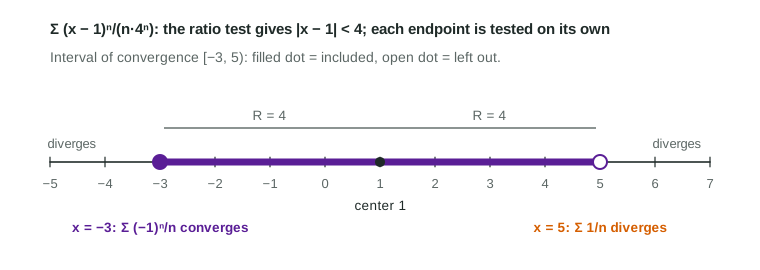
Converges when |x−1|4<1\frac{|x - 1|}{4} < 1, that is |x−1|<4|x - 1| < 4. Radius R=4R = 4; open interval −3<x<5-3 < x < 5.

Step 2, right endpoint. At x=5x = 5: 4nn⋅4n=1n\frac{4^n}{n \cdot 4^n} = \frac{1}{n}. The harmonic series diverges, so x=5x = 5 is left out.

Step 2, left endpoint. At x=−3x = -3: (−4)nn⋅4n\frac{(-4)^n}{n \cdot 4^n}=(−1)nn= \frac{(-1)^n}{n}. It alternates and 1n\frac{1}{n} decreases to 0, so it converges by the alternating series test: x=−3x = -3 is included.

Answer. The interval of convergence is [−3,5)[-3, 5).

A number line from -5 to 7. The power series sum of (x - 1) to the n over n times 4 to the n is centered at 1 with radius 4, marked by arrows to -3 and 5. A thick bar runs from -3 to 5, with a filled dot at -3, where the series becomes the alternating harmonic series and converges, and an open dot at 5, where it becomes the harmonic series and diverges. Outside the bar the series diverges. The interval of convergence is [-3, 5).
Figure 1. Center 1, radius 4; the endpoints are tested separately. LevlPrep original diagram.

Step 2: each endpoint on its own

At an endpoint the ratio test limit is exactly 1, so it cannot decide anything there. Substitute the endpoint, simplify until you can name the series, and use a test that can decide it.

At the endpoint the series becomesTestResult
∑1np\sum \frac{1}{n^p}pp-seriesconverges if p>1p > 1
∑(−1)nnp\sum \frac{(-1)^n}{n^p} with p>0p > 0alternating series testconverges
∑1\sum 1, ∑(−1)n\sum (-1)^n, ∑n\sum nnth term testdiverges
something less familiarcomparison or limit comparisondecide with a named series

Inside the open interval the series converges absolutely, which the ratio test shows. At an endpoint it may converge absolutely (like ∑(−1)nn2\sum \frac{(-1)^n}{n^2}), conditionally (like ∑(−1)nn\sum \frac{(-1)^n}{n}), or diverge.

Radius traps

  • A coefficient on xx: |2x−1|<1|2x - 1| < 1 means |x−12|<12\left|x - \frac{1}{2}\right| < \frac{1}{2}. Factor it out before reading the radius.
  • Even powers: for ∑x2n5n\sum \frac{x^{2n}}{5^n} the condition is x2<5x^2 < 5, so R=5R = \sqrt{5}, not 5.
  • Factorials: ∑xnn!\sum \frac{x^n}{n!} has ratio limit |x|n+1→0\frac{|x|}{n + 1} \to 0 for every xx, so it converges everywhere; ∑n!xn\sum n!\,x^n has ratio limit (n+1)|x|→∞(n + 1)|x| \to \infty unless x=0x = 0, so it converges only at its center.

Geometric power series

When the power series is geometric, its sum has a formula. ∑n=0∞(x−23)n\sum_{n=0}^{\infty} \left(\frac{x - 2}{3}\right)^n has ratio x−23\frac{x - 2}{3}, so for |x−2|<3|x - 2| < 3 its sum is 11−x−23\frac{1}{1 - \frac{x - 2}{3}}=35−x= \frac{3}{5 - x}. At both endpoints every term has size 1, so both diverge, and the interval is (−1,5)(-1, 5). Inside its interval, a power series is a function of xx; the next topics build power series for familiar functions.

Writing it the way graders want

Show the ratio with absolute values and an+1a_{n+1} on top, take the limit in nn, solve the inequality, then write a sentence for each endpoint that names the series and the test. Give the interval with brackets and parentheses. If the question asks for the radius, give a number; if it asks for the interval, give an interval.

Spot a mistake on this page?