Radius and Interval of Convergence
For a power series centered at a , the ratio test gives |x − a| < R : the radius R and an open interval.
Part 1 · Hook
Why this matters
Part 2 · Before you start
What this builds on
Part 3 · Prerequisite check
Quick check before you start
1. What does the ratio test conclude when its limit is exactly 1?
- Nothing: use another test
- The series converges
- The series diverges
- The series converges to 1
Show the answer
A limit of 1 is the case the ratio test leaves open.
- Correct: Nothing: use another test:
- The series converges:
- The series diverges:
- The series converges to 1:
2. Does converge?
- Yes, by the alternating series test
- No: its absolute values form the harmonic series
- No, by the nth term test
- Yes, as a -series
Show the answer
It alternates and decreases to 0.
- Correct: Yes, by the alternating series test:
- No: its absolute values form the harmonic series:
- No, by the nth term test:
- Yes, as a -series:
3. Solve .
Show the answer
, so .
- Correct: :
- :
- :
- :
Part 4 · See it
See it first
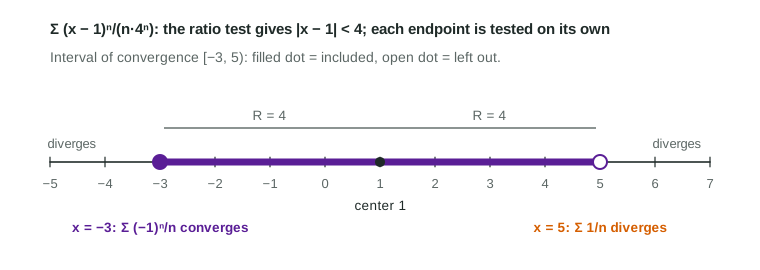
Part 5 · Step by step
How it works, step by step
- Apply the ratio test to , keeping as a letterthe limit is a multiple of
- Set that limit below 1 and solvethe radius and the open interval , where the series converges absolutely
- At and the ratio test limit is exactly 1substitute each endpoint, name the series you get, and test it with another test
- Each endpoint converges or diverges on its ownwrite the interval with a bracket for an included endpoint and a parenthesis for one left out
Part 6 · Key ideas
Key ideas
- A power series converges only at its center, for every real , or on an interval of radius around the center.
- The ratio test gives the radius; it never decides the endpoints.
- Test each endpoint separately: substitute, simplify, and use the -series, alternating series or nth term test.
- Radius and interval are different answers: , but the interval is .
Part 7 · Misconception
A common mistake
The wrong idea: The interval of convergence of is , from the ratio test.
What actually happens: The ratio test says nothing at and . Tested on its own, gives , which converges, so the interval is .
Part 8 · Check yourself
Check yourself
Exam-style questions. Anything you miss goes into your review queue.
Table
The ratio test on a power series
| Step | Result |
|---|---|
| Term | |
| Ratio | |
| Limit |
1. What is the radius of convergence of the series?
No calculator. Type the exact value (a fraction, π, e or a root is fine).
Show the answer
The series converges when , that is , so the radius is .
- Answer: 3
2. On which open interval does the ratio test show the series converges?
Show the answer
means , so . The endpoints still have to be tested.
- : The center is , not : .
- : That is centered at 0; this series is centered at .
- Correct: : Right: means .
- : That uses as the radius; the radius is 3.
3. At the right endpoint, , what does the series become, and does it converge?
- , which diverges as the harmonic series
- A series whose ratio test limit is 1, so it converges
- , which diverges by the nth term test
- : a convergent -series
Show the answer
At , and each term is . The -series with converges, so is included.
- , which diverges as the harmonic series: The denominator has , so the terms are .
- A series whose ratio test limit is 1, so it converges: A ratio test limit of 1 decides nothing; another test is needed.
- , which diverges by the nth term test: The cancels but the stays: the terms are .
- Correct: : a convergent -series: Right: .
4. At the left endpoint, , what happens?
- , which converges absolutely
- diverges, since the signs alternate
- diverges, since its terms grow
- converges, the same as at
Show the answer
At , and each term is
- Correct: , which converges absolutely: Right: the absolute values form a convergent -series.
- diverges, since the signs alternate: Alternating signs never cause divergence on their own; here the sizes even converge.
- diverges, since its terms grow: The in the denominator cancels: the terms are .
- converges, the same as at : At the signs alternate: .
5. Give the interval of convergence of , with both endpoints tested.
Type the interval, in interval notation such as [1, 5) or as an inequality such as 1 ≤ x < 5.
Show the answer
The ratio test gives . At the series is (converges); at it is (converges absolutely). The interval of convergence is .
- Answer:
6. Give the interval of convergence of .
Type the interval, in interval notation such as [1, 5) or as an inequality such as 1 ≤ x < 5.
Show the answer
The series is geometric with ratio , so it converges when , that is . At every term is 1, so both endpoints diverge: .
- Answer:
Part 9 · Summary
Summary
Part 10 · Up next
What comes next
Part 11 · Connections