The Taylor series of f about a is ∑ (f^((n))(a))/(n!) (x − a)^n ; its partial sums are the Taylor polynomials.
Practice 1: Implementing Mathematical ProcessesPractice 2: Connecting Representations
Part 1 · Hook
Why this matters
A Taylor polynomial stops after a few terms and is only an estimate. Let it run forever and, for , and , the infinite sum is not an estimate any more: it is the function, for every . Four of these series are worth knowing by heart; the rest of the unit builds on them.
Part 2 · Before you start
What this builds on
Part 3 · Prerequisite check
Quick check before you start
1. What is the coefficient of in the Taylor polynomial for about ?
Show the answer
The th derivative at the center over .
Correct: :
:
:
:
2. What is the interval of convergence of ?
all real numbers
Show the answer
It is geometric with ratio ; at the terms do not approach 0.
Correct: :
:
:
all real numbers:
Part 4 · See it
See it first
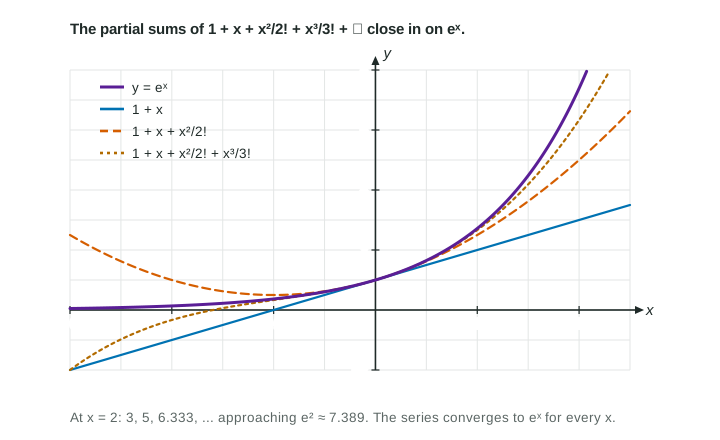
The partial sums , , close in on . LevlPrep original diagram.
Part 5 · Step by step
How it works, step by step
Keep adding terms without stopping→the result is a power series, the Taylor series of about , and is its partial sum
Know four series by heart: , , , →many sums and limits can be read off, and other series can be built from them
Part 6 · Key ideas
Key ideas
Taylor series of about : . About it is a Maclaurin series.
, , , for every .
only for .
A series is written with "" or with and a general term; a Taylor polynomial is not.
Part 7 · Misconception
A common mistake
The wrong idea: The Taylor series for about is , the same coefficients as about 0.
What actually happens: The coefficients use derivatives at the center: , so the series is .
Part 8 · Check yourself
Check yourself
Exam-style questions. Anything you miss goes into your review queue.
Graph
and two of its Taylor polynomials
The graph shows (solid) with its Taylor polynomials about of degree 3, (dashed, the one that turns down past ), and degree 5, (the one that stays close longer), for .
1. What does the graph show about the Taylor polynomials as the degree goes from 3 to 5?
The higher degree matches exactly for
The higher degree stays close to farther from 0
Both polynomials are closest to near
The lower degree is the better estimate near
Show the answer
Both polynomials match near the center. turns away past about , while stays close to about : more terms, a closer fit over a wider interval.
The higher degree matches exactly for : still pulls away from near ; no polynomial equals on an interval.
Correct: The higher degree stays close to farther from 0: Right: follows farther out than .
Both polynomials are closest to near : They are closest near the center, , and pull away farther out.
The lower degree is the better estimate near : Near , is much closer to than is.
2. Write , the fifth-degree Taylor polynomial for about .
Type an expression for .
Show the answer
, so .
Answer:
3. Which is the general term of the Maclaurin series for ?
Correct: Below: , while : Right: the dashed curve is under the solid one at .
Above: , while : ; subtract the cubic term.
Equal: a Taylor polynomial passes through : Taylor polynomials about 0 match at the center, not at .
Above: an odd-degree polynomial lies above for : Read the graph: at the dashed is below .
5. Find the exact sum of .
No calculator. Type the exact value (a fraction, π, e or a root is fine).
Show the answer
for every , so with the sum is .
Answer: ≈ 7.389
6. In the Taylor series for about , find the coefficient of .
No calculator. Type the exact value (a fraction, π, e or a root is fine).
Show the answer
Every derivative of is , so and the coefficient is .
Answer: ≈ 0.453
Part 9 · Summary
Summary
The Taylor series of about is ; its partial sums are the Taylor polynomials. The Maclaurin series of , and converge to the function for every , and for .