Representing Functions as Power Series
New power series come from known ones by substitution, multiplication by powers of x , and term-by-term differentiation or integration.
Part 1 · Hook
Why this matters
Part 2 · Before you start
What this builds on
Part 3 · Prerequisite check
Quick check before you start
1. What is the Maclaurin series for , and where does it converge?
- for
- for every
- for
- for every
Show the answer
It is the geometric series with ratio .
- Correct: for :
- for every :
- for :
- for every :
2. Find .
Show the answer
Power rule for antiderivatives: raise the power by one and divide by the new power.
- Correct: :
- :
- :
- :
3. Find the radius of convergence of .
Show the answer
It is geometric with ratio : .
- Correct: :
- :
- :
- :
Part 4 · See it
See it first
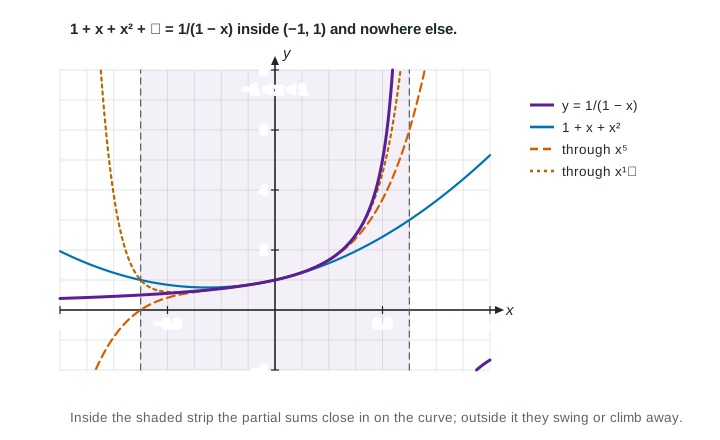
Part 5 · Step by step
How it works, step by step
- Start from a known series, such as for its sum and its interval are known
- Substitute (), multiply by a power of , or add seriesa series for a new function, valid where the substituted value meets the old condition
- Differentiate or integrate term by terma series for the derivative or integral with the same radius; test the endpoints again
Part 6 · Key ideas
Key ideas
- Substitution: replace by an expression in a known series, and the condition with it: for .
- Term by term:
and . - The radius stays the same; endpoints may change, so test them again.
- Differentiate with respect to , never ; when integrating, fix the constant with a known value such as .
Part 7 · Misconception
A common mistake
The wrong idea:
What actually happens: The radius is the same, but at the integrated series is the alternating harmonic series, which converges, so the interval is .
Part 8 · Check yourself
Check yourself
Exam-style questions. Anything you miss goes into your review queue.
Table
From a geometric series to
| Step | Series |
|---|---|
| Start | |
| Substitute | |
| Integrate from to |
1. Write the first four nonzero terms of the Maclaurin series for .
Type an expression for .
Show the answer
With :
- Answer:
2. What is the radius of convergence of the series for ?
No calculator. Type the exact value (a fraction, π, e or a root is fine).
Show the answer
The geometric series needs , that is , so and the radius is 1.
- Answer: 1
3. Integrate term by term from to : write the first four nonzero terms of the Maclaurin series for .
Type an expression for .
Show the answer
- Answer:
4. Integrate the series for from to to write the first four nonzero terms of the Maclaurin series for .
Type an expression for .
Show the answer
- Answer:
5. Give the interval of convergence of
Type the interval, in interval notation such as [1, 5) or as an inequality such as 1 ≤ x < 5.
Show the answer
The radius is 1, as for . At the series is the alternating harmonic series, which converges; at it is , which diverges. The interval is .
- Answer:
6. What happens to the radius of convergence when a power series is differentiated or integrated term by term?
- It doubles when the series is integrated
- It shrinks by 1 when the series is differentiated
- It stays the same, and so does each endpoint
- It stays the same, though an endpoint may change
Show the answer
Term-by-term differentiation and integration keep the radius of convergence. Behavior at the endpoints can change, so test them again.
- It doubles when the series is integrated: The radius does not change.
- It shrinks by 1 when the series is differentiated: The radius does not change.
- It stays the same, and so does each endpoint: Endpoints can change: converges at , but its derivative series does not.
- Correct: It stays the same, though an endpoint may change: Right: the radius is kept; test the endpoints again.
Part 9 · Summary
Summary
Part 10 · Up next
What comes next
This is the last topic in the course.
Part 11 · Connections