A Taylor polynomial has a last term. If you never stop adding terms, you get a power series, the Taylor series of the function. For the functions in this course (the four series below and every series built from them), that series does more than approximate: on its interval of convergence it equals the function. That is a property of these functions, not of every function: a few functions have a Taylor series that converges to something else, and the course does not use them.
From polynomials to a series
The Taylor series of about is
About it is called the Maclaurin series. The Taylor polynomial is its partial sum through the term. So the questions of the last three topics fit together: is a partial sum, the error bounds measure how far a partial sum is from the sum, and the interval of convergence says where the partial sums settle at all.
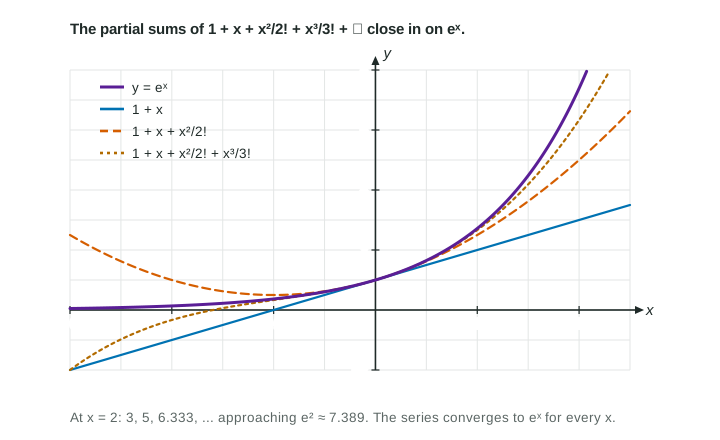
For , every derivative at 0 is 1, so the Maclaurin series is . The figure shows its first partial sums closing in on . The ratio test gives for every , so the series converges everywhere, and it converges to .
Four series to know by heart
| Function | Maclaurin series | General term | Converges to the function for |
|---|---|---|---|
| every | |||
| every | |||
| every |
Patterns help you remember them. is odd, so only odd powers appear; is even, so only even powers. Both alternate in sign because their derivatives cycle through . The series for is just the geometric series, which is why it works only for .
Building a Taylor series from derivatives
Worked example 1. Find the Taylor series for about .
Every derivative of is , so for every .
The coefficients are , and the series is
When a question gives a formula for instead of the function, the same recipe applies: divide by and simplify. If , the coefficients are and the series is the geometric series .
Reading coefficients backward
If a function is given by a power series with a positive radius, then that series is its Taylor series, so and
Worked example 2.
The coefficient of is
Using known series to find sums and limits
Worked example 3. Find .
This is the series for with , so the sum is .
Worked example 4. Find .
Series or polynomial?
When a question asks for a Taylor polynomial, write a finite sum that ends at the stated degree. When it asks for a series, write the first few terms followed by "", or use sigma notation with the general term. Mixing the two, a polynomial with "" or a series with no general term when one is asked for, costs points on the exam.