Every later test in Unit 10 takes some work. The nth term test takes almost none, so it is the first thing to check. It looks only at the terms and asks one question: do they approach 0?
The test
nth term test for divergence. If , or the limit does not exist, then diverges.
Why it works: if a series converges to , then its partial sums and both approach , so
So every convergent series has terms that approach 0. A series whose terms do not approach 0 cannot converge.
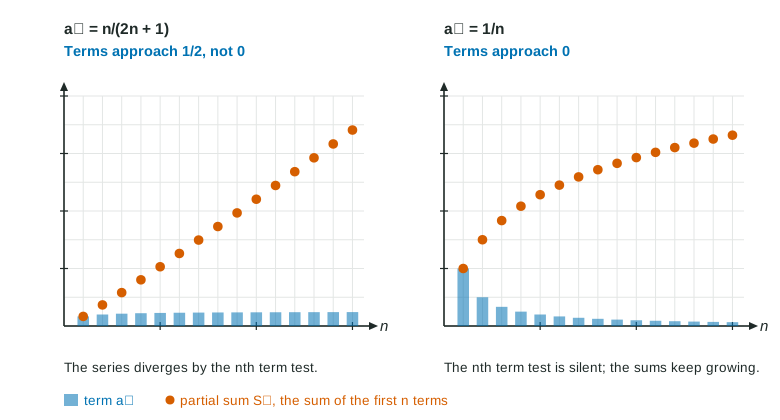
The left panel shows why: when the terms level off at , each new term adds about , and the partial sums climb without bound.
What it cannot do
The test only ever proves divergence. If , it is inconclusive: the series might converge or diverge. The right panel shows terms that approach 0 while the partial sums keep growing. In 10.1 you saw another: has terms approaching 0 and partial sums that grow without bound. On the other hand also has terms approaching 0, and it converges.
| What the nth term test says | |
|---|---|
| a number other than 0 | the series diverges |
| does not exist (including ) | the series diverges |
| nothing: use another test |
Using it
Worked example 1. Does converge?
Limit of the terms: divide the top and bottom by : .
Conclusion:
Worked example 2. What does the nth term test say about and ?
First: the sizes approach 2, so the terms jump between values near 2 and near . The limit does not exist, so it is not 0: the series diverges by the nth term test.
Second: is an form, and L'Hospital's rule gives . The terms approach 0, so the nth term test says nothing. (Topic 10.4 settles it.)
Saying it right
A justification names the limit, compares it with 0, names the test and concludes about the series:
"
Three phrases cost points: "the terms diverge" when they approach ; "the series converges to ", which mixes up the terms with the sum; and "the terms go to 0, so the series converges", which uses the test backward.
Limits in this unit are in : write . To use L'Hospital's rule or a derivative, switch to a function with , find , and then state the result for .