The comparison tests need positive terms. Many important series have terms that switch sign, Those are alternating series, and they have their own test, one of the simplest in the unit.
What an alternating series looks like
An alternating series has the form or , where every is positive. The factor supplies the sign; is the size of the term. The best-known example is the alternating harmonic series
Watch for signs in disguise: , so is alternating. And watch for signs that are not there: for every , so is the plain harmonic series.
Why the partial sums settle
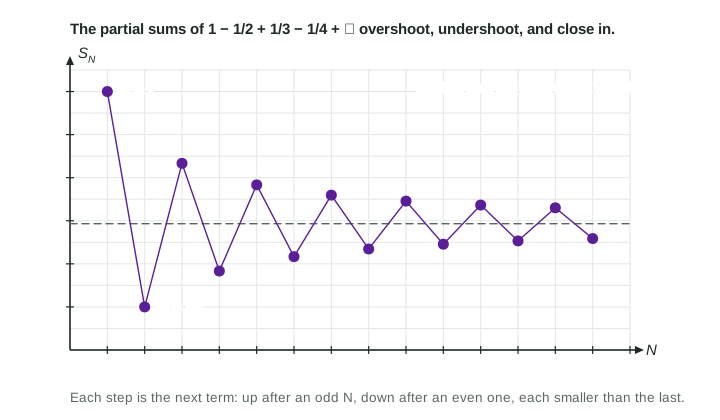
Follow the partial sums in the figure. . Subtracting gives . Adding gives , which does not climb back to , because . Each step goes the opposite way from the last and is shorter, so the partial sums zigzag inside a window that keeps shrinking. If the step sizes approach 0, the window closes on a single number: the sum.
Three facts did the work: the signs alternate, the sizes decrease, and the sizes approach 0. Those are the three conditions of the test.
The alternating series test
If for every , the sizes decrease (, at least from some on), and , then converges.
Worked example 1. Does converge?
Signs: alternates. Sizes: .
Decreasing: , so
Limit:
All three conditions hold, so the series converges by the alternating series test.
When the decreasing condition is not obvious, use a derivative. Write and show for past some point.
Worked example 2. Does converge?
With , the quotient rule gives
By L'Hospital's rule (the limit has the form ),
The signs alternate, the sizes decrease from on and approach 0: the series converges. The first two terms do not matter, since leaving out finitely many terms never changes whether a series converges.
What the test does not say
| Situation | Conclusion |
|---|---|
| All three conditions hold | The series converges. |
| The sizes do not approach 0, as in | The series diverges, by the nth term test, not by this test. |
| The sizes approach 0 but do not decrease | The test says nothing; another argument is needed. |
| The signs do not alternate | The test does not apply. |
The alternating series test is a test for convergence only. A failed condition is never, by itself, a proof of divergence.
Signs change everything
The alternating harmonic series converges, but the series of the same sizes without signs, , diverges. The same happens with (converges) and (diverges by limit comparison with ). How much the signs matter is the subject of topic 10.9, two topics ahead.
Writing it the way graders want
Name the test and state each condition with the series' own terms: "The series alternates; decreases and