A geometric series is easy to judge: each term is the same multiple of the one before, and the series converges exactly when . The ratio test asks whether a series behaves like a geometric series far out, and if so, with what ratio.
The idea: a ratio that settles
For , the ratio of a term to the one before is
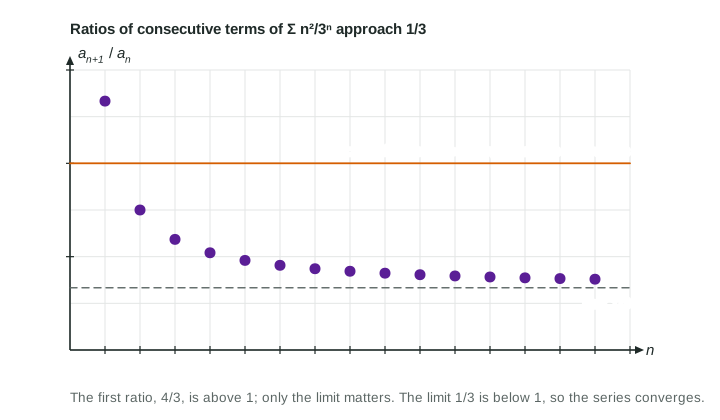
At the ratio is , so the second term is larger than the first. But as grows the ratio settles toward (the figure). Far out, each term is roughly a third of the one before, just like a geometric series with , and that series converges.
The ratio test
For a series with nonzero terms, find
| Limit | Conclusion | Why |
|---|---|---|
| the series converges | the terms shrink at least as fast as a convergent geometric series | |
| , or the limit is infinite | the series diverges | the terms grow, so they do not approach 0 |
| no conclusion | both convergent and divergent series give 1 |
The absolute value lets the test work on series whose terms change sign. Only the limit matters: any number of early ratios above or below 1 change nothing.
Simplifying the ratio
Most of the work is algebra. Write by replacing every with , then multiply by the reciprocal of . Three simplifications come up again and again:
- and
: two new factors, not one. - .
: polynomial factors contribute 1 to the limit.
Worked example 1. Does converge?
The first few ratios (, , ) are above 1, and the terms grow at first. That does not matter; the limit does.
Worked example 2. Does converge?
The limit is infinite, so the series diverges by the ratio test. (The terms themselves grow without bound, so the nth term test agrees.)
Worked example 3. What does the ratio test say about ?
No conclusion. Use limit comparison with instead: the limit of is 1, and the harmonic series diverges, so this series diverges.
When to reach for it
Use the ratio test when the terms contain factorials or exponentials such as , since those cancel cleanly in the ratio. For a -series or a ratio of polynomials the limit is always 1, so a comparison test is the right tool. Later in the unit the ratio test does its most important job: finding where a series with an in it converges.
Writing it the way graders want
Show the ratio with on top and the absolute value, simplify it, write the limit with , and compare the value with 1 in words: ", so the series converges by the ratio test." Do not say the series converges to : the limit of the ratios decides whether the series converges, not what its sum is.