The Ratio Test
The ratio test compares a series with a geometric one.
Part 1 · Hook
Why this matters
Part 2 · Before you start
What this builds on
Part 3 · Prerequisite check
Quick check before you start
1. When does the geometric series (with ) converge?
- When
- When
- When
- When
Show the answer
Each term is times the last; the sum settles when .
- Correct: When :
- When :
- When :
- When :
2. Simplify .
Show the answer
, so the quotient is .
- Correct: :
- :
- :
- :
3. Find .
Show the answer
Divide the top and bottom by : .
- Correct: :
- :
- :
- :
Part 4 · See it
See it first
Part 5 · Step by step
How it works, step by step
- Compute and its limit far out, each term is about times the one before, as in a geometric series with ratio
- the terms shrink at least as fast as a convergent geometric series, so the series converges
- (or is infinite)the terms grow, do not approach 0, and the series diverges
- the test decides nothing: use another test
Part 6 · Key ideas
Key ideas
- Ratio test:
. : converges. or infinite: diverges. : no conclusion. - Put on top and simplify before taking the limit: , .
- Use it for factorials and exponentials. For -series and ratios of polynomials the limit is 1, so compare instead.
- Only the limit matters; early ratios above or below 1 change nothing.
Part 7 · Misconception
A common mistake
The wrong idea:
What actually happens: A limit of 1 decides nothing. converges as a -series with , while , with the same limit, diverges.
Part 8 · Check yourself
Check yourself
Exam-style questions. Anything you miss goes into your review queue.
Table
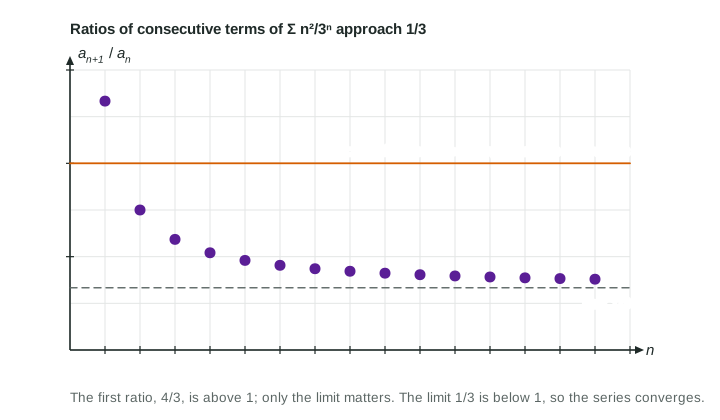
Ratios of consecutive terms of
1. Find for this series.
No calculator. Type the exact value (a fraction, π, e or a root is fine).
Show the answer
- Answer: ≈ 0.333
2. What does the ratio test conclude about ?
- It diverges, since the first ratio, , is greater than 1
- Nothing, since some of the ratios are above 1
- It converges to , the limit of the ratios
- It converges, since the limit is less than 1
Show the answer
The ratio test limit is , so the series converges. The limit says whether it converges, not what it converges to.
- It diverges, since the first ratio, , is greater than 1: Only the limit decides; one early ratio above 1 changes nothing.
- Nothing, since some of the ratios are above 1: The test uses the limit, not every ratio; the limit is below 1.
- It converges to , the limit of the ratios: The limit of the ratios decides convergence; it is not the sum.
- Correct: It converges, since the limit is less than 1: Right: a ratio test limit below 1 gives convergence.
Table
Ratios of consecutive terms of
3. What does the ratio test conclude about ?
- It converges: the first ratios are below 1
- It diverges: grows without bound
- Nothing: the ratio test limit is not a number
- It converges: is 1 at
Show the answer
- It converges: the first ratios are below 1: Only the limit decides, and the ratios grow past every bound.
- Correct: It diverges: grows without bound: Right: a limit of infinity counts as greater than 1.
- Nothing: the ratio test limit is not a number: An infinite limit is a conclusion: the series diverges.
- It converges: is 1 at : A ratio of exactly 1 at one means nothing; the limit is infinite.
4. A student notes that the ratios for to are all below 1 and concludes that the series converges. What is wrong?
- The ratio test uses the limit as , which is infinite
- Nothing: ratios below 1 mean the terms shrink, so the series converges
- The ratios should be compared with 0, not with 1
- The ratio test needs each ratio to be below
Show the answer
The ratio test looks at . Here the limit is infinite, so the series diverges. Early ratios below 1 only say the first terms shrink.
- Correct: The ratio test uses the limit as , which is infinite: Right: finitely many ratios never decide the test.
- Nothing: ratios below 1 mean the terms shrink, so the series converges: The terms shrink only until ; after that they grow without bound.
- The ratios should be compared with 0, not with 1: The threshold is 1: a limit below 1 converges, above 1 diverges.
- The ratio test needs each ratio to be below : No ratio needs to be below ; the limit decides.
5. For both and the ratio test limit is 1. What does that show?
- Both series converge, since their ratio test limits are equal
- A limit of 1 decides nothing: the two series differ
- Both series diverge, since their ratio test limits equal 1
- The ratio test was done wrong, since its limit is less than 1
Show the answer
and , yet diverges and converges. A ratio test limit of 1 decides nothing; use another test (here the -series test).
- Both series converge, since their ratio test limits are equal: diverges, so equal limits do not mean equal behavior.
- Correct: A limit of 1 decides nothing: the two series differ: Right: the two series behave differently with the same limit.
- Both series diverge, since their ratio test limits equal 1: converges (), so a limit of 1 does not mean divergence.
- The ratio test was done wrong, since its limit is less than 1: and : both limits are 1.
6. What does the ratio test conclude about ?
- It converges: the limit is
- It diverges: the limit is 2
- Nothing: the limit is 1
- It converges: is large
Show the answer
- It converges: the limit is : That inverts the ratio;
. - Correct: It diverges: the limit is 2: Right: .
- Nothing: the limit is 1: , but the factor 2 stays: the limit is 2.
- It converges: is large: eventually outgrows ; the limit 2 shows it.
Part 9 · Summary
Summary
Part 10 · Up next
What comes next
Part 11 · Connections