Unit 6 Topic 6.13

Improper Integrals

every AB topic, then series

4 min readfreeNot practiced

Every definite integral so far had finite limits and a continuous integrand on a closed interval. An improper integral breaks one of those rules: a limit of integration is infinite, as in ∫1∞1x2dx\int_1^\infty \frac{1}{x^2}\,dx, or the integrand is unbounded on the interval, as in ∫011xdx\int_0^1 \frac{1}{\sqrt{x}}\,dx. Calculus handles both the same way: integrate on a safe interval, then take a limit.

Infinite limits of integration

∫a∞f(x)dx=limb→∞∫abf(x)dx.\int_a^\infty f(x)\,dx = \lim_{b \to \infty} \int_a^b f(x)\,dx.

If the limit is a finite number, the improper integral converges to that number. If the limit is infinite or does not exist, the integral diverges. The same idea works at the other end: ∫−∞bf(x)dx\int_{-\infty}^{b} f(x)\,dx=lima→−∞∫abf(x)dx= \lim_{a \to -\infty} \int_a^b f(x)\,dx.

Worked example 1. Evaluate ∫1∞1x2dx\int_1^\infty \frac{1}{x^2}\,dx or show that it diverges.

∫1∞1x2dx\int_1^\infty \frac{1}{x^2}\,dx=limb→∞∫1bx−2dx= \lim_{b \to \infty} \int_1^b x^{-2}\,dx=limb→∞(−1x)|1b= \lim_{b \to \infty}\left(-\frac{1}{x}\right)\Big|_1^b=limb→∞(1−1b)= \lim_{b \to \infty}\left(1 - \frac{1}{b}\right)=1.= 1.

The limit is a finite number, so the integral converges to 1.

Worked example 2. Evaluate ∫1∞1xdx\int_1^\infty \frac{1}{x}\,dx or show that it diverges.

limb→∞∫1b1xdx\lim_{b \to \infty} \int_1^b \frac{1}{x}\,dx=limb→∞ln⁡b= \lim_{b \to \infty} \ln b=∞= \infty, so the integral diverges.

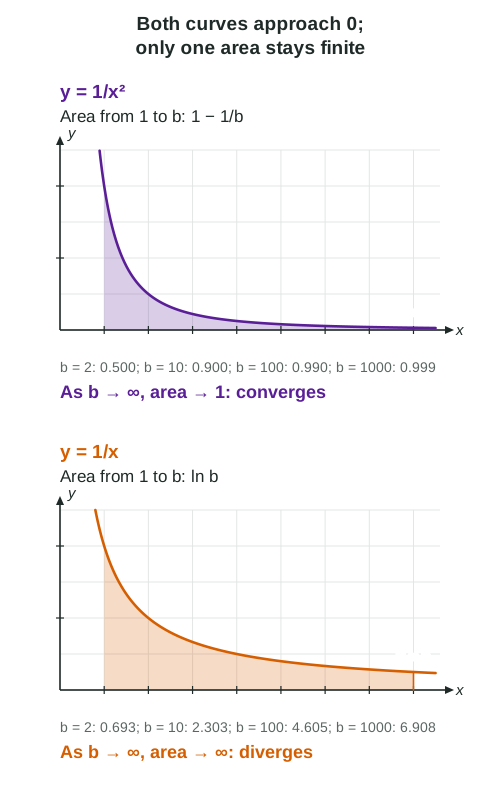
The figure puts the two side by side. Both graphs approach 0, yet one area levels off and the other grows without bound. A height that goes to 0 is not enough to make the area finite: only the limit of the integrals decides.

Two panels. Left: y = 1/x squared with the area under it from x = 1 to x = b shaded violet; that area is 1 − 1/b, which is 0.500 at b = 2, 0.900 at b = 10, 0.990 at b = 100 and 0.999 at b = 1000, so it approaches 1 and the improper integral converges. Right: y = 1/x with the area from 1 to b shaded vermillion; that area is ln b, which is 0.693, 2.303, 4.605 and 6.908 at the same values of b and grows without bound, so the improper integral diverges.
Figure 1. The area under 1/x² from 1 to b approaches 1; the area under 1/x is ln b, which grows without bound. LevlPrep original diagram.

Powers of x: the p-integrals

For p≠1p \ne 1, ∫1bx−pdx\int_1^b x^{-p}\,dx=b1−p−11−p= \frac{b^{1 - p} - 1}{1 - p}. When p>1p > 1, b1−p→0b^{1 - p} \to 0 and the integral converges to 1p−1\frac{1}{p - 1}. When p<1p < 1, b1−p→∞b^{1 - p} \to \infty and it diverges; p=1p = 1 gives ln⁡b\ln b, which also diverges.

Integral∫1b\int_1^b equalsAs b→∞b \to \infty
∫1∞x−2dx\int_1^\infty x^{-2}\,dx1−1b1 - \frac{1}{b}converges to 1
∫1∞x−3/2dx\int_1^\infty x^{-3/2}\,dx2−2b2 - \frac{2}{\sqrt{b}}converges to 2
∫1∞x−1dx\int_1^\infty x^{-1}\,dxln⁡b\ln bdiverges
∫1∞x−1/2dx\int_1^\infty x^{-1/2}\,dx2b−22\sqrt{b} - 2diverges
∫0∞e−xdx\int_0^\infty e^{-x}\,dx1−e−b1 - e^{-b} (from 0)converges to 1

Integrands that blow up

If ff is unbounded at an endpoint, put the limit at that endpoint. For an upper endpoint cc: ∫acf(x)dx\int_a^c f(x)\,dx=limb→c−∫abf(x)dx= \lim_{b \to c^-} \int_a^b f(x)\,dx.

Worked example 3. Evaluate ∫0313−xdx\int_0^3 \frac{1}{\sqrt{3 - x}}\,dx.

The integrand is unbounded as x→3−x \to 3^-. With ∫(3−x)−1/2dx\int (3 - x)^{-1/2}\,dx=−23−x= -2\sqrt{3 - x}:

limb→3−(−23−x)|0b\lim_{b \to 3^-}\left(-2\sqrt{3 - x}\right)\Big|_0^b=limb→3−(−23−b+23)= \lim_{b \to 3^-}\left(-2\sqrt{3 - b} + 2\sqrt{3}\right)=23.= 2\sqrt{3}. The integral converges.

The dangerous case is a blow-up inside the interval. ∫−111x2dx\int_{-1}^1 \frac{1}{x^2}\,dx looks like −1x|−11=−2-\frac{1}{x}\Big|_{-1}^1 = -2, a negative answer for a positive integrand. The Fundamental Theorem does not apply, because 1x2\frac{1}{x^2} is not continuous at 0. Look at the piece from 0 to 1: ∫011x2dx\int_0^1 \frac{1}{x^2}\,dx=lima→0+(1a−1)= \lim_{a \to 0^+}\left(\frac{1}{a} - 1\right)=∞= \infty, so the integral diverges. Before integrating, always check the integrand for vertical asymptotes on the interval.
Using parts and L'Hospital's rule

Worked example 4. Evaluate ∫0∞xe−xdx\int_0^\infty xe^{-x}\,dx.

Parts with u=xu = x, dv=e−xdxdv = e^{-x}\,dx: ∫xe−xdx\int xe^{-x}\,dx=−xe−x−e−x= -xe^{-x} - e^{-x}+C+ C.

limb→∞(−xe−x−e−x)|0b\lim_{b \to \infty}\left(-xe^{-x} - e^{-x}\right)\Big|_0^b=limb→∞(−beb−1eb)−(0−1).= \lim_{b \to \infty}\left(-\frac{b}{e^b} - \frac{1}{e^b}\right) - (0 - 1).

beb\frac{b}{e^b} has the form ∞∞\frac{\infty}{\infty}, so by L'Hospital's rule limb→∞beb\lim_{b \to \infty}\frac{b}{e^b}=limb→∞1eb= \lim_{b \to \infty}\frac{1}{e^b}=0= 0. The integral converges to 0−0+1=10 - 0 + 1 = 1.

Writing it so it earns the point

  • Write limb→∞\lim_{b \to \infty} in front of every expression until the step where you take the limit. Dropping it in the middle makes a false statement such as ∫1bdxx2\int_1^b \frac{dx}{x^2}=1= 1.
  • Never substitute ∞\infty: −1∞-\frac{1}{\infty} and e−∞e^{-\infty} are not numbers. Recent scoring guidelines give the point only when the notation is right all the way.
  • State the conclusion in words: "the integral converges to 1" or "the integral diverges".

Spot a mistake on this page?