Unit 6 Topic 6.14

Choosing an Antidifferentiation Technique

every AB topic, then series

4 min readfreeNot practiced

You now know every antidifferentiation technique on the BC exam: the basic rules, substitution, long division, completing the square, integration by parts and linear partial fractions. The hard part is no longer doing them; it is recognizing which one an integral wants. This page gives a reliable order of questions, then practice with the look-alikes that trip students up.

Ask the questions in order
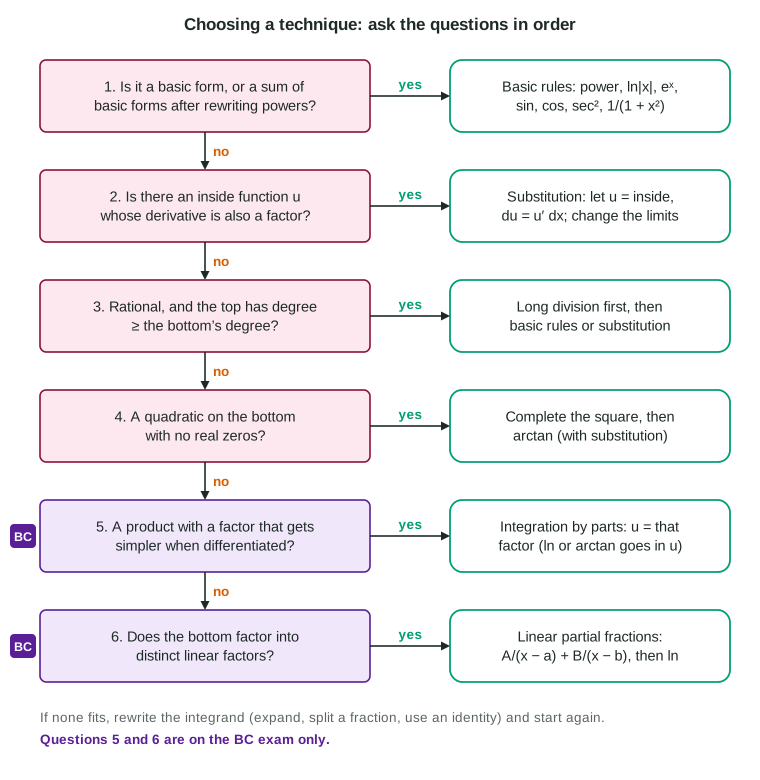
A flowchart of six questions in order, each with a yes arrow to a technique: basic form after rewriting? basic rules. Inside function whose derivative is a factor? substitution, with new limits. Rational with top degree at least bottom degree? long division first. Quadratic on the bottom with no real zeros? complete the square, then arctan. BC only: a product with a factor that gets simpler when differentiated? integration by parts. BC only: bottom with distinct linear factors? linear partial fractions. If none fits, rewrite and start again.
Figure 1. Six questions, in order: the four every course asks, then the two BC adds. Most integrals are settled by the first two. LevlPrep original diagram.
  1. Is it a basic form, or a sum of them after rewriting? Rewrite roots as powers (x+1x\frac{x + 1}{\sqrt{x}}=x1/2+x−1/2= x^{1/2} + x^{-1/2}), expand products, and split a fraction whose bottom is a single term (x3+2x=x2+2x\frac{x^3 + 2}{x} = x^2 + \frac{2}{x}).
  2. Is there an inside function whose derivative is also a factor? Then substitute: ∫xex2dx\int x e^{x^2}\,dx with u=x2u = x^2. A constant factor can be fixed; a missing variable factor cannot.
  3. Is it a fraction whose top has degree at least the bottom's? Divide first: x2+1x−1\frac{x^2 + 1}{x - 1}=x= x+1+ 1+2x−1+ \frac{2}{x - 1}.
  4. Is it a constant over a quadratic with no real zeros? Complete the square and use ∫duu2+a2\int \frac{du}{u^2 + a^2}=1aarctan⁡ua= \frac{1}{a}\arctan\frac{u}{a}+C+ C.
  5. Is it a product with one factor that gets simpler when differentiated? Use integration by parts: ∫xe2xdx\int x e^{2x}\,dx with u=xu = x, dv=e2xdxdv = e^{2x}\,dx. A logarithm or an inverse trigonometric function goes in uu.
  6. Does the bottom factor into distinct linear factors? Use linear partial fractions: 1x2−1\frac{1}{x^2 - 1}=1/2x−1−1/2x+1= \frac{1/2}{x - 1} - \frac{1/2}{x + 1}. Divide first if the top's degree is not below the bottom's.

Then check by differentiating. It takes ten seconds and catches sign errors and missing factors.

Look-alikes

Small changes in an integrand change the method completely. Compare:

IntegralMethodResult
∫1x2+1dx\int \frac{1}{x^2 + 1}\,dxbasic (arctan)arctan⁡x+C\arctan x + C
∫xx2+1dx\int \frac{x}{x^2 + 1}\,dxsubstitution, u=x2+1u = x^2 + 112ln⁡(x2+1)+C\frac{1}{2}\ln(x^2 + 1) + C
∫x2x2+1dx\int \frac{x^2}{x^2 + 1}\,dxdivisionx−arctan⁡x+Cx - \arctan x + C
∫11+4x2dx\int \frac{1}{1 + 4x^2}\,dxsubstitution, u=2xu = 2x12arctan⁡(2x)+C\frac{1}{2}\arctan(2x) + C
∫xex2dx\int x e^{x^2}\,dxsubstitution, u=x2u = x^212ex2+C\frac{1}{2}e^{x^2} + C
∫ex2dx\int e^{x^2}\,dxnone: no elementary antiderivativea calculator for definite integrals
∫xexdx\int x e^{x}\,dxintegration by parts, u=xu = x(x−1)ex+C(x - 1)e^x + C
∫1x2−1dx\int \frac{1}{x^2 - 1}\,dxlinear partial fractions12ln⁡|x−1x+1|+C\frac{1}{2}\ln\left|\frac{x - 1}{x + 1}\right| + C

Worked example 1. Find ∫xx−1dx\int x\sqrt{x - 1}\,dx.

Basic? No: a product. Inside function: x−1x - 1, with derivative 1, so u=x−1u = x - 1 and du=dxdu = dx. But an extra xx remains. Write it in terms of uu: x=u+1x = u + 1.

∫(u+1)u1/2du\int (u + 1)u^{1/2}\,du=∫(u3/2+u1/2)du= \int \left(u^{3/2} + u^{1/2}\right)du=25u5/2= \frac{2}{5}u^{5/2}+23u3/2+ \frac{2}{3}u^{3/2}+C+ C.

Back to xx: 25(x−1)5/2\frac{2}{5}(x - 1)^{5/2}+23(x−1)3/2+ \frac{2}{3}(x - 1)^{3/2}+C+ C. Every xx must be replaced, including the one outside the root.

Worked example 2. Find ∫1e1+ln⁡xxdx\int_1^e \frac{1 + \ln x}{x}\,dx.

The factor 1x\frac{1}{x} is the derivative of ln⁡x\ln x, so let u=1+ln⁡xu = 1 + \ln x, du=1xdxdu = \frac{1}{x}dx.

Limits: x=1→u=1x = 1 \to u = 1; x=e→u=2x = e \to u = 2.

∫12udu\int_1^2 u\,du=u22|12= \frac{u^2}{2}\Big|_1^2=2−12= 2 - \frac{1}{2}=32= \frac{3}{2}.

Reading someone else's work

The exam sometimes shows work and asks you to find the error. Check each line against its rule: Is dudu right? Does the constant factor match? Were the limits changed? Is the antiderivative right (differentiate it)? In ∫016xx2+1dx\int_0^1 \frac{6x}{x^2 + 1}\,dx, writing 3∫01duu3\int_0^1 \frac{du}{u} keeps the xx-limits; the correct line is 3∫12duu3\int_1^2 \frac{du}{u}=3ln⁡2= 3\ln 2.

Try substitution and rewriting before integration by parts or partial fractions: they are quicker when they work. An infinite limit of integration, or an integrand that blows up on the interval, makes the integral improper (6.13): write it as a limit before integrating.

Spot a mistake on this page?