Substitution undoes the chain rule. Integration by parts undoes the product rule, and it handles integrals that substitution cannot: , , . It is a BC-only topic, and it often appears on the free-response section as one part of a question that mixes techniques.
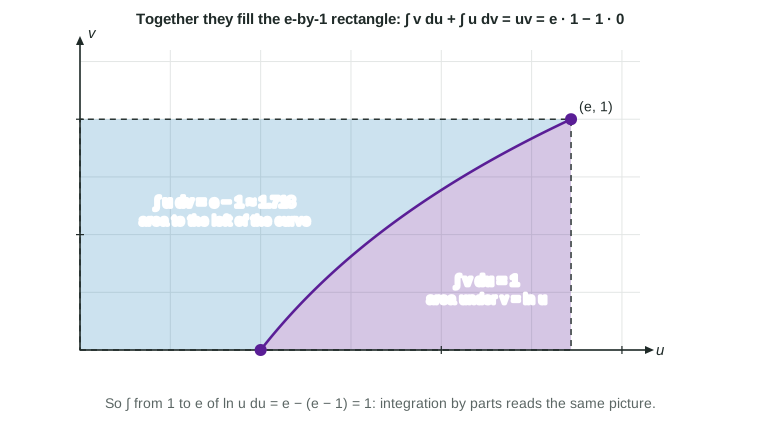
The formula trades one integral, , for another, . It helps only when the new integral is easier. The figure shows the trade as two areas that together fill a rectangle of area .
Figure 1. The two integrals are two areas; together they make the rectangle uv. LevlPrep original diagram.
Choosing u and dv
Split the integrand into (to be differentiated) and (to be integrated, and it must include ). Two tests decide the split: should get simpler when you differentiate it, and you must be able to integrate .
Integral
Why
becomes 1
becomes 1
becomes
becomes
A useful rule of thumb: logarithms and inverse trigonometric functions go in ; exponentials, sines and cosines go in ; a power of goes in unless a logarithm or an inverse trigonometric function is present.
Worked example 1. Find .
Label the parts: , , so and .
Apply the formula: .
Check: .
Writing , , and before applying the formula is the habit the scoring guidelines reward. Most lost points come from a wrong (a sign slip on ) or from multiplying two antiderivatives, which is never right.
Definite integrals: uv has bounds too
Worked example 2. Evaluate .
, , so and .
Writing with no bounds on the first term mixes a function with a number; the answer must be a number.
Repeated parts and the tabular method
For , one round of parts leaves , which needs a second round. The tabular method does every round at once. List and its derivatives down to 0 in one column, and its repeated antiderivatives in the other, and multiply along the diagonals with signs
Worked example 3. Find .
Left column: , , , . Right column: , , , .
Diagonals: , so
The table works only when the column reaches 0, so it suits a power of times , or .
When the original integral comes back
For , two rounds of parts give . Do not go around a third time. Treat the integral as an unknown : , so .
Parts with functions given by tables
Parts also works when is known only through values. With and , . You need , and the value of , which a question gives or lets you find.