Unit 6 Topic 6.12

Linear Partial Fractions

every AB topic, then series

4 min readfreeNot practiced

Adding fractions is easy: 2x−1−1x+3\frac{2}{x - 1} - \frac{1}{x + 3}=2(x+3)−(x−1)(x−1)(x+3)= \frac{2(x + 3) - (x - 1)}{(x - 1)(x + 3)}=x+7(x−1)(x+3)= \frac{x + 7}{(x - 1)(x + 3)}. The method of partial fractions runs that addition backward. It turns a rational function whose denominator factors into a sum of simple fractions, each of which integrates to a natural log. The BC course uses denominators with distinct linear factors, such as (x−1)(x+3)(x - 1)(x + 3).

Splitting a fraction

For a fraction p(x)(x−a)(x−b)\frac{p(x)}{(x - a)(x - b)} with a≠ba \ne b and the top of degree below 2, write

p(x)(x−a)(x−b)=Ax−a+Bx−b.\frac{p(x)}{(x - a)(x - b)} = \frac{A}{x - a} + \frac{B}{x - b}.

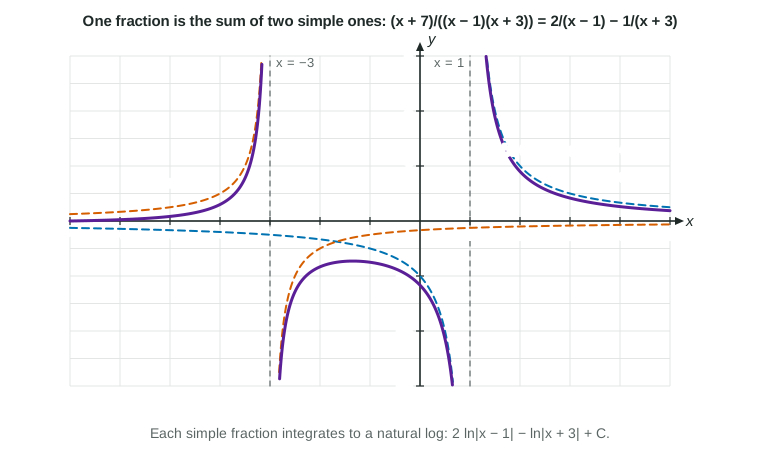
Multiply both sides by (x−a)(x−b)(x - a)(x - b): p(x)p(x)=A(x−b)+B(x−a)= A(x - b) + B(x - a). This is an identity, true for every xx, so you may substitute any value. Substituting x=ax = a removes the BB term and gives AA; substituting x=bx = b removes the AA term and gives BB. The figure shows a fraction and its two pieces.

Graph of y = (x + 7)/((x − 1)(x + 3)), solid violet, with dashed vertical asymptotes at x = 1 and x = −3, and its two pieces dashed: y = 2/(x − 1) in blue and y = −1/(x + 3) in vermillion. At every x the violet curve is the sum of the two pieces, so its integral is 2 ln|x − 1| − ln|x + 3| + C.
Figure 1. The violet curve is the sum of the two dashed pieces at every x. LevlPrep original diagram.

Worked example 1. Find ∫x+7(x−1)(x+3)dx\int \frac{x + 7}{(x - 1)(x + 3)}\,dx.

Form: x+7(x−1)(x+3)\frac{x + 7}{(x - 1)(x + 3)}=Ax−1= \frac{A}{x - 1}+Bx+3+ \frac{B}{x + 3}, so x+7x + 7=A(x+3)+B(x−1)= A(x + 3) + B(x - 1).

At x=1x = 1: 8=4A8 = 4A, so A=2A = 2. At x=−3x = -3: 4=−4B4 = -4B, so B=−1B = -1.

Check by adding back: 2x−1−1x+3\frac{2}{x - 1} - \frac{1}{x + 3}=2x+6−x+1(x−1)(x+3)= \frac{2x + 6 - x + 1}{(x - 1)(x + 3)}=x+7(x−1)(x+3)= \frac{x + 7}{(x - 1)(x + 3)}.

Integrate: ∫(2x−1−1x+3)dx\int \left(\frac{2}{x - 1} - \frac{1}{x + 3}\right)dx=2ln⁡|x−1|−ln⁡|x= 2\ln|x - 1| - \ln|x+3|+ 3|+C+ C.

A second way to find AA and BB is to match coefficients: x+7x + 7=(A+B)x+(3A−B)= (A + B)x + (3A - B), so A+B=1A + B = 1 and 3A−B=73A - B = 7. Substituting the zeros is usually faster.

Definite integrals

Worked example 2. Evaluate ∫012x2+4x+3dx\int_0^1 \frac{2}{x^2 + 4x + 3}\,dx.

Factor: x2+4x+3x^2 + 4x + 3=(x+1)(x+3)= (x + 1)(x + 3). Then 2=A(x+3)+B(x+1)2 = A(x + 3) + B(x + 1): x=−1x = -1 gives A=1A = 1; x=−3x = -3 gives B=−1B = -1.

∫01(1x+1−1x+3)dx\int_0^1 \left(\frac{1}{x + 1} - \frac{1}{x + 3}\right)dx=(ln⁡(x+1)−ln⁡(x+3))|01= \left(\ln(x + 1) - \ln(x + 3)\right)\Big|_0^1=(ln⁡2−ln⁡4)−(ln⁡1−ln⁡3)= (\ln 2 - \ln 4) - (\ln 1 - \ln 3)=ln⁡32.= \ln\frac{3}{2}.

The value at the lower bound is −ln⁡3-\ln 3, not 0; dropping it is the most common slip. Log rules tidy the answer: ln⁡2−ln⁡4+ln⁡3\ln 2 - \ln 4 + \ln 3=ln⁡2⋅34= \ln\frac{2 \cdot 3}{4}.

When the top is too big: divide first

Partial fractions need the top's degree to be below the bottom's. If it is not, use long division (6.10) first and split only the remainder.

Worked example 3. Find ∫x2+xx2−4dx\int \frac{x^2 + x}{x^2 - 4}\,dx.

Divide: x2+xx2−4\frac{x^2 + x}{x^2 - 4}=1= 1+x+4x2−4+ \frac{x + 4}{x^2 - 4}.

Split: x+4x + 4=A(x+2)+B(x−2)= A(x + 2) + B(x - 2); x=2x = 2 gives A=32A = \frac{3}{2}, x=−2x = -2 gives B=−12B = -\frac{1}{2}.

Integrate: xx+32ln⁡|x−2|−12ln⁡|x+ \frac{3}{2}\ln|x - 2| - \frac{1}{2}\ln|x+2|+ 2|+C+ C.

Which method?

Rational integrands look alike. Ask in order: is the top the derivative of the bottom (substitution)? Is the top's degree too big (divide)? Does the bottom factor into distinct linear factors (partial fractions)? Does it have no real zeros (complete the square, arctan)?

IntegralMethodResult
∫2xx2−1dx\int \frac{2x}{x^2 - 1}\,dxsubstitution, u=x2−1u = x^2 - 1ln⁡|x2−1|+C\ln|x^2 - 1| + C
∫1x2−1dx\int \frac{1}{x^2 - 1}\,dxpartial fractions12ln⁡|x−1x+1|+C\frac{1}{2}\ln\left|\frac{x - 1}{x + 1}\right| + C
∫1x2+1dx\int \frac{1}{x^2 + 1}\,dxbasic formarctan⁡x+C\arctan x + C
∫x2+3x2−1dx\int \frac{x^2 + 3}{x^2 - 1}\,dxdivide, then partial fractionsx+2ln⁡|x−1x+1|+Cx + 2\ln\left|\frac{x - 1}{x + 1}\right| + C

Always check a decomposition by adding the pieces back over the common denominator. It takes a few seconds and catches a wrong sign on BB, the slip that most often costs the answer.

A repeated factor such as (x−1)2(x - 1)^2 or a factor with no real zeros such as x2+1x^2 + 1 needs a longer form of the method. Those cases are outside the BC course.
Spot a mistake on this page?