Unit 6 · Topic 6.12
Linear Partial Fractions
When a denominator factors into distinct linear factors, split the fraction into A/(x − a) + B/(x − b) .
Practice 1: Implementing Mathematical ProcessesPractice 2: Connecting Representations
Part 1 · Hook
Why this matters
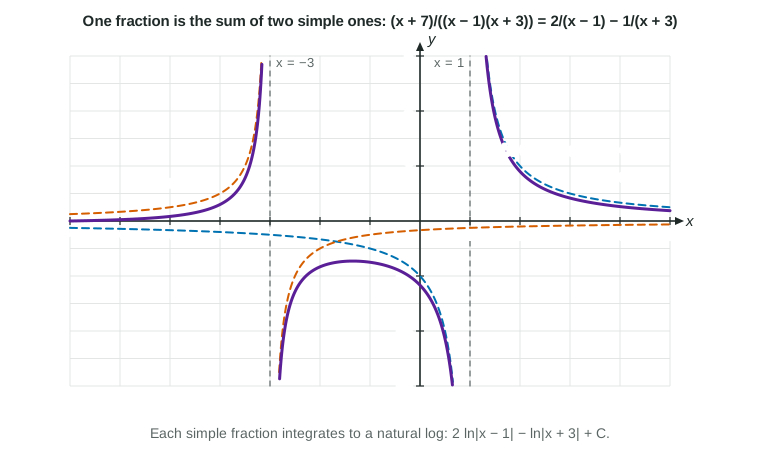
Adding
gives
, a fraction no basic rule can integrate. Running the addition backward splits it into two pieces that each integrate to a
natural log. That backward step is the method of
partial fractions.
Part 2 · Before you start
What this builds on
Part 3 · Prerequisite check
Quick check before you start
1.
Show the answer
Two numbers with product and sum : and .
- Correct: :
- :
- :
- :
2.
Show the answer
, with .
- Correct: :
- :
- :
- :
Part 5 · Step by step
How it works, step by step
- The denominator factors into distinct linear factors →the fraction can be written as
- Multiply both sides by →a polynomial identity that holds for every
- Substitute , then →one term vanishes each time, giving and then
- Each piece has the form →it integrates to
- The top's degree is at least the bottom's→do long division first, then split the remainder
Part 6 · Key ideas
Key ideas
- Factor the denominator into distinct linear factors; write one fraction per factor.
- Clear the denominator and substitute each zero to find the constants. Check by adding the pieces back.
- ; combine logs only when it helps.
- Top degree at least the bottom's: divide first. Top equal to the derivative of the bottom: substitute instead.
Part 7 · Misconception
A common mistake
The wrong idea: : the log of the denominator.
What actually happens: The log of the denominator is right only when the top is the derivative of the bottom ( here). Split first: , so the integral is .
Part 8 · Check yourself
Check yourself
Exam-style questions. Anything you miss goes into your review queue.
Table
Splitting
A student integrates
by linear partial fractions. The table shows the plan.
Steps for the partial fraction decomposition| Step | What the student writes |
|---|
| 1. Choose the form | |
|---|
| 2. Clear the denominator | |
|---|
| 3. Substitute the zeros | , then |
|---|
| 4. Integrate each piece | |
|---|
1. Why does step 3 substitute and ?
- They are the values where equals zero
- They are the special inputs where the identity in step 2 holds
- They make the original fraction equal to zero
- Each value makes one term of zero, leaving one unknown
Show the answer
The identity holds for every . Choosing the zeros of the factors makes one term disappear each time.
- They are the values where equals zero: at . The useful values are the zeros of the denominator's factors, which knock out one term each.
- They are the special inputs where the identity in step 2 holds: Step 2 holds for every (it is an identity), which is why any may be substituted. These two are just the most convenient.
- They make the original fraction equal to zero: At and the original fraction is undefined. Step 2 has no denominator, so those inputs are fine there.
- Correct: Each value makes one term of zero, leaving one unknown: Right: at the term vanishes (); at the term vanishes ().
2. Find the value of .
No calculator. Type the exact value (a fraction, π, e or a root is fine).
Show the answer
At : , so .
3. Find the value of .
No calculator. Type the exact value (a fraction, π, e or a root is fine).
Show the answer
At : , so .
4. Find . Include .
Type an expression for .
Show the answer
.
- Answer:
5. Which integral needs long division before linear partial fractions?
Show the answer
Partial fractions need the top's degree below the bottom's. When it is not, long division (6.10) comes first.
- : A constant top has degree 0, below the bottom's 2: split directly.
- : The top is the derivative of the bottom, so substitution gives with no division at all.
- Correct: : Right: the top and bottom have the same degree, so divide first: .
- : The top has degree 1, below the bottom's 2, so partial fractions apply at once.
6.
Show the answer
: gives , gives .
- Correct: : Right: , and a difference of logs is the log of a quotient.
- : That would need the top to be the derivative of the bottom, . The top is 1, so split the fraction.
- : The quotient is upside down: goes with , so is on top.
- : The pieces carry : at , .
Part 9 · Summary
Summary
When a denominator factors into distinct linear factors, split the fraction into
. Clear the denominator, substitute the zeros to find
and
, and integrate each piece to a natural log. Divide first if the top's degree is not below the bottom's.
Part 10 · Up next
What comes next
Part 11 · Connections
Connections