Unit 6 · Topic 6.13

Improper Integrals

An improper integral has an infinite limit of integration or an integrand that is unbounded on the interval.

Practice 1: Implementing Mathematical ProcessesPractice 3: JustificationPractice 4: Communication and Notation

Part 1 · Hook

Why this matters

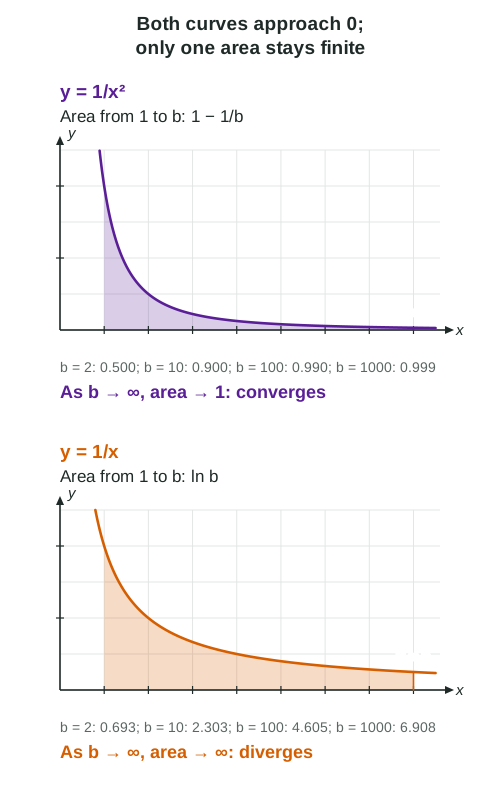
The graph of y=1x2y = \frac{1}{x^2} runs to the right forever, yet the region under it from x=1x = 1 on has area exactly 1. The graph of y=1xy = \frac{1}{x} looks almost the same, but the region under it has no finite area at all. An improper integral is how calculus decides which is which: as a limit.

Part 2 · Before you start

What this builds on

Part 3 · Prerequisite check

Quick check before you start

1. limb→∞(1−1b)\lim_{b \to \infty}\left(1 - \frac{1}{b}\right)==

  1. 1
  2. 0
  3. ∞\infty
  4. It does not exist
Show the answer

1b→0\frac{1}{b} \to 0 as bb grows.

  • Correct: 1:
  • 0:
  • ∞\infty:
  • It does not exist:

2. ∫1b1x2dx\int_1^b \frac{1}{x^2}\,dx==

  1. 1−1b1 - \frac{1}{b}
  2. 1b−1\frac{1}{b} - 1
  3. 1b3\frac{1}{b^3}
  4. ln⁡b\ln b
Show the answer

−1x|1b=−1b+1-\frac{1}{x}\Big|_1^b = -\frac{1}{b} + 1.

  • Correct: 1−1b1 - \frac{1}{b}:
  • 1b−1\frac{1}{b} - 1:
  • 1b3\frac{1}{b^3}:
  • ln⁡b\ln b:

Part 4 · See it

See it first

Two panels. Left: y = 1/x squared with the area under it from x = 1 to x = b shaded violet; that area is 1 − 1/b, which is 0.500 at b = 2, 0.900 at b = 10, 0.990 at b = 100 and 0.999 at b = 1000, so it approaches 1 and the improper integral converges. Right: y = 1/x with the area from 1 to b shaded vermillion; that area is ln b, which is 0.693, 2.303, 4.605 and 6.908 at the same values of b and grows without bound, so the improper integral diverges.
Both curves approach 0, but the area under 1/x² from 1 to b levels off at 1 while the area under 1/x, ln b, keeps growing. The limit of the area decides convergence, not the height of the curve. LevlPrep original diagram.

Part 5 · Step by step

How it works, step by step

  1. A limit of integration is infinite, or the integrand is unbounded on the intervalthe integral is improper: it is not a definite integral in the old sense
  2. Replace the troublesome end by a variable, bban ordinary definite integral, ∫1bf(x)dx\int_1^b f(x)\,dx
  3. Take the limit as bb approaches the troublesome endif the limit is a finite number, the integral converges to it; otherwise it diverges
  4. The integrand is unbounded at a point inside the intervalwrite it as two integrals that meet there, each one improper

Part 6 · Key ideas

Key ideas

  • ∫a∞f(x)dx\int_a^\infty f(x)\,dx=limb→∞∫abf(x)dx= \lim_{b \to \infty} \int_a^b f(x)\,dx. It converges if this limit is a finite number and diverges otherwise.
  • Unbounded integrand at an end: ∫01f(x)dx\int_0^1 f(x)\,dx=lima→0+∫a1f(x)dx= \lim_{a \to 0^+} \int_a^1 f(x)\,dx. At an interior point, write it as two integrals that meet there.
  • ∫1∞1xpdx\int_1^\infty \frac{1}{x^p}\,dx converges (to 1p−1\frac{1}{p - 1}) when p>1p > 1 and diverges when p≤1p \le 1.
  • Keep lim\lim in every line until you take it; never substitute ∞\infty as a number.

Part 7 · Misconception

A common mistake

The wrong idea: 1x\frac{1}{x} approaches 0 as x→∞x \to \infty, so ∫1∞1xdx\int_1^\infty \frac{1}{x}\,dx converges.

What actually happens: An integrand approaching 0 does not decide anything. ∫1b1xdx\int_1^b \frac{1}{x}\,dx=ln⁡b= \ln b, which grows without bound, so the integral diverges. Only the limit of the integrals decides.

Part 8 · Check yourself

Check yourself

Exam-style questions. Anything you miss goes into your review queue.

Graph

The graph of f(x)=6(x+2)2f(x) = \frac{6}{(x + 2)^2} for x≥0x \ge 0

Let f(x)=6(x+2)2f(x) = \frac{6}{(x + 2)^2}. The region RR lies under the graph of ff, above the xx-axis, and to the right of the yy-axis; it goes on to the right without end.
01234567891000.511.5xyf

1. Which expression gives the area of RR, written correctly?

  1. limb→∞6(b+2)2\lim_{b \to \infty} \frac{6}{(b + 2)^2}
  2. −6∞+2+62-\frac{6}{\infty + 2} + \frac{6}{2}
  3. limb→0+∫b106(x+2)2dx\lim_{b \to 0^+} \int_b^{10} \frac{6}{(x + 2)^2}\,dx
  4. limb→∞∫0b6(x+2)2dx\lim_{b \to \infty} \int_0^b \frac{6}{(x + 2)^2}\,dx
Show the answer

Area of RR=∫0∞6(x+2)2dx= \int_0^\infty \frac{6}{(x + 2)^2}\,dx, which means limb→∞∫0b6(x+2)2dx\lim_{b \to \infty} \int_0^b \frac{6}{(x + 2)^2}\,dx.

  • limb→∞6(b+2)2\lim_{b \to \infty} \frac{6}{(b + 2)^2}: That is the limit of the height of the graph, which is 0. The area is a limit of integrals, not of ff.
  • −6∞+2+62-\frac{6}{\infty + 2} + \frac{6}{2}: ∞\infty is not a number to substitute. Arithmetic with ∞\infty earns no credit; write the limit.
  • limb→0+∫b106(x+2)2dx\lim_{b \to 0^+} \int_b^{10} \frac{6}{(x + 2)^2}\,dx: The region is unbounded on the right, not at 0, and it does not stop at 10. The upper bound must go to ∞\infty.
  • Correct: limb→∞∫0b6(x+2)2dx\lim_{b \to \infty} \int_0^b \frac{6}{(x + 2)^2}\,dx: Right: an infinite limit of integration means a limit of definite integrals on [0,b][0, b] as bb grows.

2. Find the area of RR.

No calculator. Type the exact value (a fraction, π, e or a root is fine).

Show the answer

limb→∞∫0b6(x+2)2dx\lim_{b \to \infty} \int_0^b \frac{6}{(x + 2)^2}\,dx=limb→∞(−6x+2)|0b= \lim_{b \to \infty}\left(-\frac{6}{x + 2}\right)\Big|_0^b=limb→∞(3−6b+2)= \lim_{b \to \infty}\left(3 - \frac{6}{b + 2}\right)=3= 3.

  • Answer: 3

3. Find the value of ∫1∞f(x)dx\int_1^\infty f(x)\,dx.

No calculator. Type the exact value (a fraction, π, e or a root is fine).

Show the answer

limb→∞(−6x+2)|1b\lim_{b \to \infty}\left(-\frac{6}{x + 2}\right)\Big|_1^b=limb→∞(2−6b+2)= \lim_{b \to \infty}\left(2 - \frac{6}{b + 2}\right)=2= 2.

  • Answer: 2

4. A student says: "f(x)f(x) approaches 0 as xx grows, so the area of RR has to be finite." Which response is correct?

  1. Not enough: 1x\frac{1}{x} also approaches 0, yet ∫1∞dxx\int_1^\infty \frac{dx}{x} diverges
  2. The reason is enough: a graph that approaches 0 encloses a finite area
  3. The conclusion is wrong: a region that goes on without end has infinite area
  4. The reason is enough, and it holds because ff is also decreasing everywhere
Show the answer

Convergence is decided by the limit of ∫0bf(x)dx\int_0^b f(x)\,dx, not by the limit of f(x)f(x). Here that limit is 3, so the integral converges, but for 1x\frac{1}{x} the same reasoning would fail.

  • Correct: Not enough: 1x\frac{1}{x} also approaches 0, yet ∫1∞dxx\int_1^\infty \frac{dx}{x} diverges: Right: heights going to 0 do not settle it. The area of RR is finite because the limit of the integrals, 3, exists.
  • The reason is enough: a graph that approaches 0 encloses a finite area: y=1xy = \frac{1}{x} approaches 0, but its area from 1 to bb is ln⁡b\ln b, which grows without bound.
  • The conclusion is wrong: a region that goes on without end has infinite area: This region goes on without end and still has area 3. An unbounded region can have finite area.
  • The reason is enough, and it holds because ff is also decreasing everywhere: 1x\frac{1}{x} is decreasing too, and its improper integral diverges. Decreasing toward 0 does not settle it.

5. A student writes ∫−111x2dx\int_{-1}^{1} \frac{1}{x^2}\,dx=−1x|−11= -\frac{1}{x}\Big|_{-1}^{1}=−2= -2. What is the correct conclusion?

  1. The integral diverges: 1x2\frac{1}{x^2} is unbounded at x=0x = 0, and ∫011x2dx\int_0^1 \frac{1}{x^2}\,dx diverges
  2. The value −2-2 is right, by the Fundamental Theorem of Calculus
  3. The value is 22: the sign was lost
  4. The value is 0, by symmetry about the yy-axis
Show the answer

An integrand unbounded inside the interval makes the integral improper: ∫−11\int_{-1}^{1}=∫−10= \int_{-1}^{0}+∫01+ \int_0^{1}, and lima→0+∫a1x−2dx\lim_{a \to 0^+} \int_a^1 x^{-2}\,dx=lima→0+(1a−1)= \lim_{a \to 0^+}\left(\frac{1}{a} - 1\right)=∞= \infty.

  • Correct: The integral diverges: 1x2\frac{1}{x^2} is unbounded at x=0x = 0, and ∫011x2dx\int_0^1 \frac{1}{x^2}\,dx diverges: Right: the piece on [0,1][0, 1] is lima→0+(−1+1a)\lim_{a \to 0^+}\left(-1 + \frac{1}{a}\right)=∞= \infty, so the whole integral diverges.
  • The value −2-2 is right, by the Fundamental Theorem of Calculus: The Fundamental Theorem needs 1x2\frac{1}{x^2} continuous on [−1,1][-1, 1], and it is not continuous at 0. A positive integrand cannot give −2-2.
  • The value is 22: the sign was lost: No finite value is right. The integrand blows up at 0, inside the interval.
  • The value is 0, by symmetry about the yy-axis: 1x2\frac{1}{x^2} is even and positive; symmetry doubles the area, and each half diverges.

6. Which line evaluates ∫1∞1x2dx\int_1^\infty \frac{1}{x^2}\,dx with notation that earns full credit?

  1. ∫1∞dxx2\int_1^\infty \frac{dx}{x^2}=−1x|1∞= -\frac{1}{x}\Big|_1^\infty=−1∞= -\frac{1}{\infty}+1+ 1=1= 1
  2. limb→∞∫1bdxx2\lim_{b \to \infty} \int_1^b \frac{dx}{x^2}=(−1x)|1b= \left(-\frac{1}{x}\right)\Big|_1^b=1−1b= 1 - \frac{1}{b}=1= 1
  3. ∫1∞dxx2\int_1^\infty \frac{dx}{x^2}=1−0= 1 - 0=1= 1 since the curve approaches 0
  4. limb→∞∫1bdxx2\lim_{b \to \infty} \int_1^b \frac{dx}{x^2}=limb→∞(1−1b)= \lim_{b \to \infty}\left(1 - \frac{1}{b}\right)=1= 1
Show the answer

Write the limit, carry it through each step, and take it at the end. Dropping it mid-line or writing 1∞\frac{1}{\infty} loses the point even when the number is right.

  • ∫1∞dxx2\int_1^\infty \frac{dx}{x^2}=−1x|1∞= -\frac{1}{x}\Big|_1^\infty=−1∞= -\frac{1}{\infty}+1+ 1=1= 1: ∞\infty is substituted as if it were a number. That is arithmetic with infinity, which the scoring guidelines do not accept.
  • limb→∞∫1bdxx2\lim_{b \to \infty} \int_1^b \frac{dx}{x^2}=(−1x)|1b= \left(-\frac{1}{x}\right)\Big|_1^b=1−1b= 1 - \frac{1}{b}=1= 1: The limit was dropped in the middle: 1−1b1 - \frac{1}{b} does not equal 1. Keep limb→∞\lim_{b \to \infty} until you take it.
  • ∫1∞dxx2\int_1^\infty \frac{dx}{x^2}=1−0= 1 - 0=1= 1 since the curve approaches 0: No limit of integrals is shown, and the reason given (the curve approaches 0) does not decide convergence.
  • Correct: limb→∞∫1bdxx2\lim_{b \to \infty} \int_1^b \frac{dx}{x^2}=limb→∞(1−1b)= \lim_{b \to \infty}\left(1 - \frac{1}{b}\right)=1= 1: Right: the limit is written in every expression until it is taken.

Part 9 · Summary

Summary

An improper integral has an infinite limit of integration or an integrand that is unbounded on the interval. Replace the bad end by a variable, integrate, and take the limit: a finite limit means the integral converges to that value; otherwise it diverges. Write the limit in every line, and break the interval at any interior point where the integrand blows up.

Part 10 · Up next

What comes next

Part 11 · Connections

Connections