Absolute and Conditional Convergence
Every series is absolutely convergent ( ∑ |a_n| converges), conditionally convergent ( ∑ a_n converges but ∑ |a_n| diverges), or divergent.
Part 1 · Hook
Why this matters
Part 2 · Before you start
What this builds on
Part 3 · Prerequisite check
Quick check before you start
1. Does converge?
- Yes, by the alternating series test
- No, since diverges
- No, by the nth term test
- Yes, by the ratio test
Show the answer
The sizes decrease and approach 0, and the signs alternate.
- Correct: Yes, by the alternating series test:
- No, since diverges:
- No, by the nth term test:
- Yes, by the ratio test:
2. For which does converge?
Show the answer
A -series converges exactly when .
- Correct: :
- :
- :
- :
Part 4 · See it
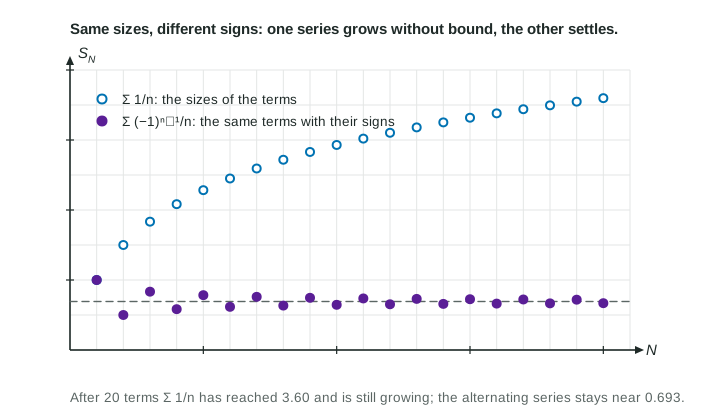
See it first
Part 5 · Step by step
How it works, step by step
- Take the absolute value of every term is a series of positive terms, which the comparison, integral and ratio tests can decide
- converges converges too (absolutely): signs can only cancel, never add
- diverges but convergesthe convergence comes from the signs cancelling: conditional convergence
- converges absolutelyits terms can be rearranged in any order without changing the sum
Part 6 · Key ideas
Key ideas
- Absolutely convergent: converges. Conditionally convergent: converges but diverges.
- Absolute convergence implies convergence.
- To classify: test first. If it converges, you are done (absolute). If not, test itself, usually with the alternating series test.
- A divergent alone decides nothing about .
Part 7 · Misconception
A common mistake
The wrong idea: diverges, so diverges too.
What actually happens: A divergent series of absolute values only rules out absolute convergence. The signed series converges by the alternating series test, so it converges conditionally.
Part 8 · Check yourself
Check yourself
Exam-style questions. Anything you miss goes into your review queue.
Table
Four series with alternating signs
| Series | Terms | Starts at |
|---|---|---|
| I | ||
| II | ||
| III | ||
| IV |
1. How does series I, , behave?
- It converges conditionally: it alternates and
- It converges absolutely: converges
- It diverges: shrinks too slowly
- It converges absolutely: its terms alternate in sign
Show the answer
is a -series with , so it converges. The series converges absolutely (and so it converges).
- It converges conditionally: it alternates and : Conditional means diverges, but converges.
- Correct: It converges absolutely: converges: Right: the series of absolute values is a -series with .
- It diverges: shrinks too slowly: shrinks fast enough: .
- It converges absolutely: its terms alternate in sign: Alternating signs do not make convergence absolute; the absolute values must form a convergent series.
2. How does series II, , behave?
- It converges absolutely
- It diverges, since diverges
- It converges conditionally
- It diverges by the nth term test
Show the answer
The signs alternate and decreases to 0, so the series converges by the alternating series test. But diverges (). It converges conditionally.
- It converges absolutely: is a -series with , which diverges.
- It diverges, since diverges: The series of absolute values diverging does not make the signed series diverge.
- Correct: It converges conditionally: Right: it converges by the alternating series test, but diverges.
- It diverges by the nth term test: , so the nth term test says nothing.
3. How does series III, , behave?
- It converges conditionally, by the alternating series test
- It converges absolutely, since
- It converges conditionally, since diverges
- It diverges: its terms do not approach 0
Show the answer
, so the terms swing near and do not approach 0. The series diverges by the nth term test.
- It converges conditionally, by the alternating series test: The sizes approach 1, not 0, so that test does not apply.
- It converges absolutely, since : diverges; each term near 1 adds about 1.
- It converges conditionally, since diverges: A divergent series of absolute values is half the story; the series itself must converge, and it does not.
- Correct: It diverges: its terms do not approach 0: Right: the sizes approach 1.
Table
A series and its absolute values
| Series | Written out |
|---|---|
4. How should be classified?
- Conditionally convergent
- Absolutely convergent
- Divergent
- Both absolutely and conditionally convergent
Show the answer
The series converges (alternating series test) and diverges (limit comparison with ), so it is conditionally convergent.
- Correct: Conditionally convergent: Right: it converges, but its absolute values do not.
- Absolutely convergent: diverges, so the convergence is not absolute.
- Divergent: The alternating series test shows it converges.
- Both absolutely and conditionally convergent: The two labels exclude each other: absolute means converges, conditional means it diverges.
5. The signs of follow no regular pattern. What can you conclude about ?
- It converges by the alternating series test
- Nothing, since the signs are irregular
- It diverges, since does not approach 0
- It converges absolutely, since
Show the answer
and converges, so converges by direct comparison. The series converges absolutely, so it converges.
- It converges by the alternating series test: The signs do not alternate in a regular pattern, so the test does not apply.
- Nothing, since the signs are irregular: Absolute convergence handles any pattern of signs.
- It diverges, since does not approach 0: The term is , which does approach 0.
- Correct: It converges absolutely, since : Right: compare the absolute values with a convergent -series.
6. You know that diverges. What can you conclude about ?
- It diverges
- Nothing yet: it may converge conditionally or diverge
- It converges conditionally
- It converges absolutely
Show the answer
A divergent rules out absolute convergence and nothing more. converges and diverges, though both have divergent absolute values.
- It diverges: The alternating harmonic series converges though diverges.
- Correct: Nothing yet: it may converge conditionally or diverge: Right: both happen, so test itself.
- It converges conditionally: has divergent and itself diverges.
- It converges absolutely: Absolute convergence needs to converge.
Part 9 · Summary
Summary
Part 10 · Up next
What comes next
Part 11 · Connections