The Alternating Series Error Bound
For a series that alternates with sizes decreasing to 0, the sum lies within a_(n + 1) , the first omitted term, of S_n : |S − S_n| ≤ a_(n + 1) .
Part 1 · Hook
Why this matters
Part 2 · Before you start
What this builds on
Part 3 · Prerequisite check
Quick check before you start
1. Which conditions does the alternating series test need for with ?
- The decrease and approach 0
- The approach 0
- The decrease
- converges
Show the answer
Both: decreasing sizes that approach 0.
- Correct: The decrease and approach 0:
- The approach 0:
- The decrease:
- converges:
2. What is for ?
Show the answer
The third partial sum is the sum of the first three terms.
- Correct: :
- :
- :
- :
Part 4 · See it
See it first
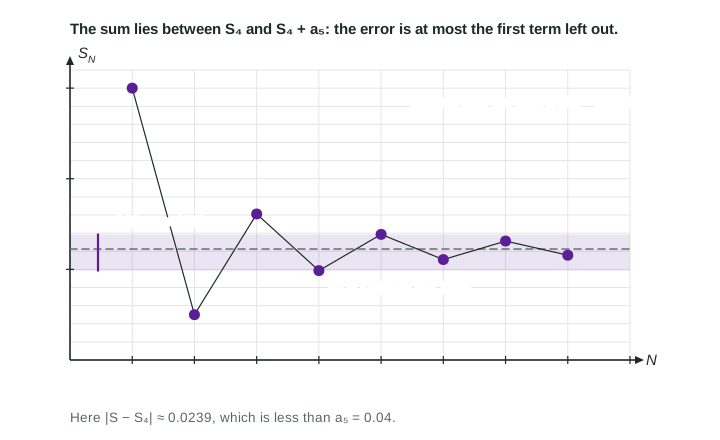
Part 5 · Step by step
How it works, step by step
- The partial sums of an alternating series zigzag around the sum with shrinking stepsthe sum always lies between two consecutive partial sums, and
- and differ by the next term, in sizethe distance from to the sum is at most :
- The sign of the first omitted termtells the direction: if it is negative, overestimates the sum; if positive, it underestimates
Part 6 · Key ideas
Key ideas
- If a series alternates and its sizes decrease to 0, then : the error is at most the first term left out.
- State the conditions every time; the bound means nothing without them.
- Write the result as an inequality: "error ". The error is at most the bound, not equal to it.
- The sign of the first omitted term says whether is too big or too small.
Part 7 · Misconception
A common mistake
The wrong idea: The error of is at most , the last term added.
What actually happens: The bound is the first term left out, . The last term added is already part of .
Part 8 · Check yourself
Check yourself
Exam-style questions. Anything you miss goes into your review queue.
Table
The terms of an alternating series
1. Find , the sum of the first three terms.
No calculator. Type the exact value (a fraction, π, e or a root is fine).
Show the answer
- Answer: ≈ 0.417
2. Use the alternating series error bound to find a number with .
No calculator. Type the exact value (a fraction, π, e or a root is fine).
Show the answer
The series alternates and its sizes decrease to 0, so the alternating series error bound applies: .
- Answer: ≈ 0.016
3. Is an overestimate or an underestimate of ?
- An underestimate: the terms keep getting smaller in size
- An underestimate: ends with a positive term,
- Neither: equals to two decimal places
- An overestimate: the next term, , is negative
Show the answer
The partial sums zigzag around , and the next step, , goes down. So : is an overestimate. (Indeed and .)
- An underestimate: the terms keep getting smaller in size: Shrinking terms do not decide the direction; the sign of the next term does.
- An underestimate: ends with a positive term, : Ending with a positive term means overshot; the sum is below it.
- Neither: equals to two decimal places: lies strictly between and , so overshoots it.
- Correct: An overestimate: the next term, , is negative: Right: the next step would go down, so is below .
4. Which statement correctly justifies that is within 0.01 of ?
- , which is less than 0.01
- The series alternates with sizes decreasing to 0, so
- The terms approach 0, so is close to
- , since is the fourth term
Show the answer
The alternating series error bound applies because the series alternates and decreases to 0. It gives
- , which is less than 0.01: The bound gives "at most", not "equals"; the actual error is smaller than .
- Correct: The series alternates with sizes decreasing to 0, so : Right: conditions, the bound, and the comparison with 0.01.
- The terms approach 0, so is close to : Terms approaching 0 do not give a size; the bound with its conditions does.
- , since is the fourth term: The fourth term is used in ; the bound is the first term left out, .
5. A student says the error in for is at most , the first term left out. What is wrong?
- The first term left out is , not
- The bound should be , the next two terms
- Nothing: the argument is correct as written
- The series does not alternate, so this bound does not apply
Show the answer
The alternating series error bound needs alternating signs. Here every omitted term is positive, so the error is , which is more than (about ).
- The first term left out is , not : uses to , so the first omitted term is .
- The bound should be , the next two terms: Adding two terms is still too small: the error is the sum of the whole tail.
- Nothing: the argument is correct as written: The bound needs alternating signs; here every omitted term is positive.
- Correct: The series does not alternate, so this bound does not apply: Right: with positive terms the error is the whole positive tail, larger than one term.
6. The first omitted term of an alternating series is , and the alternating series error bound applies. Which sentence is correct?
- The error is exactly
- The error is at most
- The error is at least
- The error is about
Show the answer
The alternating series error bound says : the error is at most . Saying it "equals" loses the point.
- The error is exactly : The actual error is less than or equal to the bound, usually less.
- Correct: The error is at most : Right: the bound is a maximum.
- The error is at least : The bound is an upper limit, not a lower one.
- The error is about : The bound does not estimate the error; it caps it.
Part 9 · Summary
Summary
Part 10 · Up next
What comes next
Part 11 · Connections