A series with mixed signs can converge for two quite different reasons. Its terms may be small enough that the series would converge even with every sign made positive. Or the series may converge only because positive and negative terms keep cancelling. The words for these two cases are absolute and conditional convergence.
Two series built from the same sizes
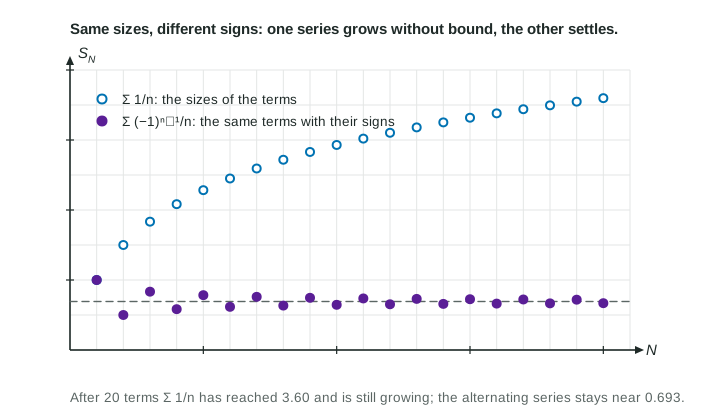
The terms of and have the same sizes. The figure shows what the signs do: the harmonic series keeps climbing (it diverges), while the alternating harmonic series zigzags in on about (it converges). Its convergence depends on the signs. Compare : here even converges, so this series would converge whatever its signs were.
The definitions
| Classification | Meaning | Example |
|---|---|---|
| absolutely convergent | converges | |
| conditionally convergent | converges, but diverges | |
| divergent | diverges |
Every series falls into exactly one of the three rows.
Absolute convergence implies convergence
If converges, then converges. Signs can only make terms cancel; they can never make the total larger in size than the sum of the absolute values. This gives a way to handle series whose signs follow no pattern at all. For , the signs of are irregular, so the alternating series test does not apply. But , so converges by direct comparison with a -series (), and the series converges absolutely.
How to classify a series
- If the terms do not approach 0, the series diverges by the nth term test. Stop.
- Test , a series of positive terms, with a comparison, the integral test, a -series or the ratio test. If it converges, the series converges absolutely. Stop.
- If diverges, test itself, usually with the alternating series test. If it converges, the convergence is conditional.
Worked example 1. Classify .
Absolute values: . Limit comparison with :
The series itself: it alternates, decreases, and
Conclusion: the series converges conditionally.
Worked example 2. Classify .
Ratio test on the absolute values:
converges, so the series converges absolutely.
The ratio test, with its absolute value, always speaks about : a limit below 1 means absolute convergence.
Why the difference matters: rearranging terms
For a finite sum, the order of the terms never matters. For an infinite series it can. If a series converges absolutely, you may rearrange its terms in any order and the sum stays the same. A conditionally convergent series has no such guarantee.
Writing it the way graders want
A classification needs two pieces of evidence: what does, with its test named, and what does, with its test named. "Converges conditionally because diverges" is only half; add "and the series converges by the alternating series test, since decreases to 0."