In Unit 4 the tangent line gave a quick estimate of a function near a point: it matched the function's value and slope there. A Taylor polynomial carries that idea further. It matches the value, the slope, the concavity and as many higher derivatives as you like, and the more it matches, the better it follows the function.
From the tangent line to a parabola
Near , the tangent line to is : right value, right slope, but flat, while bends downward. To copy the bending, add a squared term chosen so that the second derivatives agree. The second derivative of is , so we need , that is . For at 0, , which gives
The same reasoning works for every degree: the th derivative of is , so the coefficient that matches is .
The Taylor polynomial
The Taylor polynomial of degree for about is
The number is the center. and have the same value and the same first derivatives at . A Taylor polynomial about is also called a Maclaurin polynomial.
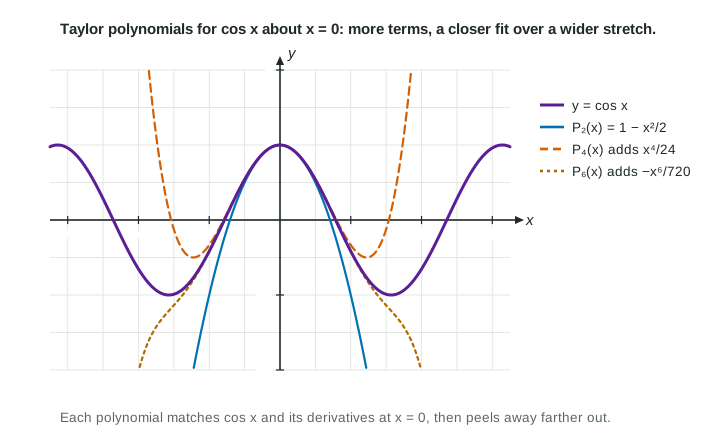
The figure shows , and for . All three agree with at the center; each extra term keeps the polynomial close for a wider stretch before it peels away.
Building one step by step
Worked example 1. Find the third-degree Taylor polynomial for about , and use it to estimate .
| coefficient | |||
|---|---|---|---|
So
Organizing the work in a table, derivative, value at the center, coefficient, keeps the factorials and the center straight.
Reading a Taylor polynomial backward
A Taylor polynomial stores derivatives: the coefficient of times is .
Worked example 2. The third-degree Taylor polynomial for about is
(there is no term). . .
Since and , has a relative maximum at by the second derivative test.
Slips that cost points
| Slip | Fix |
|---|---|
| Powers of when the center is | Use powers of , and derivatives at . |
| A coefficient of | Divide by : the coefficient is . |
| Derivatives of or without the chain rule | Each derivative brings out the inside factor: . |
| Writing "" after the last term | A polynomial ends. "" makes it an endless sum. |
| Writing | Keep the function and its value at the center apart. |
A Taylor polynomial gives an estimate, not an exact value. How far off it can be is the subject of the next topic.