Most series cannot be summed exactly, and many are neither geometric nor -series. The comparison tests let you borrow the answer from a series you already know: set the new series beside a geometric series or a -series and read its behavior from the comparison.
Why positive terms make comparison work
When every term is positive, each partial sum is larger than the one before. An increasing list of numbers can do only two things: level off at a limit, or grow past every bound. So a positive series converges exactly when its partial sums stay under some ceiling. A comparison gives you that ceiling, or shows there is none.
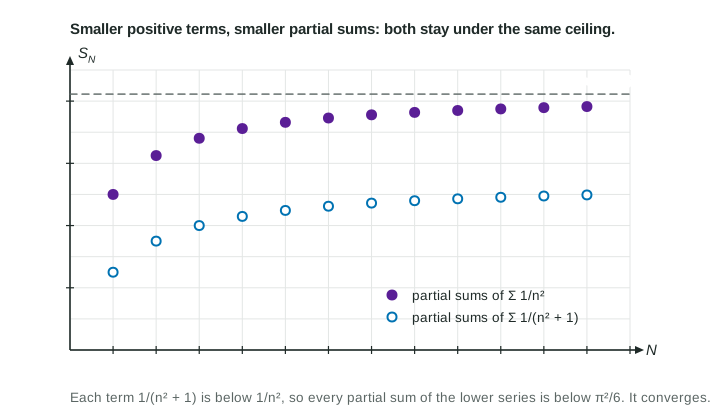
The figure shows the idea with and . Each term is below , so each partial sum of the first series is below the matching partial sum of the second, and those level off below .
The direct comparison test
Suppose for every (or for every past some point).
- If converges, then converges. Smaller than convergent: converges.
- If diverges, then diverges. Larger than divergent: diverges.
The other two cases prove nothing. A series smaller than a divergent one may converge () or diverge (). A series larger than a convergent one may do either too.
Worked example 1. Does converge?
The terms are positive. Since , the fractions satisfy for every .
is geometric with ratio , and , so it converges.
By the direct comparison test, converges.
Worked example 2. Does converge?
For every ,
The harmonic series diverges, and our terms are larger, so diverges by the direct comparison test.
The limit comparison test
Often the obvious comparison points the wrong way. The terms of (from ) are a little larger than , so a direct comparison with a convergent series says nothing. Yet for large the two terms are almost equal. The limit comparison test turns "almost equal" into a proof.
Suppose and , and
Worked example 3. Does converge?
Choose by keeping the highest power on top and bottom: , so use .
The limit is finite and positive, and converges because it is a -series with . By the limit comparison test, the series converges.
Choosing the series to compare with
| Term looks like | Compare with | Known behavior |
|---|---|---|
| a ratio of polynomials in | with = (bottom degree) (top degree) | converges if |
| roots, such as | : diverges | |
| exponentials, such as | geometric, : converges | |
| a bounded factor, such as | , using | converges |
Writing it the way graders want
Name the comparison series and say why its behavior is known: "geometric with " or "a -series with ". Do not call a series harmonic unless it is . For direct comparison, state the inequality and that the terms are positive. For limit comparison, write the limit in , compute it, and say it is finite and positive. Finally, say what the series does: "the series converges", not "the terms converge", since the terms approach 0 for every series that converges and for many that do not.
Both tests are for series with positive terms. A series whose terms change sign needs a different test, which comes next.