Comparison Tests
For a series with positive terms, compare it with a known geometric series or p -series.
Part 1 · Hook
Why this matters
Part 2 · Before you start
What this builds on
Part 3 · Prerequisite check
Quick check before you start
1. Does converge?
- Yes: it is a -series with
- No: its terms approach 0 too slowly
- No: it is the harmonic series
- Yes: it is geometric with ratio
Show the answer
A -series converges exactly when .
- Correct: Yes: it is a -series with :
- No: its terms approach 0 too slowly:
- No: it is the harmonic series:
- Yes: it is geometric with ratio :
2. Does converge?
- Yes: it is geometric with
- No: its ratio is positive
- No: its terms are all positive
- Yes: it is a -series with
Show the answer
A geometric series converges when ; here its sum is .
- Correct: Yes: it is geometric with :
- No: its ratio is positive:
- No: its terms are all positive:
- Yes: it is a -series with :
3. Find .
- The limit is infinite
Show the answer
Divide the top and bottom by : .
- Correct: :
- :
- :
- The limit is infinite:
Part 4 · See it
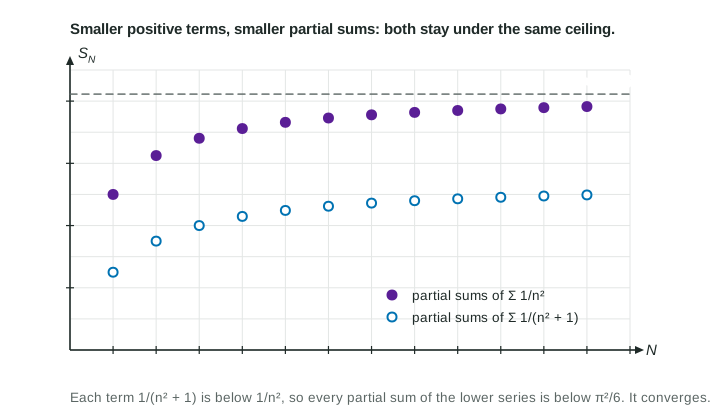
See it first
Part 5 · Step by step
How it works, step by step
- Every term of is positiveits partial sums only increase, so they converge exactly when they stay below some ceiling
- for every and convergeseach partial sum of is below the sum of , so converges (direct comparison)
- and divergesthe partial sums of grow past every bound, so diverges
with for large , is about , so the two series converge together or diverge together (limit comparison)
Part 6 · Key ideas
Key ideas
- Compare positive terms with a series whose behavior is known and named: geometric with its ratio, or a -series with its .
- Direct comparison needs the inequality in the useful direction: smaller than convergent, or larger than divergent. Larger than convergent, or smaller than divergent, proves nothing.
- Choose by keeping the highest powers on top and bottom; use limit comparison when the inequality points the wrong way.
- Write the limit in : , and say it is finite and positive.
Part 7 · Misconception
A common mistake
The wrong idea: and the harmonic series diverges, so diverges.
What actually happens: Being smaller than a divergent series proves nothing. Compare with instead: and , so the series converges.
Part 8 · Check yourself
Check yourself
Exam-style questions. Anything you miss goes into your review queue.
Table
Two series with positive terms
1. Which inequality do the table's values suggest, and why does it hold for every ?
- , because
- , because
- , because decreases faster
- once is large
Show the answer
For every , , so : each is smaller than the matching .
- , because : A bigger denominator gives a smaller fraction, so the inequality points the other way.
- Correct: , because : Right: a bigger denominator makes a smaller fraction.
- , because decreases faster: How fast the terms shrink is not the reason; compare the denominators term by term.
- once is large: The two are close for large but differ by the in the denominator for every .
2. What does the direct comparison test conclude about ?
- It diverges, since and is geometric
- Nothing, since is not geometric
- It converges, since approaches 0
- It converges, since and converges
Show the answer
The terms are positive and for every ; is geometric with , so it converges, and by the direct comparison test so does .
- It diverges, since and is geometric: Being smaller than a convergent series is the case that gives convergence.
- Nothing, since is not geometric: The test does not need to be geometric; only the comparison series needs a known behavior.
- It converges, since approaches 0: Terms approaching 0 do not prove convergence (the harmonic series has them); the comparison does.
- Correct: It converges, since and converges: Right: smaller positive terms than a convergent series.
Table
A limit comparison, step by step
3. Why is a good series to compare with ?
- Keeping the constant terms gives after cancelling
- Keeping the highest powers gives
- Both terms are equal at
- is smaller than for large , as the test needs
Show the answer
For large the numerator behaves like and the denominator like , so behaves like .
- Keeping the constant terms gives after cancelling: The constants matter least for large ; the highest powers dominate.
- Correct: Keeping the highest powers gives : Right: the dominant terms decide how the terms behave for large .
- Both terms are equal at : At , and : they are not equal, and one value decides nothing.
- is smaller than for large , as the test needs: A limit comparison needs no inequality; the choice comes from the dominant powers.
4. What does the limit comparison test conclude about ?
- It diverges: the limit is 1, which is not less than 1 as the test needs
- Nothing: the ratio is 0.5 at , so the two series differ
- It converges: the terms approach 0 and the ratios approach 1
- It converges, like the -series
Show the answer
Both series have positive terms and
- It diverges: the limit is 1, which is not less than 1 as the test needs: The limit comparison test does not compare the limit with 1; any finite positive limit links the two series.
- Nothing: the ratio is 0.5 at , so the two series differ: Only the limit as matters, not early values.
- It converges: the terms approach 0 and the ratios approach 1: Terms approaching 0 are not enough; the comparison with is the reason.
- Correct: It converges, like the -series : Right: a finite positive limit means both series do the same thing.
5. A student writes: " and the harmonic series diverges, so diverges by the direct comparison test." What is wrong?
- The series converges, because its terms are smaller than those of the harmonic series
- The inequality is false: , so the comparison is reversed
- Nothing: the argument is correct, since both series have positive terms
- Smaller than a divergent series proves nothing
Show the answer
To show divergence by direct comparison, the terms must be at least as large as those of a divergent series. Here they are smaller, so no conclusion follows. The limit comparison with works:
- The series converges, because its terms are smaller than those of the harmonic series: The series does diverge (its limit comparison with gives 1); only the reason is wrong.
- The inequality is false: , so the comparison is reversed: The inequality is true; the problem is which way it points.
- Nothing: the argument is correct, since both series have positive terms: A divergent series that is larger shows nothing about a smaller one.
- Correct: Smaller than a divergent series proves nothing: Right: the inequality points the wrong way for divergence.
6. Which argument shows that converges?
- Limit comparison with : the limit is 1 and converges
- Direct comparison with , since for each
- Direct comparison with , since
- Limit comparison with : the limit is 0 and diverges
Show the answer
The terms are larger than , so a direct comparison goes the wrong way. With limit comparison,
- Correct: Limit comparison with : the limit is 1 and converges: Right: the limit is 1.
- Direct comparison with , since for each : The inequality is backwards: makes the larger term.
- Direct comparison with , since : Smaller than a divergent series proves nothing.
- Limit comparison with : the limit is 0 and diverges: The limit comparison test needs a finite positive limit; 0 is not one.
Part 9 · Summary
Summary
Part 10 · Up next
What comes next
Part 11 · Connections