Unit 10 Topic 10.2

Geometric Series

every AB topic, then series

3 min readfreeNot practiced

A geometric series is a series in which each term is the previous one times a fixed number rr, the common ratio:

∑n=0∞arn=a+ar+ar2+ar3+⋯\sum_{n=0}^{\infty} ar^n = a + ar + ar^2 + ar^3 + \cdots

It is the one kind of series where the partial sums have a simple formula, which is why it is the first one to master. Later topics compare other series with geometric ones, and in 10.14 this very series returns as the series for 11−x\frac{1}{1 - x}.

The partial sums

Write the nnth partial sum and multiply it by rr:

Sn=a+ar+⋯+arn−1,rSn=ar+ar2+⋯+arn.S_n = a + ar + \cdots + ar^{n-1}, \qquad rS_n = ar + ar^2 + \cdots + ar^n.

Subtract: almost everything cancels, leaving Sn−rSn=a−arnS_n - rS_n = a - ar^n. So, for r≠1r \ne 1,

Sn=a(1−rn)1−r.S_n = \frac{a(1 - r^n)}{1 - r}.

When it converges, and to what

Everything depends on rnr^n as n→∞n \to \infty:

  • If |r|<1|r| < 1, rn→0r^n \to 0, so Sn→a1−rS_n \to \frac{a}{1 - r}. The series converges, and its sum is a1−r\frac{a}{1 - r}.
  • If |r|>1|r| > 1, |rn||r^n| grows without bound and so do the partial sums: the series diverges.
  • If r=1r = 1, the series is a+a+a+⋯a + a + a + \cdots, with Sn=naS_n = na: it diverges (for a≠0a \ne 0). If r=−1r = -1, the partial sums jump between aa and 00: it diverges.
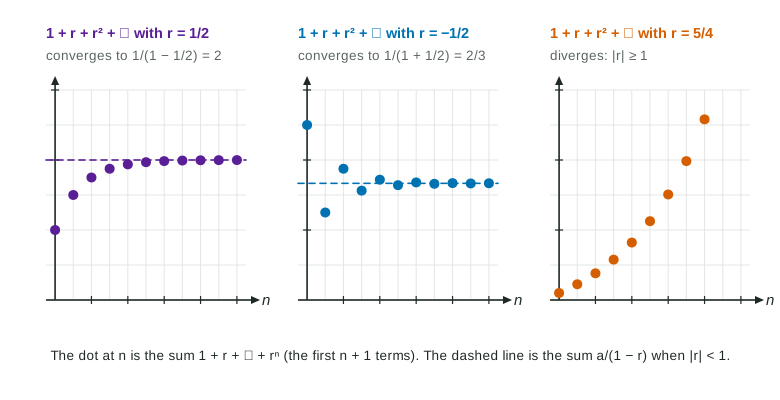
Partial sums 1 + r + ... + r to the n (the first n + 1 terms) for n = 0 to 10, one dot each, for three ratios. Left, r = 1/2: the partial sums 1, 1.5, 1.75, ... rise toward the dashed line at 2, the sum 1/(1 − 1/2). Middle, r = −1/2: the partial sums 1, 0.5, 0.75, 0.625, ... zigzag in toward 2/3, the sum 1/(1 + 1/2). Right, r = 5/4: the partial sums grow without bound, so the series diverges.
Figure 1. Partial sums of 1+r+r2+⋯1 + r + r^2 + \cdots for three ratios. LevlPrep original diagram.

The figure shows the three behaviors. With a negative ratio the partial sums zigzag, overshooting and undershooting, but still close in on a1−r\frac{a}{1 - r}.

So, in one line: ∑arn\sum ar^n converges if and only if |r|<1|r| < 1, and then its sum is first term1−r\frac{\text{first term}}{1 - r}.

The first term is the first term in the sum

The 2025 exam readers saw many geometric sums with the wrong first term. In a1−r\frac{a}{1 - r}, aa is the first term that is actually in the sum, whatever the starting index.

Worked example 1. Find ∑n=2∞3n4n+1\sum_{n=2}^{\infty} \frac{3^{n}}{4^{n+1}}.

Rewrite the term to see the ratio: 3n4n+1\frac{3^n}{4^{n+1}}=14(34)n= \frac{1}{4}\left(\frac{3}{4}\right)^n, so r=34r = \frac{3}{4} and |r|<1|r| < 1: the series converges.

First term, at n=2n = 2: 14⋅916=964\frac{1}{4} \cdot \frac{9}{16} = \frac{9}{64}.

Sum: 9/641−3/4\frac{9/64}{1 - 3/4}=964⋅4= \frac{9}{64} \cdot 4=916= \frac{9}{16}.

To find rr, divide any term by the one before it, or rewrite the general term as (constant)×\times(something)n^n. Negative signs that alternate belong in rr: 12−8+163−⋯12 - 8 + \frac{16}{3} - \cdots has r=−23r = -\frac{2}{3}, and its sum is 121+2/3=365\frac{12}{1 + 2/3} = \frac{36}{5}.

A ratio that contains xx

Worked example 2. For which xx does ∑n=0∞(x2)n\sum_{n=0}^{\infty} \left(\frac{x}{2}\right)^n converge, and to what?

It is geometric with a=1a = 1 and r=x2r = \frac{x}{2}. It converges when |x2|<1\left|\frac{x}{2}\right| < 1, that is −2<x<2-2 < x < 2.

At x=2x = 2 and x=−2x = -2, |r|=1|r| = 1 and the series diverges, so neither end is included: the set is (−2,2)(-2, 2).

For those xx, the sum is 11−x/2=22−x\frac{1}{1 - x/2} = \frac{2}{2 - x}.

So the series defines a function of xx, but only on an interval. This idea grows into the series of functions in 10.13 through 10.15.

Geometric series in context

SituationSeriesSum
0.2727…0.2727\ldots as a fraction27100+271002+⋯\frac{27}{100} + \frac{27}{100^2} + \cdots27/1001−1/100\frac{27/100}{1 - 1/100}=311= \frac{3}{11}
a ball dropped from 10 ft, rising to 34\frac{3}{4} of each fall10+2(7.5+5.625+⋯)10 + 2(7.5 + 5.625 + \cdots)10+2⋅7.51/4=7010 + 2 \cdot \frac{7.5}{1/4} = 70 ft
a drug dose of 50 mg each day, 20% left from each earlier dose50+50(0.2)+50(0.2)2+⋯50 + 50(0.2) + 50(0.2)^2 + \cdotslong-run level 500.8=62.5\frac{50}{0.8} = 62.5 mg

Spot a mistake on this page?