Unit 10 · Topic 10.2
Geometric Series
A geometric series ∑ ar^n has a constant ratio r between terms.
Practice 1: Implementing Mathematical ProcessesPractice 3: Justification
Part 1 · Hook
Why this matters
Cut a square in half, then cut one half in half, and keep going: the pieces
fill the whole square, exactly 1. Each piece is the one before times the same number.
Series built this way,
geometric series, are the one family where you can always write the sum, and they return in every later topic of the unit.
Part 2 · Before you start
What this builds on
Part 3 · Prerequisite check
Quick check before you start
1. A series has partial sums . Its sum is
- It has no sum
Show the answer
The sum is .
- Correct: :
- :
- :
- It has no sum:
2.
Show the answer
A number between and raised to larger and larger powers shrinks to 0.
- Correct: :
- :
- :
- :
Part 5 · Step by step
How it works, step by step
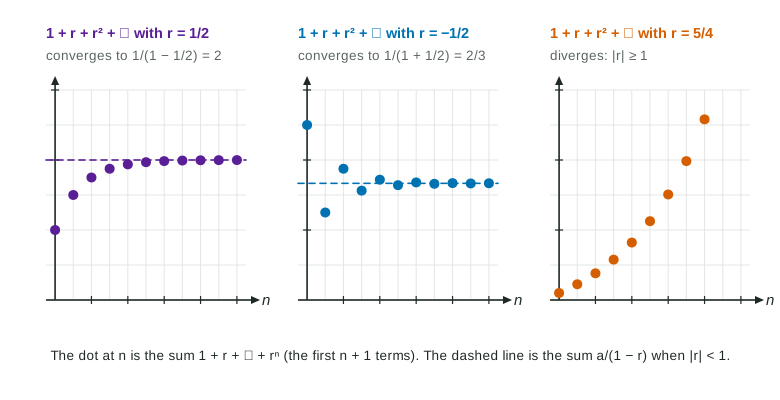
- Each term is the previous one times →
- If , then →: the series converges
- If , the terms do not shrink to 0→the partial sums have no limit: the series diverges
- The sum starts at a later index→ is the first term actually in the sum, not the value at
Part 6 · Key ideas
Key ideas
- when ; it diverges when (and ).
- In the formula, is the first term of the sum as written: has , not 5.
- Find by dividing a term by the one before it; rewrite as to see and .
- With in the ratio, the series converges for the where , and its sum is a function of .
Part 7 · Misconception
A common mistake
The wrong idea: .
What actually happens: The first term in the sum is at : . The sum is .
Part 8 · Check yourself
Check yourself
Exam-style questions. Anything you miss goes into your review queue.
Table
The first terms of a geometric series
The terms of a geometric series , starting at | | | | |
|---|
| | | | |
|---|
1. Find the common ratio .
No calculator. Type the exact value (a fraction, π, e or a root is fine).
Show the answer
Divide any term by the one before it: , and .
- Answer: ≈ -0.667
2. Find .
No calculator. Type the exact value (a fraction, π, e or a root is fine).
Show the answer
.
- Answer: ≈ 7.200
3. Find .
No calculator. Type the exact value (a fraction, π, e or a root is fine).
Show the answer
Starting at , the first term is and the ratio is still : . Check: .
- Answer: ≈ 3.200
Table
A geometric series with in the ratio
The first terms of | | | | |
|---|
| Term | | | | |
|---|
4. Give all for which the series converges, as an interval.
Type the interval, in interval notation such as [1, 5) or as an inequality such as 1 ≤ x < 5.
Show the answer
The series converges when , that is , or . At both ends , and the series diverges, so the interval is .
5. For , write the sum of the series as an expression in .
Type an expression for .
Show the answer
.
- Answer:
6. Find .
No calculator. Type the exact value (a fraction, π, e or a root is fine).
Show the answer
The first term is at : . Sum: .
- Answer: ≈ 1.667
Part 9 · Summary
Summary
A geometric series
has a constant ratio
between terms. It converges exactly when
, to
, where the first term is the first one actually in the sum. If
it diverges.
Part 10 · Up next
What comes next
Part 11 · Connections
Connections