The integral test settles one whole family of series at once. These -series, together with the geometric series of 10.2, are the reference series of Unit 10: the tests in 10.6 work by measuring other series against them.
For , is positive, continuous and decreasing on , so the integral test applies:
: , and , so the integral is : finite. The series converges.
: . The series diverges.
: . The series diverges.
: the terms do not approach 0, so the series diverges by the nth term test.
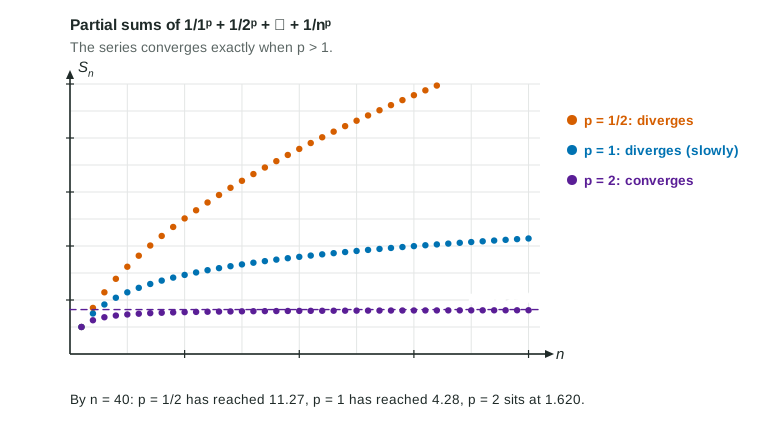
Figure 1. Partial sums for three values of . LevlPrep original diagram.
The harmonic series
The -series with is the harmonic series, It is the most important divergent series in the course, because its terms approach 0. The boxes of the integral test show , which grows without bound. The growth is slow: in the figure the blue dots reach only about 4.3 after 40 terms, and it takes 12,367 terms to pass 10. Slow growth is still growth: the partial sums pass every number.
Change every other sign and the result is the alternating harmonic series, , which converges (its sum is ). The proof comes in 10.7. Keep the two apart: same sizes of terms, opposite behavior.
Recognizing a -series
Rewrite with exponent rules until the term is , then compare with 1:
Series
Rewritten
Result
diverges
converges
converges
diverges (harmonic)
converges
A constant factor does not change convergence. Neither does the starting index: converges because does.
Worked example. For which does converge?
Rewrite: , a -series with .
It converges when , that is : for every positive . At it would be the harmonic series, which diverges.
Combining reference series
The rules from 10.1 let you build on these results. A sum of two convergent series converges; a convergent series plus a divergent one diverges.
Worked example 2. Does converge?
First part: , a -series with , converges.
Second part: is geometric with , , so it converges.
The sum of two convergent series converges, so the whole series converges. Replace the first part by and the answer flips: a divergent part plus a convergent part diverges.
Saying it right
Name the series and its : " is a -series with , so it converges." Exam readers took points from answers that called a series "harmonic" when it was not, or gave the result with no value of . And as with the integral test, the test gives convergence, not the sum: is a separate fact, not something the test produces.