Harmonic Series and p-Series
A p -series ∑ 1/(n^p) converges exactly when p > 1 ; the integral test proves it.
Part 1 · Hook
Why this matters
Part 2 · Before you start
What this builds on
Part 3 · Prerequisite check
Quick check before you start
1. If is positive, continuous and decreasing and diverges, then
- diverges
- converges
- converges to the integral
- may do either
Show the answer
By the integral test, the series and the integral behave alike.
- Correct: diverges:
- converges:
- converges to the integral:
- may do either:
2.
Show the answer
, which grows without bound.
- Correct: :
- :
- :
- :
Part 4 · See it
See it first
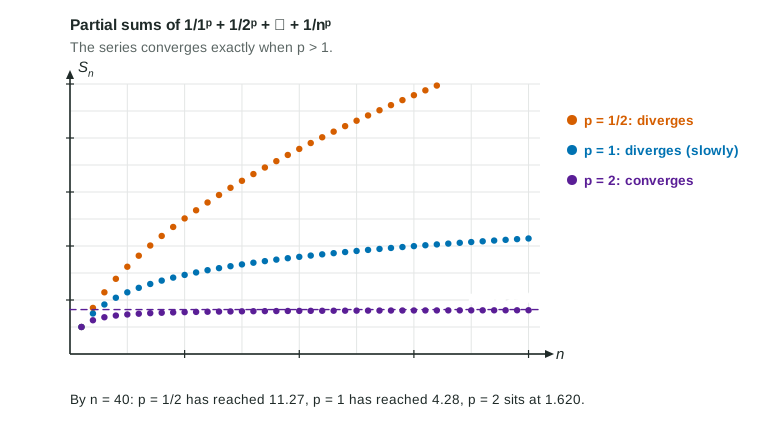
Part 5 · Step by step
How it works, step by step
- Apply the integral test to , is positive, continuous and decreasing on
- For ,
is finite the -series converges - For ,
; for , the -series diverges - For , the terms do not approach 0the series diverges by the nth term test
Part 6 · Key ideas
Key ideas
- converges if and diverges if .
- The harmonic series () diverges, though its terms approach 0. The alternating harmonic series converges.
- Rewrite before deciding: , , . Name the series and its when you use it.
Part 7 · Misconception
A common mistake
The wrong idea: converges because its terms get smaller and smaller.
What actually happens: The harmonic series diverges: its partial sums pass every number, though very slowly (). Shrinking terms are not enough.
Part 8 · Check yourself
Check yourself
Exam-style questions. Anything you miss goes into your review queue.
Table
Five series of powers of
| Name | Series |
|---|---|
| I | |
| II | |
| III | |
| IV | |
| V |
1. Which of the series I, II, III and IV converge?
- I, II and IV
- I, III and IV
- IV alone
- I and IV
Show the answer
A -series converges exactly when . I: . II: . III: , . IV: . So I and IV converge.
- I, II and IV: Series II has , which is not greater than 1.
- I, III and IV: Series III simplifies to : , the harmonic series, which diverges.
- IV alone: Series I has , so it converges too.
- Correct: I and IV: Right: and are both greater than 1.
2. What is series III, and does it converge?
- A -series with ; it converges
- A -series with ; it diverges
- The harmonic series ; it diverges
- The harmonic series ; it converges
Show the answer
: the harmonic series, the -series with , which diverges.
- A -series with ; it converges: Simplify first: the powers subtract, .
- A -series with ; it diverges: is not : subtract the exponents, .
- Correct: The harmonic series ; it diverges: Right: , so .
- The harmonic series ; it converges: The harmonic series diverges, though its terms approach 0.
3. For which values of does series V converge? Give an interval.
Type the interval, in interval notation such as [1, 5) or as an inequality such as 1 ≤ x < 5.
Show the answer
Series V is a -series with . It converges when , that is .
- Answer:
Graph
Partial sums of the harmonic series
4. What does the graph, with , show about the harmonic series?
- It converges: the partial sums grow more and more slowly
- It converges to about 3.6, the last partial sum shown
- Nothing: the terms approach 0
- It diverges: its lower bound grows without bound
Show the answer
and , so : the harmonic series diverges.
- It converges: the partial sums grow more and more slowly: Slowing growth is not leveling off; passes every number eventually.
- It converges to about 3.6, the last partial sum shown: , but the partial sums keep growing past it.
- Nothing: the terms approach 0: The nth term test is silent, but the lower bound settles it.
- Correct: It diverges: its lower bound grows without bound: Right: a lower bound that grows without bound drags the partial sums up with it.
5. Which statement about the harmonic series is true?
- Its terms approach 0, but its partial sums grow without bound
- Its terms approach 0, so it converges to a finite sum
- Its partial sums approach
- It diverges because its terms do not approach 0
Show the answer
, yet . The harmonic series diverges, which is why the nth term test can never prove convergence.
- Correct: Its terms approach 0, but its partial sums grow without bound: Right: the standard example that terms approaching 0 do not guarantee convergence.
- Its terms approach 0, so it converges to a finite sum: Terms approaching 0 are necessary for convergence, not enough.
- Its partial sums approach : is the sum of the alternating harmonic series, not of this one.
- It diverges because its terms do not approach 0: Its terms do approach 0; it diverges for another reason.
6. How do and behave?
- Both converge: the powers are close to 1
- Both diverge: the powers are close to 1
- The first diverges and the second converges
- The first converges and the second diverges
Show the answer
A -series converges exactly when : diverges and converges, however close they look.
- Both converge: the powers are close to 1: How close is to 1 does not matter; which side of 1 it is on does.
- Both diverge: the powers are close to 1: , so the second converges, slowly.
- Correct: The first diverges and the second converges: Right: and .
- The first converges and the second diverges: Reversed: a larger power makes the terms shrink faster, which helps convergence.
Part 9 · Summary
Summary
Part 10 · Up next
What comes next
Part 11 · Connections