Unit 10 Topic 10.4

The Integral Test

every AB topic, then series

3 min readfreeNot practiced

The nth term test can only prove divergence. The integral test can prove either convergence or divergence, for series whose terms are positive and shrinking. It connects a series to the improper integrals of Topic 6.13.

The picture

Suppose an=f(n)a_n = f(n) for a function ff that is positive and decreasing. Draw each term as a box of width 1 and height ana_n. Its area is ana_n.

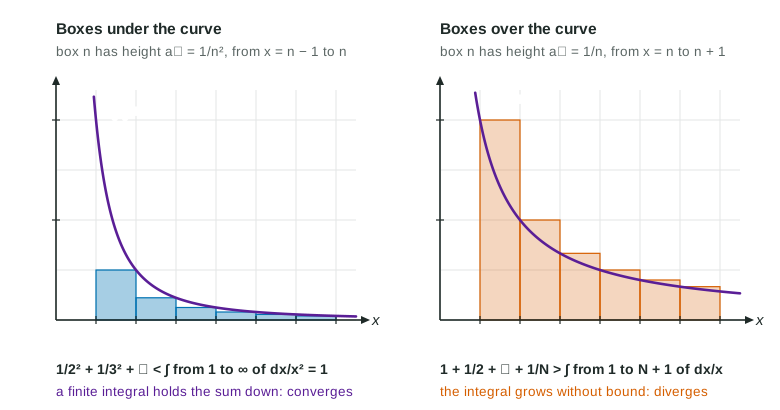
Left: the curve f(x) = 1/x² with boxes of width 1 drawn under it; box n spans x = n − 1 to n and has height 1/n², for n = 2 to 7. The boxes fit under the curve from x = 1 on, so 1/2² + 1/3² + ... is less than the integral from 1 to infinity of 1/x², which is 1: the series converges. Right: the curve f(x) = 1/x with boxes of height 1/n from x = n to n + 1, for n = 1 to 6, sticking out above the curve, so 1 + 1/2 + ... + 1/N is more than the integral from 1 to N + 1 of 1/x, which is ln(N + 1) and grows without bound: the series diverges.
Figure 1. Boxes under y=1x2y = \frac{1}{x^2} and over y=1xy = \frac{1}{x}. LevlPrep original diagram.
  • Boxes under the curve. Put box nn on [n−1,n][n - 1, n]. Since ff is decreasing, its height f(n)f(n) is the lowest value of ff there, so the box fits under the curve. Then a2a_2+a3+ a_3+⋯+ \cdots+an≤∫1nf(x)dx+ a_n \le \int_1^{n} f(x)\,dx. If ∫1∞f(x)dx\int_1^{\infty} f(x)\,dx is finite, the partial sums are bounded and keep rising, so they approach a limit: the series converges.
  • Boxes over the curve. Put box nn on [n,n+1][n, n + 1]. Now f(n)f(n) is the highest value there, so the box covers the curve. Then a1a_1+⋯+ \cdots+an≥∫1n+1f(x)dx+ a_n \ge \int_1^{n+1} f(x)\,dx. If that integral grows without bound, so do the partial sums: the series diverges.

The figure shows both: ∑1n2\sum \frac{1}{n^2} is held down by a finite area, and ∑1n\sum \frac{1}{n} is pushed up by ∫1N+1dxx\int_1^{N+1} \frac{dx}{x}=ln⁡(N+1)= \ln(N + 1), which grows without bound.

The test

Integral test. If ff is positive, continuous and decreasing on [k,∞)[k, \infty) and an=f(n)a_n = f(n) for n≥kn \ge k, then

∑n=k∞an and ∫k∞f(x)dx both converge or both diverge.\sum_{n=k}^{\infty} a_n \text{ and } \int_k^{\infty} f(x)\,dx \text{ both converge or both diverge.}

All three conditions matter, and on the exam you must say they hold. Positive and continuous are usually clear from the formula. Decreasing usually needs a derivative: show f′(x)<0f'(x) < 0 for x≥kx \ge k.

Worked example 1. Does ∑n=1∞nen2\sum_{n=1}^{\infty} \frac{n}{e^{n^2}} converge?

Conditions: f(x)=xe−x2f(x) = xe^{-x^2} is positive and continuous for x≥1x \ge 1. f′(x)f'(x)=e−x2(1−2x2)<0= e^{-x^2}(1 - 2x^2) < 0 for x≥1x \ge 1, so ff is decreasing.

Integral (substitute u=x2u = x^2): ∫1∞xe−x2dx\int_1^{\infty} xe^{-x^2}\,dx=limb→∞[−12e−x2]1b= \lim_{b \to \infty} \Big[-\frac{1}{2}e^{-x^2}\Big]_1^{b}=limb→∞(−12e−b2+12e)= \lim_{b \to \infty} \left(-\frac{1}{2}e^{-b^2} + \frac{1}{2e}\right)=12e= \frac{1}{2e}.

Conclusion: the integral converges, so the series converges by the integral test.

Worked example 2. Does ∑n=2∞1nln⁡n\sum_{n=2}^{\infty} \frac{1}{n\ln n} converge?

Conditions: f(x)=1xln⁡xf(x) = \frac{1}{x\ln x} is positive and continuous for x≥2x \ge 2, and decreasing because its denominator xln⁡xx\ln x increases.

Integral (substitute u=ln⁡xu = \ln x): ∫2bdxxln⁡x\int_2^{b} \frac{dx}{x\ln x}=ln⁡(ln⁡b)−ln⁡(ln⁡2)= \ln(\ln b) - \ln(\ln 2), which grows without bound as b→∞b \to \infty.

Conclusion: the integral diverges, so the series diverges by the integral test, even though its terms approach 0.

Three cautions

CautionWhy
The integral is not the sum∫1∞dxx2\int_1^{\infty} \frac{dx}{x^2}=1= 1, but ∑n=1∞1n2\sum_{n=1}^{\infty} \frac{1}{n^2}≈1.645\approx 1.645; the boxes and the curve have different areas
Decreasing may start lateln⁡xx\frac{\ln x}{x} rises until x=ex = e; run the test from n=3n = 3, since the first terms never change convergence
Keep limit notationwrite limb→∞∫1b\lim_{b \to \infty} \int_1^{b}; never substitute ∞\infty as a number

When the conditions fail, for example sin2⁡nn2\frac{\sin^2 n}{n^2}, whose function keeps dropping to 0 and rising again, the integral test cannot be used at all; Topic 10.6 gives tests that handle such series. Next, in 10.5, the integral test settles a whole family at once: ∑1np\sum \frac{1}{n^p}.

Spot a mistake on this page?