The Integral Test
For a series of positive terms a_n = f(n) with f positive, continuous and decreasing, compute lim as b → ∞, ∫ from k to b of f(x) dx .
Part 1 · Hook
Why this matters
Part 2 · Before you start
What this builds on
Part 3 · Prerequisite check
Quick check before you start
1. equals
Show the answer
- Correct: :
- :
- :
- :
2. is decreasing on an interval when
- there
- there
- there
- there
Show the answer
A negative derivative means the function falls as grows.
- Correct: there:
- there:
- there:
- there:
Part 4 · See it
See it first
Part 5 · Step by step
How it works, step by step
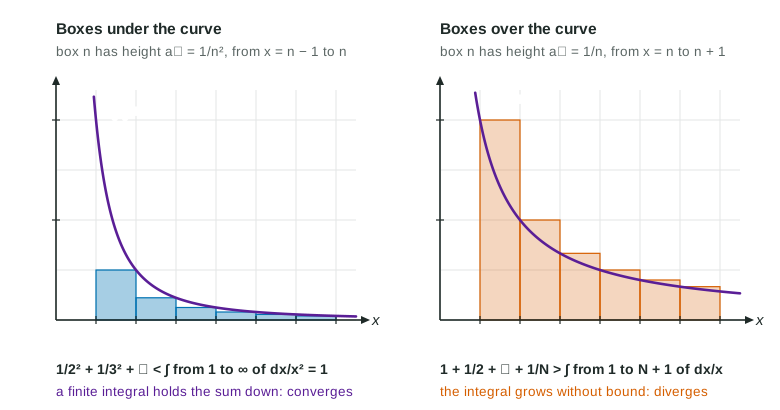
- Match the terms with a function: , with positive, continuous and decreasingeach term is the area of a box of width 1 that fits beside the curve
- Boxes under the curve, from on
: a finite integral holds the series down - Boxes over the curve
: an infinite integral pushes the series up - So the series and the integral behave alikeboth converge or both diverge
Part 6 · Key ideas
Key ideas
- Integral test: if is positive, continuous and decreasing on and , then and both converge or both diverge.
- State the three conditions every time. \"Decreasing\" usually needs ; it may hold only from some on, and then the test starts there.
- The integral's value is not the series' sum. The test decides convergence only.
- Write the improper integral as a limit, , to the end.
Part 7 · Misconception
A common mistake
The wrong idea:
What actually happens: The integral test shows the series converges, nothing more. Its first term is already 1, and the sum is about 1.645.
Part 8 · Check yourself
Check yourself
Exam-style questions. Anything you miss goes into your review queue.
Table
Four series and their improper integrals
| Series | Improper integral | |
|---|---|---|
| diverges | ||
| diverges |
1. What does the integral test say about ?
- It converges, since its integral is finite
- It converges to
- It diverges, since is not 0
- Nothing, since the integral is not a whole number
Show the answer
is positive, continuous and decreasing for , and
- Correct: It converges, since its integral is finite: Right: a finite improper integral means the series converges.
- It converges to : The test gives convergence, not the sum. The sum is not .
- It diverges, since is not 0: That mixes in the nth term test, which is about the limit of the terms, not the integral.
- Nothing, since the integral is not a whole number: Any finite value of the integral gives convergence.
2. A student concludes from the table that
- Yes: the integral test gives the sum
- No: the series diverges, though the integral is finite
- Yes: both are limits of sums of
- No: the integral decides convergence but is not the sum
Show the answer
The integral test says only whether the series converges. Here and the other terms are positive, so the sum is more than 1 (it is ).
- Yes: the integral test gives the sum: The test compares the series with the integral; the two are not equal.
- No: the series diverges, though the integral is finite: The integral is finite, so the series converges; it just does not equal 1.
- Yes: both are limits of sums of : The integral adds areas under a curve; the series adds boxes of height , which differ.
- Correct: No: the integral decides convergence but is not the sum: Right: the sum is more than 1, since its first term alone is 1.
3. What does the integral test say about ?
- It converges, since its terms approach 0
- Nothing, since the series starts at
- It diverges, since its integral diverges
- It converges, since grows faster than
Show the answer
With ,
- It converges, since its terms approach 0: Terms approaching 0 never prove convergence; the integral decides here.
- Nothing, since the series starts at : The test works from any starting index; integrate from that index.
- Correct: It diverges, since its integral diverges: Right:
grows without bound. - It converges, since grows faster than : Growing faster than is not enough; the integral grows like , without bound.
Table
The function
| Quantity | Formula |
|---|---|
| Series |
4. On which interval is decreasing?
Show the answer
, so the sign of is the sign of , which is negative for . is decreasing on , which is where the series starts.
- : For , , so and is increasing there.
- : That is where , so is increasing there.
- : changes sign at , where ; is never 0.
- Correct: : Right:
when .
5. Find .
No calculator. Type the exact value (a fraction, π, e or a root is fine).
Show the answer
- Answer: ≈ 0.736
6. Which conditions must meet on for the integral test to apply to with ?
- Positive, continuous and increasing
- Positive, continuous and decreasing
- Continuous, with
- Differentiable and bounded
Show the answer
The integral test needs positive, continuous and decreasing on ; then and both converge or both diverge.
- Positive, continuous and increasing: An increasing positive gives terms that do not approach 0; the test needs decreasing.
- Correct: Positive, continuous and decreasing: Right: all three, on the interval where the series runs.
- Continuous, with : A limit of 0 is not one of the conditions, and it is not enough.
- Differentiable and bounded: These are not the test's conditions; positive, continuous and decreasing are.
Part 9 · Summary
Summary
Part 10 · Up next
What comes next
Part 11 · Connections