Unit 10 Topic 10.15

Representing Functions as Power Series

every AB topic, then series

4 min readfreeNot practiced

Four Maclaurin series are worth memorizing: 11−x\frac{1}{1 - x}, exe^x, sin⁡x\sin x and cos⁡x\cos x. Almost every other series you need can be built from them without computing a single higher derivative. This topic is about the four moves that do the building, and about what they do to the interval of convergence.

Move 1: substitute

A known series holds for any input that meets its condition. Replace xx by an expression, and replace it in the condition too.

Worked example 1. Find a power series for 11+4x2\frac{1}{1 + 4x^2} and its interval of convergence.

Start with 11−u\frac{1}{1 - u}=1+u+u2+⋯= 1 + u + u^2 + \cdots for |u|<1|u| < 1, and substitute u=−4x2u = -4x^2:

11+4x2=1−4x2+16x4−64x6+⋯=∑n=0∞(−4)nx2n.\frac{1}{1 + 4x^2} = 1 - 4x^2 + 16x^4 - 64x^6 + \cdots = \sum_{n=0}^{\infty} (-4)^n x^{2n}.

Condition: |−4x2|<1|-4x^2| < 1, so x2<14x^2 < \frac{1}{4}, that is |x|<12|x| < \frac{1}{2}. At x=±12x = \pm\frac{1}{2} every term has size 1, so both endpoints diverge: the interval is (−12,12)\left(-\frac{1}{2}, \frac{1}{2}\right).

Substitution works the same way in the other series: e−x2e^{-x^2}=∑(−x2)nn!= \sum \frac{(-x^2)^n}{n!}=1−x2= 1 - x^2+x42!−⋯+ \frac{x^4}{2!} - \cdots for every xx, and cos⁡(3x)\cos(3x)=1−9x22!= 1 - \frac{9x^2}{2!}+81x44!−⋯+ \frac{81x^4}{4!} - \cdots

Move 2: multiply by a power of x

Multiplying each term by xkx^k shifts every power up by kk and does not change where the series converges. For example, xcos⁡xx\cos x=x−x32!+x54!−⋯= x - \frac{x^3}{2!} + \frac{x^5}{4!} - \cdots for every xx.

Move 3: differentiate term by term

Inside its interval, a power series can be differentiated one term at a time, and the result is the derivative of its sum:

ddx∑n=0∞cnxn=∑n=1∞ncnxn−1.\frac{d}{dx}\sum_{n=0}^{\infty} c_n x^n = \sum_{n=1}^{\infty} n c_n x^{n-1}.

Differentiating 11−x=∑xn\frac{1}{1 - x} = \sum x^n gives 1(1−x)2\frac{1}{(1 - x)^2}=∑n=1∞nxn−1= \sum_{n=1}^{\infty} n x^{n-1}=1= 1+2x+ 2x+3x2+ 3x^2+⋯+ \cdots for |x|<1|x| < 1. Each term is differentiated with respect to xx; the index nn is a fixed number in each term.

Move 4: integrate term by term

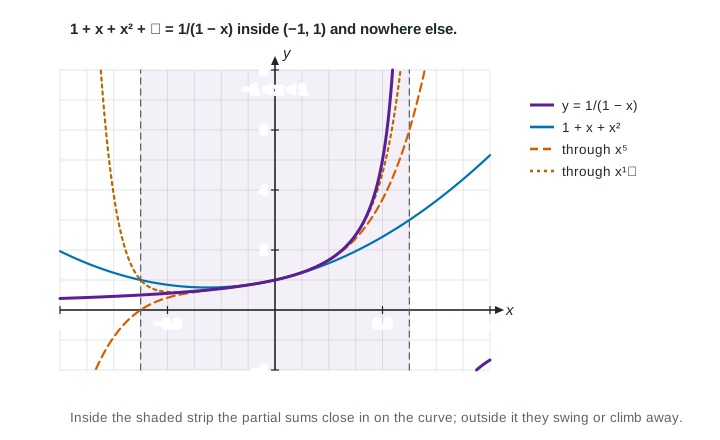
The graph of y = 1/(1 - x) from x = -1.6 to 1.6, with a vertical asymptote at x = 1, and three partial sums of 1 + x + x squared + ...: through x squared, through x to the fifth and through x to the tenth. A shaded strip marks -1 < x < 1, where the partial sums close in on the curve. To the left of -1 they swing up and down with growing size; to the right of 1 they climb, while 1/(1 - x) is negative there.
Figure 1. The geometric series matches 11−x\frac{1}{1 - x} only on (−1,1)(-1, 1). LevlPrep original diagram.

Worked example 2. Find the Maclaurin series for ln⁡(1+x)\ln(1 + x) and its interval of convergence.

Substitute u=−tu = -t: 11+t\frac{1}{1 + t}=1−t+t2−t3+⋯= 1 - t + t^2 - t^3 + \cdots for |t|<1|t| < 1.

Integrate from 0 to xx, term by term: ln⁡(1+x)\ln(1 + x)=∫0x11+tdt= \int_0^x \frac{1}{1 + t}\,dt=x−x22= x - \frac{x^2}{2}+x33−x44+ \frac{x^3}{3} - \frac{x^4}{4}+⋯+ \cdots=∑n=1∞(−1)n+1xnn= \sum_{n=1}^{\infty} \frac{(-1)^{n+1} x^n}{n}.

The radius stays 1. Endpoints: at x=1x = 1 the series is the alternating harmonic series, which converges; at x=−1x = -1 every term is −1n-\frac{1}{n}, which diverges. The interval is (−1,1](-1, 1], one endpoint more than the series we started from.

Integrating from 0 fixes the constant: the integral is 0 at x=0x = 0, matching ln⁡1=0\ln 1 = 0. In the same way, integrating 11+t2\frac{1}{1 + t^2}=1−t2+t4−⋯= 1 - t^2 + t^4 - \cdots gives arctan⁡x\arctan x=x−x33+x55−⋯= x - \frac{x^3}{3} + \frac{x^5}{5} - \cdots for |x|≤1|x| \le 1.

What happens to the interval

MoveRadiusEndpoints
substitute u=g(x)u = g(x)from the new conditiontest again
multiply by xkx^kunchangedunchanged
differentiate term by termunchangedmay lose an endpoint: test again
integrate term by termunchangedmay gain an endpoint: test again

The figure is a reminder of why the interval matters: outside (−1,1)(-1, 1) the partial sums of 1+x+x2+⋯1 + x + x^2 + \cdots swing or climb away, while 11−x\frac{1}{1 - x} stays finite. A series stands for its function only on its interval of convergence.

Using a built series

Once you have a series, you can read off derivatives at the center (f(n)(0)=n!⋅cnf^{(n)}(0) = n! \cdot c_n), evaluate sums such as ∑n2n\sum \frac{n}{2^n}=12∑n(12)n−1= \frac{1}{2}\sum n\left(\frac{1}{2}\right)^{n-1}=12⋅1(1−1/2)2= \frac{1}{2} \cdot \frac{1}{(1 - 1/2)^2}=2= 2, and approximate integrals with no elementary antiderivative, such as ∫0xe−t2dt\int_0^x e^{-t^2}\,dt=x−x33= x - \frac{x^3}{3}+x510−⋯+ \frac{x^5}{10} - \cdots. When the resulting values alternate with sizes decreasing to 0, the alternating series error bound says how accurate the estimate is.
Spot a mistake on this page?