The Alternating Series Test
A series whose terms alternate in sign converges when the sizes of its terms decrease and approach 0.
Part 1 · Hook
Why this matters
Part 2 · Before you start
What this builds on
Part 3 · Prerequisite check
Quick check before you start
1. What does the nth term test say about when ?
- Nothing: the series may converge or diverge
- The series converges
- The series diverges
- The series converges to 0
Show the answer
A limit of 0 leaves the question open; the nth term test can only show divergence.
- Correct: Nothing: the series may converge or diverge:
- The series converges:
- The series diverges:
- The series converges to 0:
2. Does the harmonic series converge?
- No: it diverges, though its terms approach 0
- Yes: its terms approach 0
- Yes: it is a -series with
- Yes: its sum is 1
Show the answer
It is the -series with , which diverges.
- Correct: No: it diverges, though its terms approach 0:
- Yes: its terms approach 0:
- Yes: it is a -series with :
- Yes: its sum is 1:
3. Which sequence is decreasing for ?
Show the answer
A larger gives a larger denominator, so decreases.
- Correct: :
- :
- :
- :
Part 4 · See it
See it first
Part 5 · Step by step
How it works, step by step
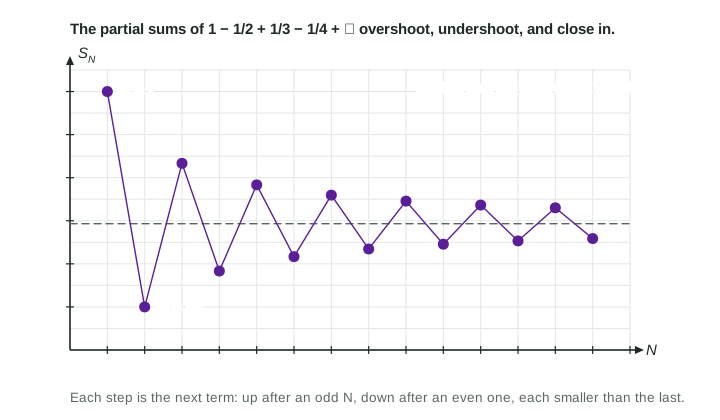
- The signs alternateeach partial sum steps up, then down, then up again, so the partial sums zigzag
- The sizes of the terms decreaseeach step is shorter than the last, so the zigzag never passes back beyond the previous turn
- The sizes approach 0the steps shrink to nothing, the zigzag closes in on one number, and the series converges
Part 6 · Key ideas
Key ideas
- The alternating series test: if , the decrease (from some point on), and , then converges.
- Check and state all three conditions: alternating signs, decreasing sizes, a limit of 0.
- The test only proves convergence. If the sizes do not approach 0, use the nth term test for divergence instead.
- When the conditions hold from the first term on, the sum lies between any two consecutive partial sums.
Part 7 · Misconception
A common mistake
The wrong idea: The alternating series test fails for because , so the series diverges.
What actually happens: The sizes only need to decrease from some point on (here from ), so the test applies and the series converges. And a failed condition never proves divergence by itself.
Part 8 · Check yourself
Check yourself
Exam-style questions. Anything you miss goes into your review queue.
Graph
Partial sums of
1. Which statement verifies the conditions of the alternating series test for this series?
- The terms alternate in sign and diverges
- The terms alternate in sign and the partial sums stay between 0 and 1
- The signs alternate and decreases to 0
- The sizes decrease, so the partial sums decrease
Show the answer
The series is with ;
- The terms alternate in sign and diverges: What does is not a condition of this test; the sizes must decrease to 0.
- The terms alternate in sign and the partial sums stay between 0 and 1: Bounded partial sums are not a condition of the test; the sizes must decrease and approach 0.
- Correct: The signs alternate and decreases to 0: Right: all three conditions, each one stated.
- The sizes decrease, so the partial sums decrease: The partial sums go up and down; the test needs alternating signs and a limit of 0 as well.
2. Which statement about the sum does the graph support?
- , the last partial sum shown
Show the answer
The partial sums alternate above and below the sum while their swings shrink, so lies between any two consecutive partial sums. is above the line and below it: .
- Correct: : Right: consecutive partial sums sit on either side of the sum.
- : ends with an added term, so it is above the sum, and is below it.
- , the last partial sum shown: ends with a subtracted term and lies below the dashed line.
- : is the highest point; every later partial sum and the sum lie below it.
Table
The sizes of the terms of an alternating series
3. What does the alternating series test conclude about ?
- Nothing, since breaks the decreasing condition
- It diverges, since
- It converges, since the terms alternate in sign
- It converges: the sizes decrease from on and approach 0
Show the answer
The signs alternate; decreases for ; and
- Nothing, since breaks the decreasing condition: The condition only has to hold from some point on; dropping the first term does not change convergence.
- It diverges, since : The test never shows divergence, and one early rise does not stop convergence.
- It converges, since the terms alternate in sign: Alternating signs alone are not enough; the sizes must also decrease and approach 0.
- Correct: It converges: the sizes decrease from on and approach 0: Right: the first term does not affect convergence, so decreasing from on is enough.
4. What happens to ?
- It converges by the alternating series test
- It diverges by the nth term test: the terms do not approach 0
- It converges, since the sizes decrease
- Nothing can be decided, since the alternating series test fails
Show the answer
, so the terms do not approach 0 (they swing near and ). By the nth term test, the series diverges.
- It converges by the alternating series test: The sizes approach 1, not 0, so that test does not apply.
- Correct: It diverges by the nth term test: the terms do not approach 0: Right: the sizes approach 1, so the terms swing near .
- It converges, since the sizes decrease: Decreasing sizes are not enough; they must also approach 0.
- Nothing can be decided, since the alternating series test fails: When the terms do not approach 0, the nth term test shows divergence.
5. For with , which conditions does the alternating series test need?
- from some on, and
- , with no condition on how the sizes change
- from some on, with no condition on the limit
- converges as a series of positive terms
Show the answer
The alternating series test: if the sizes are positive, decrease (at least from some point on), and approach 0, then converges.
- Correct: from some on, and : Right: decreasing sizes that approach 0.
- , with no condition on how the sizes change: A limit of 0 is not enough; the sizes must also decrease.
- from some on, with no condition on the limit: Decreasing is not enough: sizes that level off at 1 decrease but do not approach 0.
- converges as a series of positive terms: If converges, the signed series does too, but this is not the alternating series test's condition.
6. Why does the alternating series test not apply to ?
- The sizes do not decrease as grows large
- The sizes do not approach 0 as grows large
- It does apply, and it shows that this series converges
- , so the terms are all positive and the series is harmonic
Show the answer
- The sizes do not decrease as grows large: does decrease; the trouble is the sign.
- The sizes do not approach 0 as grows large: approaches 0; the trouble is the sign.
- It does apply, and it shows that this series converges: : the series is , which diverges.
- Correct: , so the terms are all positive and the series is harmonic: Right: an even power of is 1, so there is no alternation.
Part 9 · Summary
Summary
Part 10 · Up next
What comes next
Part 11 · Connections