Skills

Sequences, Sigma Notation and Factorials

every AB topic, then series

4 min readfreeNot practiced

Unit 10 adds up infinitely many numbers. Before that, this page reviews three tools it leans on: sequences and their limits, factorials, and sigma notation.

Sequences

An infinite sequence is a list a1,a2,a3,…a_1, a_2, a_3, \ldots with one term for each counting number nn. Think of it as a function whose inputs are 1,2,3,…1, 2, 3, \ldots A formula such as an=nn+1a_n = \frac{n}{n + 1} gives any term directly: a1=12a_1 = \frac{1}{2}, a2=23a_2 = \frac{2}{3}, a10=1011a_{10} = \frac{10}{11}.

Some sequences start at n=0n = 0. The index matters: (−12)n\left(-\frac{1}{2}\right)^{n} starting at n=0n = 0 and (−12)n−1\left(-\frac{1}{2}\right)^{n - 1} starting at n=1n = 1 are the same list, 1,−12,14,…1, -\frac{1}{2}, \frac{1}{4}, \ldots To find a formula from a few terms, look for a pattern in the numerators, the denominators and the signs separately; a sign that alternates is a factor (−1)n(-1)^n or (−1)n+1(-1)^{n+1}.

A sequence in which each term is the one before times the same number rr is a geometric sequence: a,ar,ar2,…a, ar, ar^2, \ldots Unit 10 uses these constantly.

Limits of sequences

A sequence converges to LL if its terms get as close to LL as you like and stay there as nn grows: limn→∞an=L\lim_{n \to \infty} a_n = L. Otherwise it diverges.

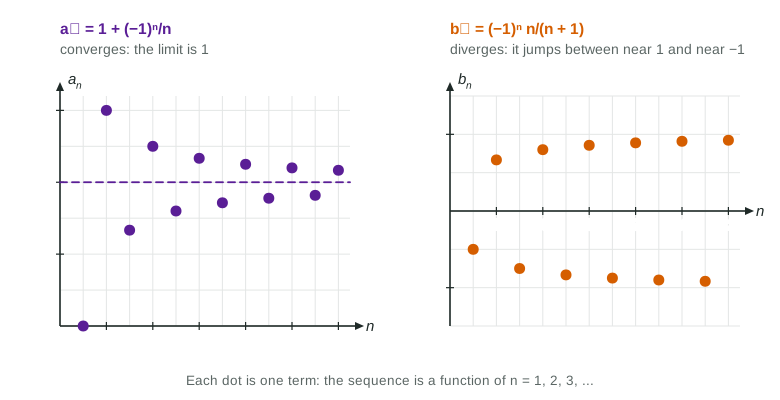
Two plots of terms against n for n = 1 to 12, one dot per term. Left: a sub n = 1 + (−1) to the n over n; the dots alternate above and below the dashed line at height 1 and close in on it, so the sequence converges to 1. Right: b sub n = (−1) to the n times n over (n + 1); the dots jump between values near 1 and near −1 and never settle, so the sequence diverges.
Figure 1. A sequence that converges and one that diverges. LevlPrep original diagram.

If an=f(n)a_n = f(n) and limx→∞f(x)=L\lim_{x \to \infty} f(x) = L, then limn→∞an=L\lim_{n \to \infty} a_n = L. So the AB tools work:

  • Leading terms for rational expressions: limn→∞3n2+12n2−n\lim_{n \to \infty} \frac{3n^2 + 1}{2n^2 - n}=32= \frac{3}{2}.
  • L'Hospital's rule on the function: ln⁡xx\frac{\ln x}{x} is an ∞∞\frac{\infty}{\infty} form, and 1/x1→0\frac{1/x}{1} \to 0, so ln⁡nn→0\frac{\ln n}{n} \to 0.
  • Growth rates: as n→∞n \to \infty, ln⁡n\ln n grows slower than any power npn^p with p>0p > 0, which grows slower than ene^n or bnb^n with b>1b > 1, which grows slower than n!n!.
  • The squeeze theorem for signs that alternate: −1n≤(−1)nn≤1n-\frac{1}{n} \le \frac{(-1)^n}{n} \le \frac{1}{n}, so (−1)nn→0\frac{(-1)^n}{n} \to 0 (the figure shows a cousin, 1+(−1)nn→11 + \frac{(-1)^n}{n} \to 1).

Worked example 1. Do an=(−1)nnn+1a_n = \frac{(-1)^n\,n}{n + 1} and cn=(23)nc_n = \left(\frac{2}{3}\right)^n converge?

For ana_n: the sizes nn+1\frac{n}{n + 1} approach 1, so the odd terms approach −1-1 and the even terms approach 11. The terms never settle on one number: ana_n diverges.

For cnc_n: a number between −1-1 and 11 raised to higher and higher powers shrinks toward 0, so cn→0c_n \to 0. In general rn→0r^n \to 0 when |r|<1|r| < 1; rnr^n grows without bound when |r|>1|r| > 1; rnr^n stays at 1 when r=1r = 1 and jumps between 11 and −1-1 when r=−1r = -1.

Factorials

For a positive integer nn, n!n!=n(n−1)(n−2)⋯3⋅2⋅1= n(n - 1)(n - 2)\cdots 3 \cdot 2 \cdot 1, and by agreement 0!=10! = 1. Factorials grow very fast: 5!=1205! = 120, 10!=3,628,80010! = 3{,}628{,}800.

Ratios of factorials simplify by writing the larger one down until it reaches the smaller one:

Worked example 2. Simplify (n+1)!n!\frac{(n + 1)!}{n!} and (2n)!(2n+2)!\frac{(2n)!}{(2n + 2)!}.

(n+1)!=(n+1)⋅n!(n + 1)! = (n + 1) \cdot n!, so (n+1)!n!=n+1\frac{(n + 1)!}{n!} = n + 1.

(2n+2)!(2n + 2)!=(2n+2)(2n+1)(2n)!= (2n + 2)(2n + 1)(2n)!: two factors, not one. So (2n)!(2n+2)!\frac{(2n)!}{(2n + 2)!}=1(2n+2)(2n+1)= \frac{1}{(2n + 2)(2n + 1)}.

Later Unit 10 topics (10.8 and 10.11) lean on exactly these simplifications, and dropping one factor of (2n+2)!(2n + 2)! is a common slip.

Sigma notation

∑k=1mak\sum_{k=1}^{m} a_k means a1+a2+⋯+ama_1 + a_2 + \cdots + a_m. The letter kk is a counter; any letter works. Constants factor out and sums split:

∑k=1mcak=c∑k=1mak,∑k=1m(ak+bk)=∑k=1mak+∑k=1mbk.\sum_{k=1}^{m} c\,a_k = c\sum_{k=1}^{m} a_k, \qquad \sum_{k=1}^{m} \left(a_k + b_k\right) = \sum_{k=1}^{m} a_k + \sum_{k=1}^{m} b_k.

WrittenMeansValue
∑k=14k2\sum_{k=1}^{4} k^21+4+9+161 + 4 + 9 + 163030
∑k=032k\sum_{k=0}^{3} 2^k1+2+4+81 + 2 + 4 + 81515
∑k=13kk+1\sum_{k=1}^{3} \frac{k}{k + 1}12+23+34\frac{1}{2} + \frac{2}{3} + \frac{3}{4}2312\frac{23}{12}

Changing the starting index shifts the formula: ∑k=032k\sum_{k=0}^{3} 2^k and ∑k=142k−1\sum_{k=1}^{4} 2^{k-1} are the same sum. In 10.1 the upper limit becomes ∞\infty, and the question becomes whether the sum settles to a number at all.
Spot a mistake on this page?