Unit 9 follows points that move in the plane. To describe them you need two tools from precalculus: parametric equations, which give the position at each time, and vectors, which describe a change in position. This page rebuilds both, one step at a time.
A point for each value of t
A graph gives one for each . Parametric equations instead give both coordinates from a third variable, the parameter :
Think of as time. At each time the point is at , and as increases the point moves, tracing a path. The order of the points matters, so a parametric path has a direction (its orientation). Draw it with arrows.
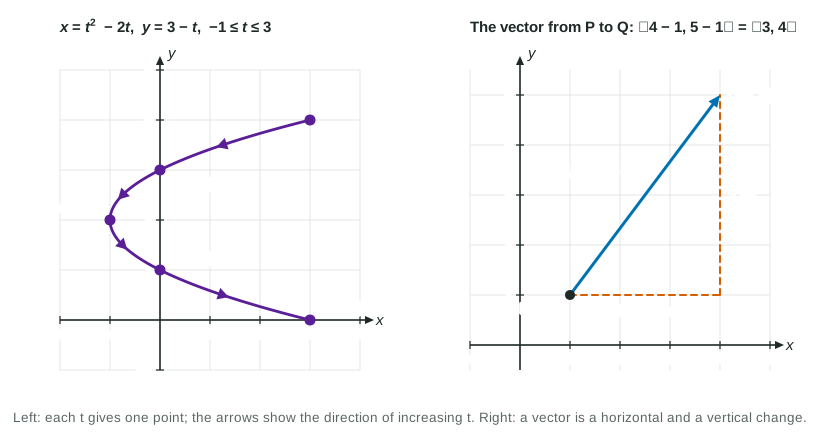
Worked example 1. Sketch the path , for .
Make a table: put each into both equations, with parentheses around negative inputs.
Plot , , , , in that order and join them. keeps falling, so the point moves down the page; falls until and then rises, so it moves left and then right. The figure shows the path with its arrows.
Eliminating the parameter
To see the shape of a path, remove and get one equation in and . Two methods cover almost every case.
Solve and substitute. When one equation is linear in , solve it for and put the result into the other. In worked example 1, gives , so
a parabola that opens to the right. Check a point: gives , as in the table at .
Use an identity. When the equations hold and , square and add: removes .
Worked example 2. Describe , for .
Direction: gives and gives . From the right side to the top is counterclockwise, and from 0 to is one full turn.
Elimination keeps the shape and throws away the rest. , satisfies the same equation , yet it starts at the top, , and goes clockwise. And on either path goes around twice. Always find the start and the direction from the parametric equations themselves.
Vectors: a change in position
A vector has a size and a direction. In the plane it is written by its components,
The vector from to is end minus start: . The vector from the origin to a point is that point's position; the position of is .
The magnitude (length) of is the hypotenuse of a right triangle with legs and :
Add vectors and multiply them by numbers one component at a time:
Worked example 3. A drone flies from to , in meters. Find the vector of the trip and its length.
End minus start: , so 3 meters east and 4 meters north.
Length: meters. Not : the drone flies the diagonal, not the two legs.
Common slips
| Slip | Fix |
|---|---|
| Writing or putting in the place | A point is : evaluate both functions at the same |
| Reading the shape and guessing the direction | Plot two nearby values of and see which way the point moves |
| Start minus end for the vector from to | End minus start: |
| Length as , or forgetting the square root | ; a magnitude is never negative |
With these two tools, the rest of Unit 9 is calculus you already know, applied to each coordinate: rates of and , slopes of paths, and how far a point travels.