Parametric Equations and Vectors
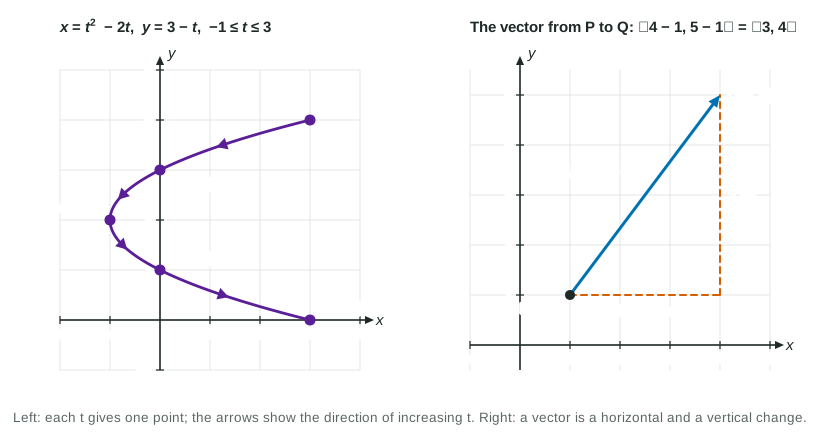
Parametric equations describe a path by giving x and y as functions of a parameter t ; increasing t traces the path in a direction.
Part 1 · Hook
Why this matters
Part 2 · Before you start
What this builds on
Part 3 · Prerequisite check
Quick check before you start
1. On the unit circle, the point at angle is
Show the answer
Cosine is the -coordinate and sine the -coordinate, so .
- Correct: :
- :
- :
- :
2. The distance between and is
Show the answer
The changes are 3 and 4, the legs of a right triangle: by the Pythagorean theorem.
- Correct: :
- :
- :
- :
3. If , then
Show the answer
Replace every by :
- Correct: :
- :
- :
- :
Part 4 · See it
See it first
Part 5 · Step by step
How it works, step by step
- Give each coordinate its own function of a parameter each gives one point , and together the points trace a path
- Increase and watch the pointsthe path gets a direction (its orientation), which an equation in and cannot show
- Solve one equation for , or use eliminating gives the shape of the path as an equation in and
- Record a change in position as a vector, whose length comes from the Pythagorean theorem
Part 6 · Key ideas
Key ideas
- Parametric equations , give a point for each . Make a table of , , , plot the points in order of , and draw arrows for the direction.
- Eliminate the parameter to see the shape: solve a linear equation for and substitute, or square and add sines and cosines. The direction and the timing are lost when you do.
- , is a circle of radius traced counterclockwise from ; swapping sine and cosine starts at the top and goes clockwise.
- A vector is a change: across and up. From to it is end minus start; its magnitude is . Add vectors and multiply by numbers one component at a time.
Part 7 · Misconception
A common mistake
The wrong idea: The vector from to is , and its length is .
What actually happens: is the position of , the vector from the origin. From to it is end minus start, , and its length is , not the sum of the components.
Part 8 · Check yourself
Check yourself
Exam-style questions. Anything you miss goes into your review queue.
Table
A path given by two equations in
1. Where is the point when ?
Show the answer
and , so the point is : the -value comes first.
- : These are the right numbers in the wrong order: the point is .
- Correct: : Right:
. - : This puts in the place. The -coordinate is , not itself.
- : , not : . Put parentheses around a negative input before squaring.
2. Eliminate the parameter: write as a function of for this path.
Type an expression for .
Show the answer
From , . Substitute into : . Check with the table: gives , as at .
- Answer:
3. As increases from to , how does the point move?
- Left the whole time, first down and then up
- Right the whole time, first up and then down
- Right the whole time, first down and then up
- Down and then up, first right and then left
Show the answer
goes : it keeps increasing, so the point moves right. goes : down until , then up. The path is a parabola traced from left to right.
- Left the whole time, first down and then up: The -values increase ( up to ), so the motion is to the right, not the left.
- Right the whole time, first up and then down: The -values fall from 1 to before rising: down first, then up.
- Correct: Right the whole time, first down and then up: Right: increases throughout; falls to at , then rises.
- Down and then up, first right and then left: Read the column: it increases at every step, so the point never turns back to the left.
4. Find the magnitude of the vector from the point where to the point where .
No calculator. Type the exact value (a fraction, π, e or a root is fine).
Show the answer
From to the vector is
- Answer: ≈ 5.657
5. The path , , , is a circle of radius 2. Where does it start, and which way does it go around?
- It starts at and goes counterclockwise
- It starts at and goes counterclockwise
- It starts at and goes clockwise
- It starts at and goes clockwise
Show the answer
At :
- It starts at and goes counterclockwise: , so the start is ; swapping sine and cosine moves the start to the top.
- It starts at and goes counterclockwise: The start is right, but the next quarter turn reaches , on the right: that is clockwise.
- It starts at and goes clockwise: Plug in : and , so the start is the top of the circle, not .
- Correct: It starts at and goes clockwise: Right: from to to is clockwise.
6. What is the vector from to ?
Show the answer
End minus start:
- : That is start minus end, the vector from back to . Subtract the start from the end.
- : That adds the coordinates of and . A vector from to is the change: end minus start.
- Correct: : Right: .
- : That is the position of alone, the vector from the origin to , not from .
Part 9 · Summary
Summary
Part 10 · Up next
What comes next
Part 11 · Connections