Unit 8 Topic 8.13

Arc Length and Distance Traveled

every AB topic, then series

4 min readfreeNot practiced

Area under a curve and volume of a solid came from adding up thin slices. The arc length of a curve, its length measured along the curve, comes the same way: from adding up short straight pieces. Each piece is the hypotenuse of a small right triangle, so the Pythagorean theorem does the work.

Chords first

Split [a,b][a, b] into pieces. Over a piece with run Δx\Delta x, the curve rises Δy\Delta y, and the chord joining the two points has length

(Δx)2+(Δy)2=1+(ΔyΔx)2Δx\sqrt{(\Delta x)^2 + (\Delta y)^2} = \sqrt{1 + \left(\frac{\Delta y}{\Delta x}\right)^2}\,\Delta x

The figure shows three chords along y=23x3/2y = \frac{2}{3}x^{3/2} on [0,3][0, 3]. Their total, about 4.647, is a little less than the curve's length: a chord is the shortest path between its endpoints. More, shorter chords bring the total closer.
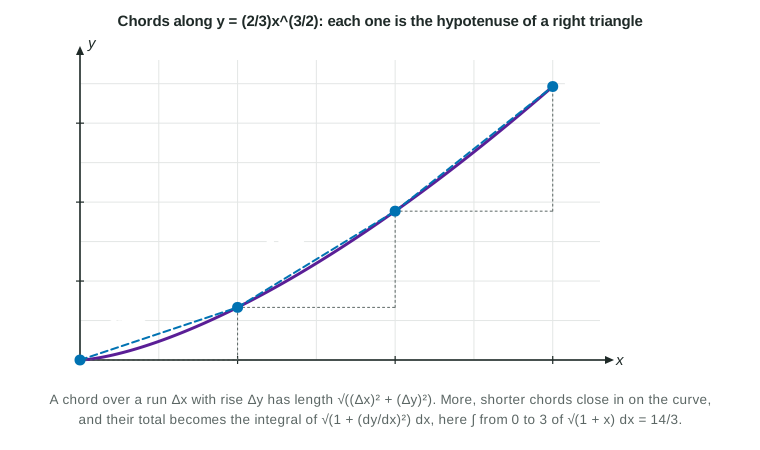
The curve y = (2/3)x to the 3/2 from x = 0 to x = 3, in violet, rising from (0, 0) to (3, 2√3), about 3.464. Three dashed blue chords join the points at x = 0, 1, 2 and 3, with dotted right triangles showing each run and rise. The chords measure 1.202, 1.577 and 1.869, a total of 4.647, a little less than the curve’s length 14/3, about 4.667. With more chords the total becomes the integral of √(1 + (dy/dx)²) dx, here the integral from 0 to 3 of √(1 + x) dx.
Figure 1. Each chord is a hypotenuse; their total approaches the length of the curve. LevlPrep original diagram.

From chords to an integral

If ff is differentiable, the Mean Value Theorem gives a point cc in each piece with ΔyΔx=f′(c)\frac{\Delta y}{\Delta x} = f'(c). So the chord total is ∑1+(f′(c))2Δx\sum \sqrt{1 + (f'(c))^2}\,\Delta x, a Riemann sum. As the pieces shrink it becomes an integral:

arc length=∫ab1+(f′(x))2dx,\text{arc length} = \int_a^b \sqrt{1 + (f'(x))^2}\,dx,

for a function ff whose derivative is continuous on [a,b][a, b].

Worked example 1. Find the length of the graph of y=23x3/2y = \frac{2}{3}x^{3/2} from x=0x = 0 to x=3x = 3.

Derivative: y′=x1/2y' = x^{1/2}, so (y′)2=x(y')^2 = x.

Setup: ∫031+xdx\int_0^3 \sqrt{1 + x}\,dx.

Evaluate: 23(1+x)3/2|03\frac{2}{3}(1 + x)^{3/2}\Big|_0^3=23(8−1)= \frac{2}{3}(8 - 1)=143= \frac{14}{3}≈4.667\approx 4.667.

Exact answers like this are rare: the square root usually has no elementary antiderivative. Most arc length questions are calculator questions, where the setup earns a point and the value to three decimal places earns another.

Worked example 2 (calculator). Find the length of one arch of y=sin⁡xy = \sin x, from x=0x = 0 to x=πx = \pi.

y′=cos⁡xy' = \cos x, so the length is ∫0π1+cos2⁡xdx\int_0^\pi \sqrt{1 + \cos^2 x}\,dx≈3.820\approx 3.820 (radian mode).

Sanity check: the arch is longer than its base, π≈3.142\pi \approx 3.142, and longer than the two chords from (0,0)(0, 0) to (π2,1)\left(\frac{\pi}{2}, 1\right) to (π,0)(\pi, 0), which total about 3.724.

Setups that lose the point

Curve and intervalRight setupCommon wrong setup
y=x3y = x^3, [0,1][0, 1]∫011+9x4dx\int_0^1 \sqrt{1 + 9x^4}\,dx∫011+x6dx\int_0^1 \sqrt{1 + x^6}\,dx (squared ff, not f′f')
y=xy = \sqrt{x}, [1,4][1, 4]∫141+14xdx\int_1^4 \sqrt{1 + \frac{1}{4x}}\,dx∫141+12xdx\int_1^4 \sqrt{1 + \frac{1}{2\sqrt{x}}}\,dx (derivative not squared)
y=x22y = \frac{x^2}{2}, [0,2][0, 2]∫021+x2dx\int_0^2 \sqrt{1 + x^2}\,dx∫02(1+x2)dx\int_0^2 (1 + x^2)\,dx (no square root)

The scoring guidelines give the setup point only for an integrand in the right form, with the right limits. Write 1+(f′(x))2\sqrt{1 + (f'(x))^2} with your derivative substituted, then evaluate.

Curves given as x = g(y)

When xx is a function of yy, swap the roles: the length from y=cy = c to y=dy = d is ∫cd1+(g′(y))2dy\int_c^d \sqrt{1 + (g'(y))^2}\,dy. For x=y2x = y^2 from y=0y = 0 to y=2y = 2: ∫021+4y2dy\int_0^2 \sqrt{1 + 4y^2}\,dy≈4.647\approx 4.647. The limits are yy-values.

Arc length from a table

If only values of f′f' are known, estimate ∫ab1+(f′(x))2dx\int_a^b \sqrt{1 + (f'(x))^2}\,dx with a Riemann or trapezoidal sum of the values of 1+(f′(x))2\sqrt{1 + (f'(x))^2}, using the table's widths. For example, with f′(0)=0f'(0) = 0, f′(2)=34f'(2) = \frac{3}{4} and f′(4)=125f'(4) = \frac{12}{5}, the left sum on [0,6][0, 6] is 2(1+54+135)=9.72\left(1 + \frac{5}{4} + \frac{13}{5}\right) = 9.7.

Reading an arc length in context

If h(x)h(x) is the height of a cable in meters, xx meters from a pole, then ∫051+(h′(x))2dx\int_0^5 \sqrt{1 + (h'(x))^2}\,dx is the length of cable between x=0x = 0 and x=5x = 5, in meters. Name the curve, the interval and the unit. The length does not depend on where the curve sits: moving a graph up or down leaves f′f', and so its length, unchanged.

Spot a mistake on this page?