Arc Length and Distance Traveled
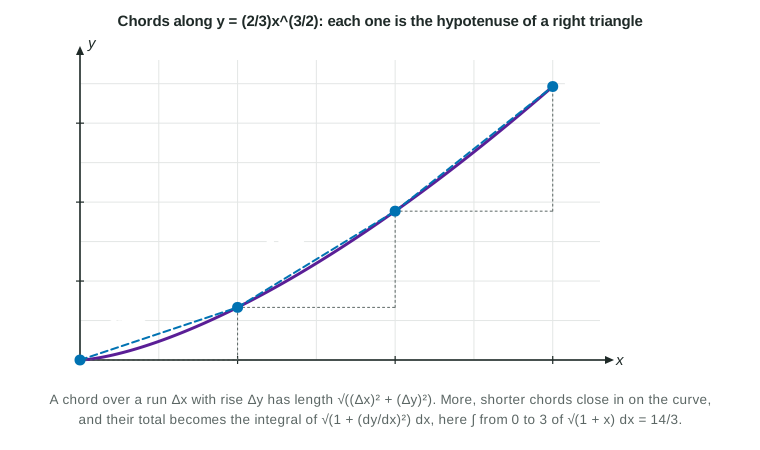
The length of the graph of y = f(x) from x = a to x = b is ∫ from a to b of √(1 + (f′(x))²) dx : the limit of sums of chord lengths, each a hypotenuse.
Part 1 · Hook
Why this matters
Part 2 · Before you start
What this builds on
Part 3 · Prerequisite check
Quick check before you start
1. What is the distance between and ?
- 5
- 7
- 25
Show the answer
.
- Correct: 5:
- 7:
- 25:
- :
2. If , then
Show the answer
- Correct: :
- :
- :
- :
Part 4 · See it
See it first
Part 5 · Step by step
How it works, step by step
- Replace a short piece of the curve by its chord, with run and rise the chord's length is
- By the Mean Value Theorem, for some in the piecethe chord total is a Riemann sum of
- Let the pieces shrinkthe sum becomes , the arc length
- The curve is given as swap roles: with -limits
Part 6 · Key ideas
Key ideas
- Arc length of from to : , for continuous on .
- Square the derivative, not the function; keep the square root and the 1.
- Few arc length integrals have exact values; most are calculator questions. Write the setup, then the value to three decimal places.
- From a table of , estimate the length with a Riemann or trapezoidal sum of .
Part 7 · Misconception
A common mistake
The wrong idea: The length of from 0 to 1 is .
What actually happens: squares the function. The formula squares the derivative: , so the length is
Part 8 · Check yourself
Check yourself
Exam-style questions. Anything you miss goes into your review queue.
Graph
Chords along
1. Find the length of the chord from to .
No calculator. Type the exact value (a fraction, π, e or a root is fine).
Show the answer
By the Pythagorean theorem:
- Answer: ≈ 1.118
2. Find the total length of the two chords.
No calculator. Type the exact value (a fraction, π, e or a root is fine).
Show the answer
- Answer: ≈ 2.921
3. Which integral gives the exact length of the graph of from to ?
Show the answer
Arc length with .
- : That squares itself. The formula uses the derivative: .
- : The square root is missing: the integrand comes from a hypotenuse, .
- : The derivative must be squared:
. - Correct: : Right: , so the integrand is
.
4. How does the two-chord total compare with the length of the graph?
- It is less: a chord is the shortest path between its endpoints
- It is greater, because is concave up
- It is equal, because the chords meet the curve at its endpoints
- No comparison is possible without evaluating the integral
Show the answer
Each chord is the straight path between two points of the curve, so the chord total, about 2.921, is less than the arc length, about 2.958. More chords raise the total toward it.
- Correct: It is less: a chord is the shortest path between its endpoints: Right: each piece of the curve is at least as long as its chord, and here strictly longer, since the curve bends.
- It is greater, because is concave up: Concavity decides whether chords lie above or below the curve, not whether they are shorter. A straight segment is never longer than a curved path.
- It is equal, because the chords meet the curve at its endpoints: Sharing endpoints does not make the lengths equal: the curve bends between them.
- No comparison is possible without evaluating the integral: The comparison follows from geometry alone: the straight path is the shortest.
5. Find the length of the graph of from to .
No calculator. Type the exact value (a fraction, π, e or a root is fine).
Show the answer
, so the length is
- Answer: ≈ 4.667
6. A cable hangs between two poles 5 meters apart; is its height, in meters, above the point meters from the first pole. What does
- The cable's height changes by 6.2 meters between the poles
- The area between the cable and the ground is 6.2 square meters
- The average height of the cable is 6.2 meters
- The cable is 6.2 meters long between the two poles
Show the answer
is the length of the graph of on , here the cable from one pole to the other, in meters.
- The cable's height changes by 6.2 meters between the poles: A change in height is
, without the root. - The area between the cable and the ground is 6.2 square meters: An area would be , in square meters.
- The average height of the cable is 6.2 meters: An average height would divide by 5.
- Correct: The cable is 6.2 meters long between the two poles: Right: the arc length integral of the graph of from to is the cable's length, in meters.
Part 9 · Summary
Summary
Part 10 · Up next
What comes next
Part 11 · Connections