A curve given by parametric equations , is the path of a moving point. Calculus asks three questions about it at each instant: how fast is changing, how fast is changing, and how steep is the path? The first two are derivatives you already know how to take. The third needs one new idea.
Two rates and a direction
Differentiate each coordinate with respect to . is the horizontal rate and the vertical rate of the point. Their signs tell you which way it moves:
| Sign | Meaning |
|---|---|
| is increasing: the point moves right | |
| is decreasing: the point moves left | |
| is increasing: the point moves up | |
| is decreasing: the point moves down |
Every rule from Units 2 and 3 applies, one coordinate at a time: the power, product, quotient and chain rules all work exactly as before, with as the variable.
The slope of the curve
If can be thought of as a function of near a point, the chain rule says
Solve for :
In words: the slope is the vertical rate over the horizontal rate. If the point rises 6 units per second while it moves right 2 units per second, the path rises 3 units per unit of . Notice that comes out as a function of . You evaluate it at a time, not at a point.
Worked example 1. A curve is given by , . Find the line tangent to the curve at .
Rates: and .
Slope:
Point:
Tangent line: , that is, .
Check by eliminating : , so
Horizontal and vertical tangents
A fraction is 0 when its numerator is 0, and it is undefined when its denominator is 0. So:
- Horizontal tangent: and . For an instant the point moves straight across.
- Vertical tangent: and . For an instant the point moves straight up or down.
In worked example 1, at , while . The tangent is horizontal at , the lowest point of the curve.
When both rates are 0 at the same time, the point stops for an instant and the quotient tells you nothing. The curve may have a sharp corner there or a perfectly smooth tangent; you have to look more closely, so state that the test does not apply.
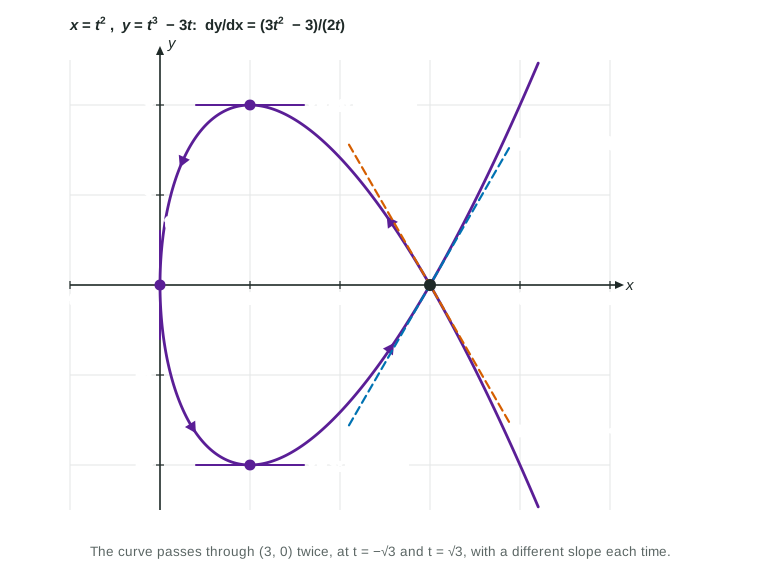
The figure shows why "evaluate at a time" matters. The curve , passes through twice. Its slope is , which is at and at : two tangent lines at one point. A formula in could never give both.
Curves given by a table
On the exam, and are often known only through a table of values and derivatives. The same rules apply to the numbers.
Worked example 2. At , a curve has , , and . Find the tangent line and the direction of motion at .
Slope:
Direction: , so the point moves left; , so it moves up.
Common slips
| Slip | Fix |
|---|---|
| Using as the slope | Divide by : the slope is change in per unit of |
| Dividing upside down | : the rate on top, as in |
| Using as the -coordinate | The point is ; compute both |
| Calling horizontal | No horizontal motion means a vertical tangent |
On calculator questions, store and before dividing, and give the slope to three decimal places, with the quotient written out as your setup.