In 9.1 you found the slope of a parametric curve, . The next question is how that slope changes as you move along the curve: the second derivative , which tells you whether the curve bends up or down. It takes one idea, used twice.
The slope rule, applied to the slope
The rule from 9.1 works for any quantity that depends on : its rate of change with respect to is its rate with respect to , divided by . The slope is such a quantity. So
For every factor is positive, so the curve is concave up there. At the value is .
Why the extra division matters
measures how fast the slope changes per unit of time. Concavity is about how fast the slope changes per unit of . Dividing by converts one into the other, and it can change the sign.
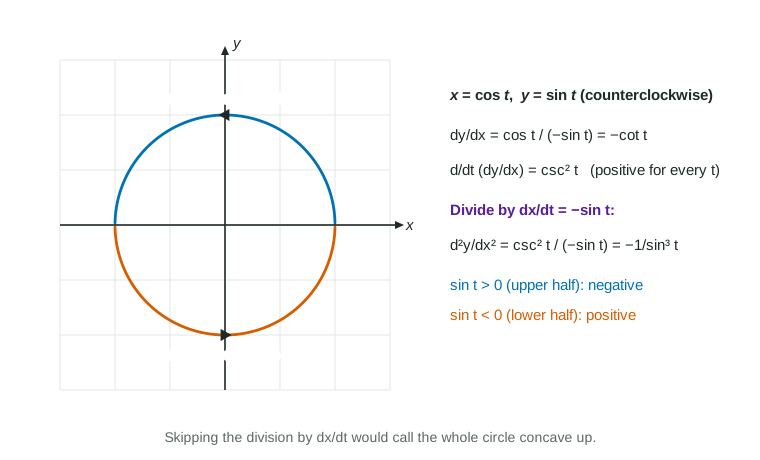
Figure 1. The division by decides the concavity of the circle. LevlPrep original diagram.
The figure shows the circle , . Its slope is , and , positive for every . If you stopped there, you would call the whole circle concave up. Dividing by gives : negative on the upper half, where , and positive on the lower half. That matches the picture.
The other tempting shortcut, , is simply not the second derivative. For , it gives , but the curve is , whose second derivative is . The three steps give the same : , its -derivative is , and .
Concavity, inflection points and the second derivative test