Unit 9 Topic 9.3

Arc Length of a Parametric Curve

every AB topic, then series

4 min readfreeNot practiced

In 8.13 you found the length of a graph y=f(x)y = f(x). A parametric curve can loop, turn back and cross itself, so it is often not a graph of a function at all. Its length still comes from the same picture: many short straight pieces, each measured with the Pythagorean theorem.

Building the formula
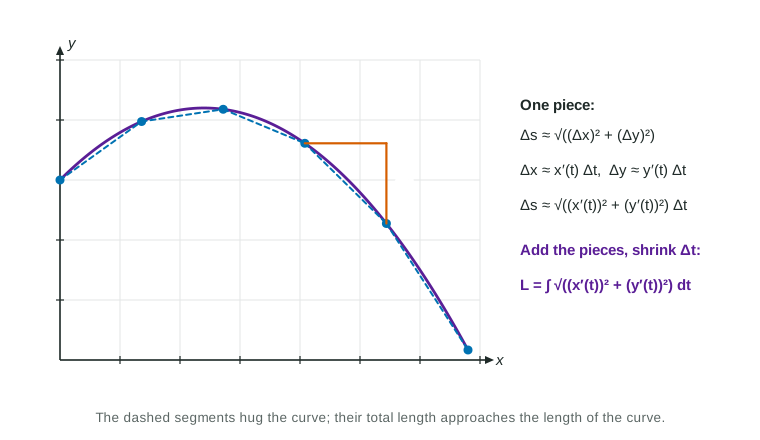
A curved path is replaced by five dashed straight segments joining points on it. On one segment a right triangle is drawn with a horizontal leg delta x, a vertical leg delta y and the segment delta s as its hypotenuse. Beside it: delta s is about the square root of delta x squared plus delta y squared; delta x is about x prime of t times delta t and delta y about y prime of t times delta t, so delta s is about the square root of x prime squared plus y prime squared, times delta t. Adding the pieces and shrinking delta t gives L, the integral of the square root of x prime of t squared plus y prime of t squared, dt.
Figure 1. Short straight pieces approximate the curve; each is a hypotenuse. LevlPrep original diagram.

Split the time interval a≤t≤ba \le t \le b into short steps of length Δt\Delta t. In one step the point moves about Δx≈x′(t)Δt\Delta x \approx x'(t)\,\Delta t across and Δy≈y′(t)Δt\Delta y \approx y'(t)\,\Delta t up, so that piece of the curve is close to a segment of length

Δs≈(Δx)2+(Δy)2≈(x′(t))2+(y′(t))2Δt.\Delta s \approx \sqrt{(\Delta x)^2 + (\Delta y)^2} \approx \sqrt{(x'(t))^2 + (y'(t))^2}\,\Delta t.

The figure shows one such triangle. Adding the pieces gives a Riemann sum, and letting Δt\Delta t shrink turns it into an integral:

L=∫ab(x′(t))2+(y′(t))2dt.L = \int_a^b \sqrt{(x'(t))^2 + (y'(t))^2}\,dt.

The integrand (x′(t))2+(y′(t))2\sqrt{(x'(t))^2 + (y'(t))^2} is the speed of the moving point: how much path it covers per unit of time. So the integral says "speed times time, added up", which is distance traveled. It equals the length of the curve when the curve is traced exactly once as tt runs from aa to bb.

Exact lengths

An exact answer needs an integrand that simplifies. Look for cos2⁡t+sin2⁡t=1\cos^2 t + \sin^2 t = 1 or a common factor that comes out of the root.

Worked example 1. Find the length of x=2cos⁡tx = 2\cos t, y=2sin⁡ty = 2\sin t for 0≤t≤π0 \le t \le \pi.

x′=−2sin⁡tx' = -2\sin t and y′=2cos⁡ty' = 2\cos t, so (x′)2(x')^2+(y′)2+ (y')^2=4sin2⁡t= 4\sin^2 t+4cos2⁡t+ 4\cos^2 t=4= 4.

LL=∫0π4dt= \int_0^{\pi} \sqrt{4}\,dt=2π= 2\pi.

Check: the curve is the upper half of a circle of radius 2, and half its circumference is 12(2π⋅2)=2π\frac{1}{2}(2\pi \cdot 2) = 2\pi.

Worked example 2. Find the length of x=13t3x = \frac{1}{3}t^3, y=12t2y = \frac{1}{2}t^2 for 0≤t≤80 \le t \le \sqrt{8}.

x′=t2x' = t^2 and y′=ty' = t, so t4+t2\sqrt{t^4 + t^2}=t2(t2+1)= \sqrt{t^2(t^2 + 1)}=tt2+1= t\sqrt{t^2 + 1} for t≥0t \ge 0.

Substitute u=t2+1u = t^2 + 1, du=2tdtdu = 2t\,dt; the limits become u=1u = 1 and u=9u = 9:

L=12∫19u1/2du=13u3/2|19=13(27−1)=263.L = \frac{1}{2}\int_1^9 u^{1/2}\,du = \frac{1}{3}u^{3/2}\Big|_1^9 = \frac{1}{3}(27 - 1) = \frac{26}{3}.

Calculator lengths

Most arc length integrals have no elementary antiderivative, so on the exam they are calculator questions. Write the full integral as your setup, then give the value to three decimal places.

Worked example 3. Find the length of x=t2x = t^2, y=sin⁡(2t)y = \sin(2t) for 0≤t≤20 \le t \le 2.

Setup: LL=∫02(2t)2+(2cos⁡(2t))2dt= \int_0^2 \sqrt{(2t)^2 + (2\cos(2t))^2}\,dt.

Calculator (radian mode): L≈5.147L \approx 5.147.

Three formulas, one idea

SituationIntegralVariable and limits
A graph y=f(x)y = f(x) (8.13)∫ab1+(f′(x))2dx\int_a^b \sqrt{1 + (f'(x))^2}\,dxxx from aa to bb
A parametric curve traced once∫ab(x′(t))2+(y′(t))2dt\int_a^b \sqrt{(x'(t))^2 + (y'(t))^2}\,dttt from aa to bb
Distance traveled by a moving point∫ab(x′(t))2+(y′(t))2dt\int_a^b \sqrt{(x'(t))^2 + (y'(t))^2}\,dtthe time interval, retraced parts counted again

The first row is a special case of the second: write y=f(x)y = f(x) as x=tx = t, y=f(t)y = f(t), so x′=1x' = 1 and y′=f′(t)y' = f'(t). The second and third rows are the same integral. They differ only when the point covers some part of the curve more than once: then the integral gives the distance traveled, which is more than the length of the curve. For example, x=cos⁡(3t)x = \cos(3t), y=sin⁡(3t)y = \sin(3t) on 0≤t≤2π0 \le t \le 2\pi goes around the unit circle three times at speed 3, and the integral gives 6π6\pi, not 2π2\pi.

Common slips

SlipFix
Squaring xx and yy instead of their derivativesThe legs of each triangle are x′(t)dtx'(t)\,dt and y′(t)dty'(t)\,dt
Adding |x′|+|y′||x'| + |y'|Square, add, take the root
Using xx-values as limitsThe integral is in tt: use the tt-values
A missing parenthesis: 2t2+⋯\sqrt{2t^2 + \cdots} for (2t)2(2t)^2Write (x′(t))2(x'(t))^2 with its parentheses, then simplify

Spot a mistake on this page?