Unit 9 Topic 9.7

Polar Coordinates and Polar Derivatives

every AB topic, then series

4 min readfreeNot practiced

A polar curve r=f(θ)r = f(\theta) is traced as θ\theta turns. Write it in xx and yy and it becomes a parametric curve with parameter θ\theta:

x=rcos⁡θ=f(θ)cos⁡θ,y=rsin⁡θ=f(θ)sin⁡θ.x = r\cos\theta = f(\theta)\cos\theta, \qquad y = r\sin\theta = f(\theta)\sin\theta.

So every idea from Topics 9.1 and 9.2 carries over. This page adds two things polar questions ask about: the slope in polar form, and the meaning of drdθ\frac{dr}{d\theta}.

Derivatives of xx and yy with respect to θ\theta

Both xx and yy are products, so each derivative has two terms:

dxdθ=drdθcos⁡θ−rsin⁡θ,dydθ=drdθsin⁡θ+rcos⁡θ.\frac{dx}{d\theta} = \frac{dr}{d\theta}\cos\theta - r\sin\theta, \qquad \frac{dy}{d\theta} = \frac{dr}{d\theta}\sin\theta + r\cos\theta.

Do not memorize these as new formulas. Write x=rcos⁡θx = r\cos\theta, apply the product rule, and they appear. The signs tell you how the point moves: dydθ>0\frac{dy}{d\theta} > 0 means the point is moving up as θ\theta increases, dxdθ<0\frac{dx}{d\theta} < 0 means it is moving left.

The slope of a polar curve

As for any parametric curve, where dxdθ≠0\frac{dx}{d\theta} \ne 0:

dydx=dy/dθdx/dθ=drdθsin⁡θ+rcos⁡θdrdθcos⁡θ−rsin⁡θ.\frac{dy}{dx} = \frac{dy/d\theta}{dx/d\theta} = \frac{\frac{dr}{d\theta}\sin\theta + r\cos\theta}{\frac{dr}{d\theta}\cos\theta - r\sin\theta}.

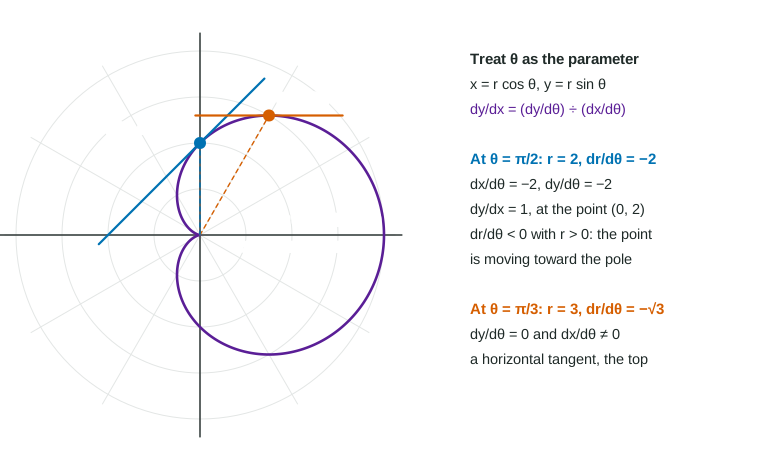
The cardioid r = 2 + 2 cos θ on a polar grid. At θ = π/2 the point is (0, 2) and the blue tangent line has slope 1: there r = 2, dr/dθ = −2, dx/dθ = −2 and dy/dθ = −2; since dr/dθ is negative while r is positive, the point is moving toward the pole. At θ = π/3 the point is (3/2, 3√3/2), the top of the curve, where the vermillion tangent is horizontal: dy/dθ = 0 and dx/dθ is not 0.
Figure 1. Two tangent lines to the cardioid r=2+2cos⁡θr = 2 + 2\cos\theta. LevlPrep original diagram.

Worked example 1. Find the tangent line to r=2+2cos⁡θr = 2 + 2\cos\theta at θ=π2\theta = \frac{\pi}{2}.

Values first: r=2+2cos⁡π2=2r = 2 + 2\cos\frac{\pi}{2} = 2 and drdθ=−2sin⁡θ=−2\frac{dr}{d\theta} = -2\sin\theta = -2.

Derivatives: dxdθ\frac{dx}{d\theta}=(−2)(0)−(2)(1)= (-2)(0) - (2)(1)=−2= -2 and dydθ\frac{dy}{d\theta}=(−2)(1)+(2)(0)= (-2)(1) + (2)(0)=−2= -2.

Slope: dydx=−2−2=1\frac{dy}{dx} = \frac{-2}{-2} = 1. The point: x=2cos⁡π2=0x = 2\cos\frac{\pi}{2} = 0, y=2sin⁡π2=2y = 2\sin\frac{\pi}{2} = 2.

Tangent line: y−2=1(x−0)y - 2 = 1(x - 0), so y=x+2y = x + 2 (the blue line in the figure).

Horizontal and vertical tangents. A horizontal tangent needs dydθ=0\frac{dy}{d\theta} = 0 with dxdθ≠0\frac{dx}{d\theta} \ne 0; a vertical tangent needs dxdθ=0\frac{dx}{d\theta} = 0 with dydθ≠0\frac{dy}{d\theta} \ne 0. On the cardioid at θ=π3\theta = \frac{\pi}{3}: r=3r = 3, drdθ=−3\frac{dr}{d\theta} = -\sqrt{3}, so dydθ\frac{dy}{d\theta}=−3⋅32+3⋅12= -\sqrt{3}\cdot\frac{\sqrt{3}}{2} + 3 \cdot \frac{1}{2}=0= 0 while dxdθ\frac{dx}{d\theta}=−32−332= -\frac{\sqrt{3}}{2} - \frac{3\sqrt{3}}{2}=−23= -2\sqrt{3}. That is the top of the curve.

At the pole. If r=0r = 0 at θ=α\theta = \alpha and drdθ≠0\frac{dr}{d\theta} \ne 0 there, the formula simplifies to dydx=tan⁡α\frac{dy}{dx} = \tan\alpha: the curve leaves the pole along the ray θ=α\theta = \alpha.

What drdθ\frac{dr}{d\theta} tells you

drdθ\frac{dr}{d\theta} is the rate of change of rr, the signed distance from the pole. It is not the slope. Its sign, read together with the sign of rr, says whether the point is moving toward or away from the pole:

rrdrdθ\frac{dr}{d\theta}Distance |r||r|The point is moving
>0> 0>0> 0increasingaway from the pole
>0> 0<0< 0decreasingtoward the pole
<0< 0<0< 0increasingaway from the pole
<0< 0>0> 0decreasingtoward the pole

The short rule: the same sign means away, opposite signs mean toward. On the exam, give both signs as your reason: "r(2)>0r(2) > 0 and r′(2)<0r'(2) < 0, so the point is moving toward the origin."

Worked example 2. For r=1+2cos⁡θr = 1 + 2\cos\theta at θ=π\theta = \pi, is the point moving toward or away from the pole?

r(π)=1−2=−1r(\pi) = 1 - 2 = -1 and drdθ=−2sin⁡π=0\frac{dr}{d\theta} = -2\sin\pi = 0. Neither, for an instant: the distance has a turning point. A little later, at θ=7π6\theta = \frac{7\pi}{6}, r=1−3<0r = 1 - \sqrt{3} < 0 and drdθ\frac{dr}{d\theta}=−2sin⁡7π6= -2\sin\frac{7\pi}{6}=1>0= 1 > 0: opposite signs, so the point is moving toward the pole, finishing the inner loop.

Rates in time and distances from the axes

If θ\theta depends on time, the chain rule converts: drdt=drdθ⋅dθdt\frac{dr}{dt} = \frac{dr}{d\theta} \cdot \frac{d\theta}{dt}, and likewise for xx and yy. Distance from the yy-axis is |x|=|rcos⁡θ||x| = |r\cos\theta|; distance from the xx-axis is |y|=|rsin⁡θ||y| = |r\sin\theta|. On calculator questions, write the setup ("x=r(θ)cos⁡θx = r(\theta)\cos\theta") before the number, use radian mode, and round to three decimals only at the end.
Spot a mistake on this page?